Enjoy the benefits of a premium membership!
Upgrade Account
-
TalkBass has been independent since 1998. Add your voice.
Create a free account to reply to discussions, view embedded media, and browse with fewer display ads.
Join free Log in
Want zero display ads or expanded classifieds tools? Compare plans.
You are using an out of date browser. It may not display this or other websites correctly.
You should upgrade or use an alternative browser.
You should upgrade or use an alternative browser.
Amp Guts Photos - Official Thread - Lets see those pics
- Thread starter svtb15
- Start date
More options
Who Replied?
Mr. Foxen
Commercial User
Fender has a SS preamp, and a couple of pre valves in addition. Graphic, compressor, fuzz all built in. Different animal to the Trace.



- Feb 12, 2006
- 61,059
- 5
- 221,081
- Disclosures
- Development Engineer-Mesa Boogie, Development Engineer-Genzler (pedals), Product Support-Genz Benz
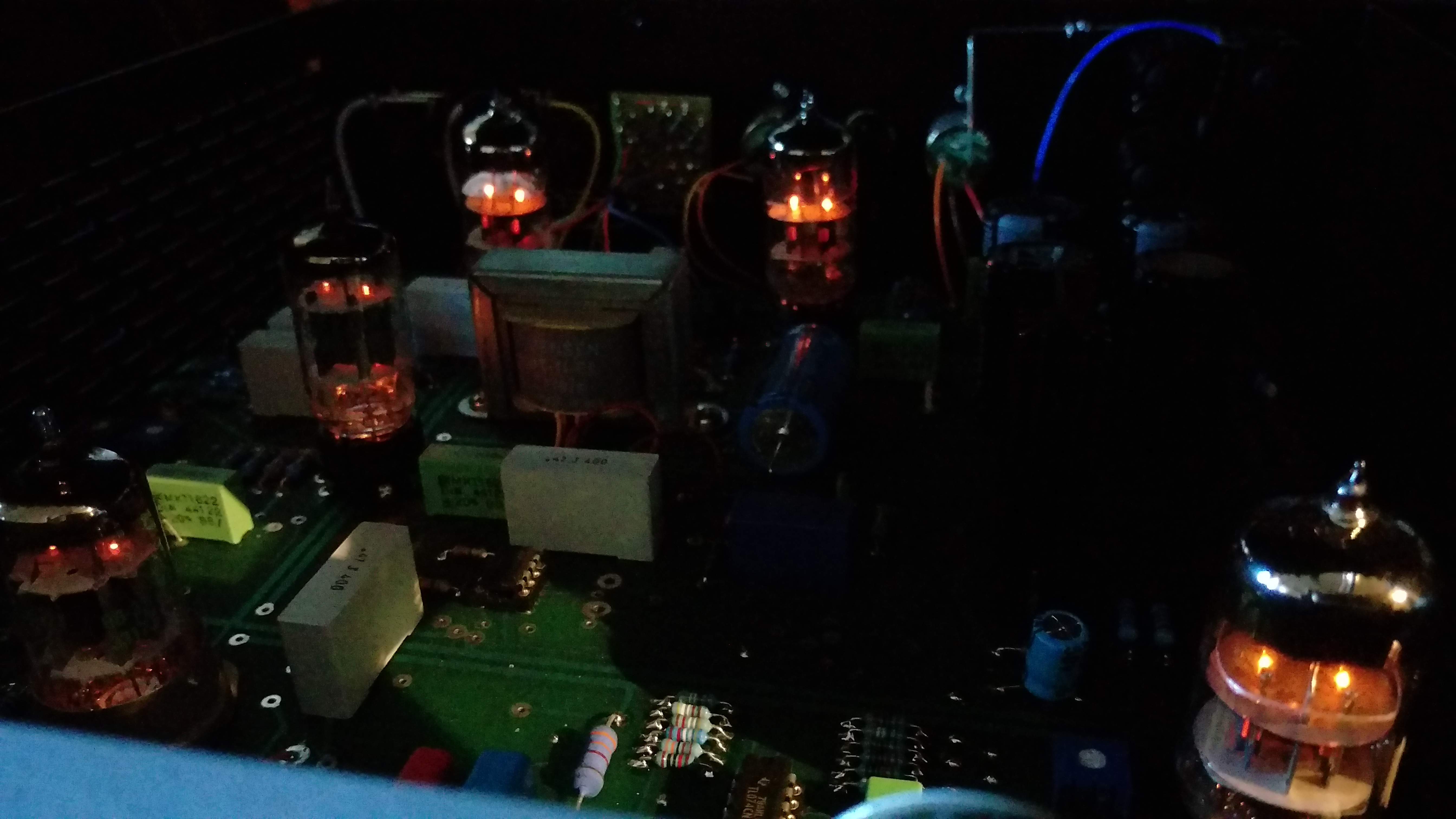
There's a lot of cool, and somewhat geeky builds that I would love to share but just can't because of the commercial nature of the build as well as much of it being covered under NDA's, BUT as I was going through some steel shelving FULL of concept builds and R&D builds, I came across this amp that I built up about 15 years ago, which never became a product (nor was it ever intended to) but was part of some advanced (and pure) research on high current, and shared current load lines of common 12AU7 triodes, especially at lower plate voltages. I think this amp, maxed out, delivers about 3.5 watts, and at lower plate voltages puts out about 2 watts, the harmonic structure is quite different under the different load curves. (edit: looked up the test docs and was able to get 6.13 watts under heavy plate loads, I would expect the tube life might suffer a bit but this is why I remember it being a loud little sucker for guitar)
Goofy you might think? Has Andy gone bat sh*t crazy you might casually offer up as an opinion? Has he come off his horses one time too many? Well, on the surface it sure as heck seems that way BUT it was actually some very early R&D study on what happens when you treat a common signal triode as a mini power triode, drive it hard and see what could be accomplished with manipulating the harmonics spectrum. As I have discussed many, many times before, it's easy peasy to design a characterless power amplifier. I've been doing this for 30 years, in a variety of capacities. About 20 or so years ago I began to study what happens when an amp is driven hard into overdriven territory, and what makes one design sound better (or worse) than another, as this can be responsible for how folks characterize the size, tone and feel of an amp. As part of this study, I was trying to emulate what a large and desirable type of tube amp might look like scaled WAY down so that it could be used as part of a hybrid. This approach yielded some valuable data that ultimately surfaced in some of the dynamics management mechanisms incorporated into class D products today.
Thought you would enjoy seeing the often seemingly roundabout way that (more pure) research is done, and the timespan that is involved, in order to understand some of the design approaches that are responsible for today's products.
What is especially interesting, or at least what I find interesting, is that in order to isolate this as an output stage phenomena, I chose to drive the grids with a high current opamp driving a very wide bandwidth phase splitter transformer (custom wound) in order to be able to apply global feedback without worry of phase shift and (God forbid) the dreaded motorboating. Otherwise, there are 8 triode sections (4 sections or 2 tubes per half), a high primary impedance output transformer, suitable cathode resistors for just a little local feedback, With enough global feedback and moderate plate load, I think the THD was in the 0.02% range until beginning to overdrive.
Of course it's not practical as a bass amp, but we plugged a guitar into it, and hooked it up to a 412 cabinet and it certainly provided some interesting, totally useable and surprisingly loud tone.
Anyway, here's the porn with tubes, solid state, and plenty of iron:
View media item 3930View media item 3929
Goofy you might think? Has Andy gone bat sh*t crazy you might casually offer up as an opinion? Has he come off his horses one time too many? Well, on the surface it sure as heck seems that way BUT it was actually some very early R&D study on what happens when you treat a common signal triode as a mini power triode, drive it hard and see what could be accomplished with manipulating the harmonics spectrum. As I have discussed many, many times before, it's easy peasy to design a characterless power amplifier. I've been doing this for 30 years, in a variety of capacities. About 20 or so years ago I began to study what happens when an amp is driven hard into overdriven territory, and what makes one design sound better (or worse) than another, as this can be responsible for how folks characterize the size, tone and feel of an amp. As part of this study, I was trying to emulate what a large and desirable type of tube amp might look like scaled WAY down so that it could be used as part of a hybrid. This approach yielded some valuable data that ultimately surfaced in some of the dynamics management mechanisms incorporated into class D products today.
Thought you would enjoy seeing the often seemingly roundabout way that (more pure) research is done, and the timespan that is involved, in order to understand some of the design approaches that are responsible for today's products.
What is especially interesting, or at least what I find interesting, is that in order to isolate this as an output stage phenomena, I chose to drive the grids with a high current opamp driving a very wide bandwidth phase splitter transformer (custom wound) in order to be able to apply global feedback without worry of phase shift and (God forbid) the dreaded motorboating. Otherwise, there are 8 triode sections (4 sections or 2 tubes per half), a high primary impedance output transformer, suitable cathode resistors for just a little local feedback, With enough global feedback and moderate plate load, I think the THD was in the 0.02% range until beginning to overdrive.
Of course it's not practical as a bass amp, but we plugged a guitar into it, and hooked it up to a 412 cabinet and it certainly provided some interesting, totally useable and surprisingly loud tone.
Anyway, here's the porn with tubes, solid state, and plenty of iron:
View media item 3930View media item 3929
Last edited:
"Has Andy gone bat sh*t crazy"? No pics, no amp porn my friend 
- Feb 12, 2006
- 61,059
- 5
- 221,081
- Disclosures
- Development Engineer-Mesa Boogie, Development Engineer-Genzler (pedals), Product Support-Genz Benz
It appear that my media preferences defaulted to private but even more disturbing is that I can't edit these settings from my iPhone (unless I really am going crazy). I will try from my computer in the morning... Sorry

- Feb 12, 2006
- 61,059
- 5
- 221,081
- Disclosures
- Development Engineer-Mesa Boogie, Development Engineer-Genzler (pedals), Product Support-Genz Benz

Nice clean and safe layout. The advantage is that you can put it on the shelf and get back to it whenever you want.
I sometimes think that it would be good to have a general purpose breadboard for speedy development like the one below.
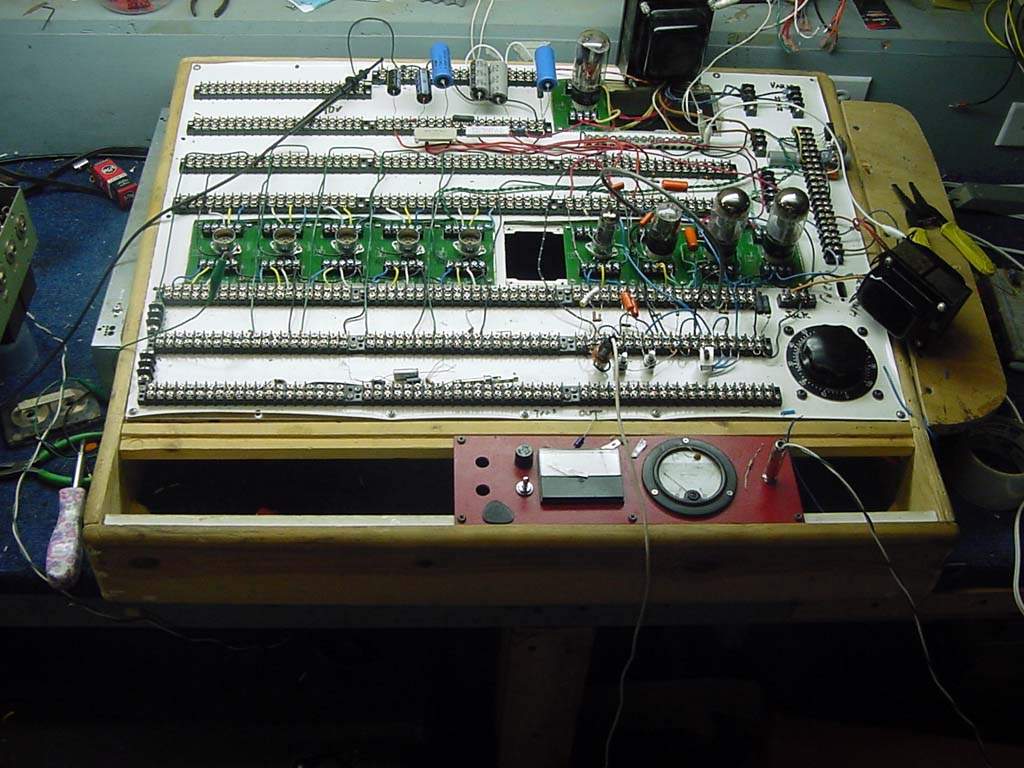
I sometimes think that it would be good to have a general purpose breadboard for speedy development like the one below.
- Feb 12, 2006
- 61,059
- 5
- 221,081
- Disclosures
- Development Engineer-Mesa Boogie, Development Engineer-Genzler (pedals), Product Support-Genz Benz
Mr. Foxen
Commercial User

Is the right hand lead on that large electrolytic cap that's tipped up towards the bottom of the photo intentionally clipped off or did it break away from the board?
Mr. Foxen
Commercial User
Mr. Foxen
Commercial User




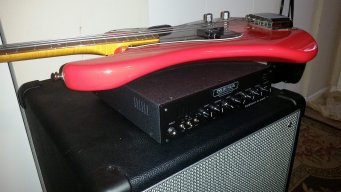
Aguilar DB 680 while semi-racked and on...