• TalkBass has been independent since 1998. Add your voice.
    Create a free account to reply to discussions, view embedded media, and browse with fewer display ads.
    Join freeLog in
    Want zero display ads or expanded classifieds tools? Compare plans.
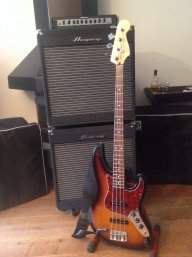
Ampeg is mixing cabs!

Science wise it is not valid just to consider different phase response of stacked cabs versus relative phase which is caused by room reflections.
As different phase response of different but narrow stacked cabs does not cause any relative delay it's not valid to predict something like relative phase which was caused by delay, just like it clearly happens with room reflectons.

Narrow stacked cabs couple acoustically together as just to one source independent of any (relative) phase response deviation.
Different phase response of cabs does NOT relate in relative delay between several cabs as long as the cabs do couple acoustically

Lots of "engineers" try to predict delay caused by different phase response of different cabs. That's a totally mistake of (electro-) acoustic science and can be easily disproved by math.

So any question asked if different cabs may cause mud due to different relative phase has to be denied.
It's not possible to explain any mush sound by different phase of different cabs.
However different cabs which don't match "soundwise" do show different phase response anyway but, it's not the relative phase deviation which was responsible for mush sound.
 
  • Like
Reactions: Lvjoebass
Funny thing:
I actually don't like threads about mixing cabs (and their Great War combat like arguing and debating), but I always end up reading them A to Z (whilst trying to stop myself from engaging...)
They always end the same way, in a deadlock.
Funny thing indeed.
It never seems to be anymore of a deadlock to me than admitting that any single cab with one, and only one driver (and no other bass cabinets within a 5 mile radius), will sound great in every venue with every head and every bass. The truth is that you can minimize your chances of having problems when using more than one cab, but there is no way to ensure you will always get the exact tone you're after with any cab or set of cabs in all circumstances...and from the musicians I've heard, it would seem there are folks with vastly different tone goals out there.
 
  • Like
Reactions: ThisBass
What do the mixed cab police think about mixed cabs and bi-amping with a crossover?

This one thinks it's great if you actually use well considered driver choices. That does not include using two standalone bass cabs, pretty much ever.
 
Signal direkt transfered from speaker to listener
View attachment 1181229
Signal delayed by wall reflection. relative phase caused by delay equals to 765 degree
View attachment 1181230
total signal at listener position if both signals direct and reflected signal show same level at listener position
upload_2017-7-19_21-52-2.png


Cabinaet A with a phase shift of 90 degree at 60Hz
View attachment 1181232
Cabinet B with a phase shift of 135 degree at 60 Hz. That's relative phase shift of 45 versus cab A which was quite a very lot of deviation for different ported MI cabs
View attachment 1181233

As both cabs are stacked very close there is coupling of the two sources at 60Hz. So there is a total signal that looks like
View attachment 1181234

For comparison two matching cabs with identical phase shift of 90 degree at 60 Hz gives a total signal that looks like
View attachment 1181235

As a 90 phase shift turns the sine into cosine waveform even matching cabs do some nasty things to the signal, Fortunatelly it doesn't hurt the total sound by no means

The total signal of the stacked cabs (either matching or mixed) can't cause mush in the room while the reflected total at listener position might do it.
 
Last edited:
  • Like
Reactions: Lvjoebass and tfer
please help ive been arrested by the cab mixing police. I did it but I thought it sounded good....if they release me I swear to not do it again...they're coming ive got to go icant call out this might be my last communication......


Come along, Nurse Ratched has your afternoon meds ready.
 
Let me share with you another example why phase can't tell the truth.

Frequency response of two different MI bass cabs
upload_2017-7-19_22-41-45.png


Phase response
upload_2017-7-19_22-42-20.png

around 165 degree phase shift both cabs at 50Hz so everything looks to be fine at 50Hz. Based on pure phase the signal at front baffle of each cabinet looks like
upload_2017-7-19_23-5-45.png

Based on phase response it looks like we would get two coherent signals for both cabs at 50Hz which add to a total of
upload_2017-7-20_0-57-50.png

Now lets have a look to the group delay
upload_2017-7-19_23-8-2.png

around 6msec of delay at 50Hz yellow cab versus white cab
So the signal of the yellow cab versus white cab looks for 50Hz in relation like
upload_2017-7-19_23-11-55.png

Due to group delay (which is not phase) both cabs will add to a total signal like
upload_2017-7-20_0-52-42.png

upload_2017-7-20_0-53-14.png

lets have a final look to the frequency response,
upload_2017-7-20_0-58-51.png

the yellow response looks close to Tschebyscheff alignment while the white one looks more close to Butterworth filter alignment characteristic. Each alignment provides distinct characteristic for frequency response (roll-off shape) and damping and group delay. The frequency response is shown with the pic, the group delay is discussed above, the phase response is very close but, besides group delay the damping differs a very lot which makes it delicate to mix both cabs.
Phase response does match well (as discussed above) but other variables don't.
Flat earth folks and also mixed police folks very likely will never understand why phase on its own can't tell the truth
 

Attachments

  • upload_2017-7-19_23-11-36.png
    upload_2017-7-19_23-11-36.png
    17.8 KB · Views: 23
Last edited:
IMG_1876.JPG


This Westlake Audio speaker is in Prince's Paisley Park studio.
IMG_1877.JPG


Another Westlake cab. Looks like it would make a great sounding bass cab.
IMG_1878.JPG


There's nothing wrong with mixed speakers if they are designed to work together. Studio monitors are a good example. These days, monitors tend to be self powered, with multiple dedicated amps, one for each speaker or within the same group. This allows for even better fine tuning. There are always solutions.
 
Not really. Bill left because TB brass requested he be less condescending in his replies and he didn't want to. I liked Bill myself, but he does get a kick out of being condescending. I don't think I'm letting any cats out of the bag there. It's pretty true about Greenboy, though...he left because he was sick of being hammered by anti-fEarful types who accused him of forming a cult and sending this cult out across TB to force people into buying his cabs.

In any case, one less snarky TB'er (albeit an informed one) absent from the amps forums is a good thing. I'm not so sure the snark I see there is directly proportionate to the number of "bad" ideas shared by inexperienced posters, but it's uncalled for nonetheless. The subject of amps/cabs can be daunting and the Amps forum has to be one of the less friendly places on TB to people who aren't educated on the subject. There are plenty of engineers on the FX side that can manage not to be nasty or condescending, so the Amp gurus can do it too. The problem isn't even so much them, if at all, but the vociferous lemmings that attach themselves to every word someone smarter than they are says as if they had known it all along.
 
Science wise it is not valid just to consider different phase response of stacked cabs versus relative phase which is caused by room reflections.
As different phase response of different but narrow stacked cabs does not cause any relative delay it's not valid to predict something like relative phase which was caused by delay, just like it clearly happens with room reflectons.

Narrow stacked cabs couple acoustically together as just to one source independent of any (relative) phase response deviation.
Different phase response of cabs does NOT relate in relative delay between several cabs as long as the cabs do couple acoustically

Lots of "engineers" try to predict delay caused by different phase response of different cabs. That's a totally mistake of (electro-) acoustic science and can be easily disproved by math.

So any question asked if different cabs may cause mud due to different relative phase has to be denied.
It's not possible to explain any mush sound by different phase of different cabs.
However different cabs which don't match "soundwise" do show different phase response anyway but, it's not the relative phase deviation which was responsible for mush sound.
Please explain in your own terms the phenomenon that is displayed by my mixed narrow stack.

At relatively modest volume easily achievable by a single cab, the biamped stack sounds pristine, whereas the full range stack is but ok.

I describe this as a lack of coherance between the phase responses of the two cabs. In other words they are summing well enough but not perfectly. What do you call it?