
My problem is that I tend to take things apart to see what makes them tick before I plug in for the first time. Not an approach that I would recommend for everyone.

TalkBass has been independent since 1998. Add your voice.
Create a free account to reply to discussions, view embedded media, and browse with fewer display ads.
Join free Log in
Want zero display ads or expanded classifieds tools? Compare plans.

My problem is that I tend to take things apart to see what makes them tick before I plug in for the first time. Not an approach that I would recommend for everyone.
 companies love guys like you because you would rather fix it yourself than send it in. I just hope my gorgeous baby holds up I love this amp and I went with it over the 100T because it's a much simpler design. Beans I have a question how tough is it to bias the tubes in these?
+1 You,B-String and Jimmy are on a different level than us mortals


It's an illness really
Wouldn't be a "bug" situation, but you would be enabling

I'll change tubes in an amp but that's about it. Beans and B-String are miles above me, bro.+1 You,B-String and Jimmy are on a different level than us mortals
I'll change tubes in an amp but that's about it. Beans and B-String are miles above me, bro.
Beans I have a question how tough is it to bias the tubes in these?
There is a pot inside the amp for the power tube bias. You need a volt meter. Ampeg has posted the instructions in a TB thread because people were asking. Of course, they don't encourage anyone that isn't an authorized service tech to undertake the work.
Here are the instructions:
- CONNECT LOAD TO AMPLIFIER
- TURN R16 (BIAS ADJUSTMENT POT) FULLY CCW (MINIMUM SETTING)
- TURN MASTER CONTROL FULLY CCW (MINIMUM SETTING)
- TURN POWER SWITCH TO ON AND WAIT 2 MINUTES
- TURN STANDBY SWITCH ON
- ENSURE THAT THERE IS NOTHING PLUGGED INTO INPUT CHANNELS
- WAIT 10 MINUTES
- MEASURE VDC ACROSS R12, THE CATHODE RESISTOR OF V5
- ADJUST R16 UNTIL YOU MEASURE 450mVDC ACROSS R12
- MEASURE VDC ACROSS R13 (V6). SHOULD FALL BETWEEN 400mVDC - 500mVDC
- REPEAT STEP #10 FOR R14 (V8), THEN R15 (V7)
- ALL MEASUREMENTS FOR V5, V6, V8, AND V7 SHOULD BE WITHIN 400mVDC - 500mVDC
- IF #12 IS TRUE, ENJOY 100W OF V-4B
- IF #12 IS FALSE, THE TUBES ARE NOT PROPERLY MATCHED FOR YOUR PRECIOUS V-4B, SO GET NEW ONES.
I'll add to this:
- Volume and Master pots off (CCW), Bass, Midrange, Treble pots at their center (noon), tone switches to the left.
- If you don't have a dummy load, the speaker cabinet needs to be connected.
- I prefer to wait at least 30 minutes with the amp in playing mode, what I call standby off, before setting the bias. When done, play it for a bit and check the bias again. Sometime you need to iterate. The goal is to get all the tubes as close to 450mVDC as possible. With perfectly matched tubes they will all be 450mVDC.
- R12, R13, R14, R15 are 10 ohm, 1W cathode resistors connect to pin-8 of each power tube. R16 is a 20K adjustable pot. When adjusting a bias pot, I prefer to back it off and move up to the desired voltage.

I pretty sure this was a shipping issue. My engineering background makes me wonder though what would take out all the tubes at the same time, allow the pilot light to come on when turning the master on, but causing it to fade out when the standby switch is flipped off? Almost as if it's going to ground when the standby switch is flipped.
If you get zapped you'll need a pair of rubber pants.
Seriously though, there are lethal voltages inside these amps.
When it comes to match sets of tubes, different companies use different procedures to match them. So a matched set is not a matched set because there are no standards. A good reseller will do a good job at matching and stand behind their products and work. There are many good resellers, this is one. This is how they test them.
If the tubes are not matched closely, some tubes will be working harder than the others. The tubes are never exactly the same. Within 5% is very good. Within 20% is not so good. Tube matching can also affect distortion. Some additional details are here.
As for a voltmeter, I'm not sure what to recommend. It depends on your budget. I tend to spend too much on these sort of things.
You want one that is accurate in the 450 milli volt range. A true RMS meter is good. One that can read up to 1000V is good. The Fluke 115, at around $150, is a good meter for amp work. There are less expensive descent ones for around $100. Bottom line, get one that is affordable.
Thanks for all the great advise.I did reseat the tubes..no change. I'll call to get a replacement ordered. In the meantime I'll play around with the tubes. I have 6 draws full of NOS stuff I've collected through the years for guitar amps.
I think I'll be wasting my time though, only because both the preamp and power amp tubes don't light up. Almost as if all the tubes are not seeing any current at all.
I can bias my own amps if the bias adjustment is on the rear panel, which this is not. I don't feel comfortable taking the chassis out because I never am certain I have all the current drained.
Jimmy is right that this head is built like a tank! I don't think I've ever seen a head cab built as strong as this is. Also I've never seen so much dampening isolation as this chassis has.
In all fairness I have never had a problem with Ampeg gear. Currently I have a Heritage B-15, a SVT3 Pro and 410 cab, along with a Micro VR set up. All I bought new and all have worked perfectly without one problem from the first day.
I pretty sure this was a shipping issue. My engineering background makes me wonder though what would take out all the tubes at the same time, allow the pilot light to come on when turning the master on, but causing it to fade out when the standby switch is flipped off? Almost as if it's going to ground when the standby switch is flipped.
Oh well, there are bigger problems in life.
Thanks again for all the advice.
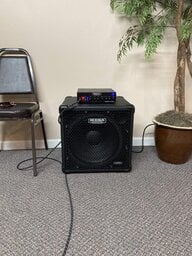
Well my new V4B and 112 cab came today! Link Removed

Well, replacement V4B has been ordered and Ampeg says should be here in about 1 week. No problems with customer service at all. They don't want customers messing around with the inside of a new amp. From a liability aspect I can really understand that.
Congrats!! Let us know how ya like it. I'm really loving mine through the 212 AV cab.


