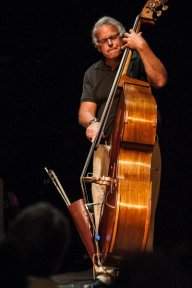
Years ago Johnny Griffin was in Boston for a 4 or 5 night stand at The Regatta Bar in Cambridge. At that point in time Mr. Griffin was coming to Boston at least once a year and possibly a little more often. The time I’m referring to JG had his regular working trio, Michael Weiss, Dennis Irwin and (I think) Kenny Washington.
This particular week started off with a incident that many local bass players and musicians in Boston were talking about. Opening night, during the first set, Dennis’ bridge collapsed and without hardly missing a beat he grabbed the bass mic and finished the tune by singing the bass notes. For anyone who was lucky enough to meet or know Dennis this was typical of him. I think it’s fair to say he was down to earth, resourceful and practical.
I decided after hearing the quartet and being mesmerized by Dennis’ sound, notes and time feel to call Dennis and see if I could have a lesson and hang out with him. We had met a couple of times prior though I’m sure that he probably didn’t remember me. Interestingly, one of the times we met he was playing the upstairs room at Rlyles Jazz Club with Mose Allison and I was working on the first floor with a local quartet. We talked for a minute as the club was closing. That night he was playing with his arm in a full cast! (Down to earth and practical.)
That morning Dennis answered the phone and said “sure, come by and we can hang. I want to show you something “.
When I got to Dennis’ room I was struck by how friendly and welcoming he was. We talked and he showed me his clarinet (he was a clarinetist first) and explained that he had recently started practicing it again but strictly as a classical instrument. Once we had talked for awhile he said “let’s get started”.
He had a format in mind. The first thing he wanted to teach me was the “Green Room”. Now I’m sure there are bassists reading this that know about the Green Room, but if you don’t what’s next is vital. It was invented by the great bassist from Detroit, Ali Jackson. He was the brother of the late great drummer Oliver Jackson and is related to Ali Jackson former drummer for The Lincoln Center Jazz Orchestra.
It would take too long to lay out everything about the Green Room here. There is one main exercise with more than several variations. For the sake of brevity I’ll describe the basic exercise. The variations are pretty hard to describe in words.
When Dennis showed it to me it was like he was he was giving me the keys to the kingdom........HE WAS. His reverence was palpable from the minute he started explaining it. His plan was once I learned it we would do it for 20 uninterrupted minutes and without talking. Oh, and arco! I was, to say the least, nervous!
The Green Room is an exercise for improving intonation, time, ears and fingerboard geography knowledge. That’s at the least. It requires either 2 musicians or 1 with a recorder. Two bassists is perfect. Bass #1 is going to play in 4/4 whole notes starting on open E and each measure ascending up a fourth. So bass #1 plays in whole notes E/// A/// D/// etc. at 60bpm. Bass #2 starts on the D( where the harmonic is)on the G string and plays chromatically D/// Db/// C/// etc. with bass#1. So for the first 4 beats the combined notes are a minor 7th , the next measure a Major 10 th and that is the continuing pattern for phase 1. Here’s where it gets interesting. Playing that slow (and in time) arco is a challenge as is the pitch. Either bassist can change register (and should explore all registers once comfortable with the format) either by running out of notes ( if bass #2 continued all the way to low E) or at will. Once bass#1 is playing in a higher register than bass #2, and assuming the pitch and time are locked, you ears will hear the inversions created and your fingers challenged to play notes in tune all over the fingerboard and if you go the distance of more than 10 minutes you will be greatly rewarded with a feeling of having warmed up your ears and instrument not to mention the comraderie you’ll feel with your fellow bassist. “Green Room” is spoken by one of the bassists as the signal to stop and it’s always when the relationship between instruments is the 10th. There are variations beyond this entry-level format. They are really important and somewhat different but for now I will leave it here. The Green Room was played at Dennis Irwin’s memorial service. I will forever be thankful he showed it to me and to so many others.
Dennis and I played the Green Room for 10 or 15 minutes. It was transformative to say the least. What he said next was the WHOLE reason I’m writing this!! He said “ now that we have done the Green Room, let’s play duets”. “But!! Marshall, when you accompany me, remember this is 2 basses playing together so you should just be whispering on your instrument behind me. Too often bassists accompany each other at too loud of a volume which destroys the balance between melody and harmony.” For the first time I was playing a song with with another bassist ( A GREAT ONE!) and instead of it being a contest of volume and even showing off, it was music. That, too, really changed my life!
Thanks to Dennis’ and his incredible generosity. I left him that day with two of the most important music lessons I’ve ever learned. Thank you Dennis Irwin.
This particular week started off with a incident that many local bass players and musicians in Boston were talking about. Opening night, during the first set, Dennis’ bridge collapsed and without hardly missing a beat he grabbed the bass mic and finished the tune by singing the bass notes. For anyone who was lucky enough to meet or know Dennis this was typical of him. I think it’s fair to say he was down to earth, resourceful and practical.
I decided after hearing the quartet and being mesmerized by Dennis’ sound, notes and time feel to call Dennis and see if I could have a lesson and hang out with him. We had met a couple of times prior though I’m sure that he probably didn’t remember me. Interestingly, one of the times we met he was playing the upstairs room at Rlyles Jazz Club with Mose Allison and I was working on the first floor with a local quartet. We talked for a minute as the club was closing. That night he was playing with his arm in a full cast! (Down to earth and practical.)
That morning Dennis answered the phone and said “sure, come by and we can hang. I want to show you something “.
When I got to Dennis’ room I was struck by how friendly and welcoming he was. We talked and he showed me his clarinet (he was a clarinetist first) and explained that he had recently started practicing it again but strictly as a classical instrument. Once we had talked for awhile he said “let’s get started”.
He had a format in mind. The first thing he wanted to teach me was the “Green Room”. Now I’m sure there are bassists reading this that know about the Green Room, but if you don’t what’s next is vital. It was invented by the great bassist from Detroit, Ali Jackson. He was the brother of the late great drummer Oliver Jackson and is related to Ali Jackson former drummer for The Lincoln Center Jazz Orchestra.
It would take too long to lay out everything about the Green Room here. There is one main exercise with more than several variations. For the sake of brevity I’ll describe the basic exercise. The variations are pretty hard to describe in words.
When Dennis showed it to me it was like he was he was giving me the keys to the kingdom........HE WAS. His reverence was palpable from the minute he started explaining it. His plan was once I learned it we would do it for 20 uninterrupted minutes and without talking. Oh, and arco! I was, to say the least, nervous!
The Green Room is an exercise for improving intonation, time, ears and fingerboard geography knowledge. That’s at the least. It requires either 2 musicians or 1 with a recorder. Two bassists is perfect. Bass #1 is going to play in 4/4 whole notes starting on open E and each measure ascending up a fourth. So bass #1 plays in whole notes E/// A/// D/// etc. at 60bpm. Bass #2 starts on the D( where the harmonic is)on the G string and plays chromatically D/// Db/// C/// etc. with bass#1. So for the first 4 beats the combined notes are a minor 7th , the next measure a Major 10 th and that is the continuing pattern for phase 1. Here’s where it gets interesting. Playing that slow (and in time) arco is a challenge as is the pitch. Either bassist can change register (and should explore all registers once comfortable with the format) either by running out of notes ( if bass #2 continued all the way to low E) or at will. Once bass#1 is playing in a higher register than bass #2, and assuming the pitch and time are locked, you ears will hear the inversions created and your fingers challenged to play notes in tune all over the fingerboard and if you go the distance of more than 10 minutes you will be greatly rewarded with a feeling of having warmed up your ears and instrument not to mention the comraderie you’ll feel with your fellow bassist. “Green Room” is spoken by one of the bassists as the signal to stop and it’s always when the relationship between instruments is the 10th. There are variations beyond this entry-level format. They are really important and somewhat different but for now I will leave it here. The Green Room was played at Dennis Irwin’s memorial service. I will forever be thankful he showed it to me and to so many others.
Dennis and I played the Green Room for 10 or 15 minutes. It was transformative to say the least. What he said next was the WHOLE reason I’m writing this!! He said “ now that we have done the Green Room, let’s play duets”. “But!! Marshall, when you accompany me, remember this is 2 basses playing together so you should just be whispering on your instrument behind me. Too often bassists accompany each other at too loud of a volume which destroys the balance between melody and harmony.” For the first time I was playing a song with with another bassist ( A GREAT ONE!) and instead of it being a contest of volume and even showing off, it was music. That, too, really changed my life!
Thanks to Dennis’ and his incredible generosity. I left him that day with two of the most important music lessons I’ve ever learned. Thank you Dennis Irwin.
Last edited: