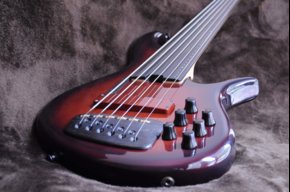
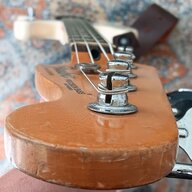
I'm going to approach the question from a different perspective. HOW CAN YOU POSSIBLY ACCESS THE FRETS DOWN BY THE BODY FROM YOUR SITTING POSITION AND ACTUALLY PLAY??? I can see that you don't have command of the entire fingerboard. In fact, I'll bet you have difficulty below the 7th fret. The position from a versatility perspective is fundamentally compromised. IMO you've habituated a bad playing position then have issues if you try to change it to a better position.
While a lot of folks say that you should have the same position seated as when standing. Perhaps I've said that too, but there may be a compromise where you change your seated position and what you perceive should be the standing position and find something in the middle. THE ONE THING I WOULD SUGGEST IS USE A STRAP AT ALL TIMES and find that in-between position, at least for now. Don't use your leg as a reference right now. It's messing up your position. I can see that sitting with the bass on your leg it's skewed too far to the right. Your left hand is contracted to the point where it can't be fluid and your right hand is cramped (and limited in what you can do). Even without a strap, you can find a way to sit and have a more open position.
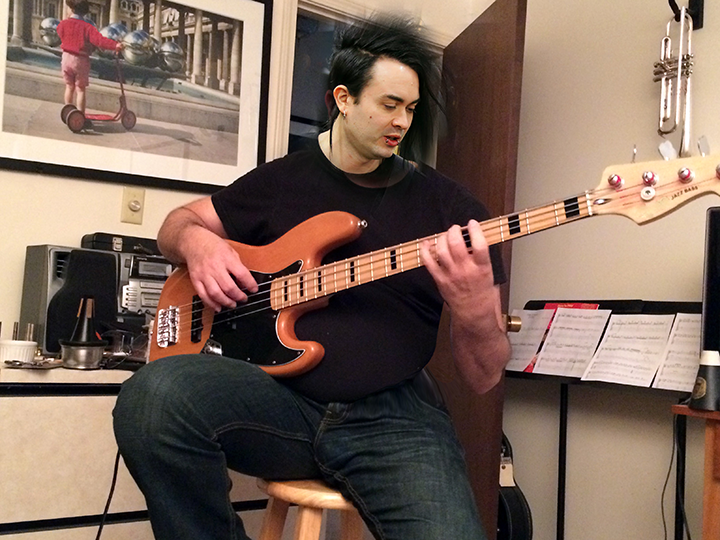
IMO, based on what you have habituated, I would suggest you always play a strap. Unless your position will allow your leg to place the bass properly, a strap will be invaluable. Based on the your photo is looks like you're playing an MIM P bass. Does it feel like there is neck dive? If so, a strap is essential unless you can balance it with lighter tuners. You don't want to fight the bass for position. If not balanced- use a strap. The friction will free you from having to support the neck with your hand and give you way more fluidity. Photo 2 is good, but if you raised it 1/2" to 1" you might see a great difference. The bass doesn't need to be dead center on your body. With a strap there are adjustments and compromises.
Strap hurts your shoulder? Get a wider strap, probably 3.5" wide, maybe padded if the bass is heavy. There is a cheap 3.5" Perris strap on Amazon for $13. Not padded, but suede inside so if you have neck-dive the friction counters that. Need padding? While some straps can cost a lot, there are some good budget alternatives.
On my lighter basses I use the cheap strap below. I take time and effort to break it in, sometimes to the point where it looks distressed (and oh so cool). Because I don't like the strap digging into my neck vein I cut a crescent out for comfort. No need on the padded straps. Below I will list the two straps I use on my basses, the more expensive one on the two basses that get close to 10 pounds, though I comfortably use the cheaper one on my 10 pound Squier. Again, the cheap one needs a lot of TLC to get it broken in right. Thumbnail will take you to the link. See the broken in photo. You'd not think that was a $13 strap... $11 when I purchased it. I have about 7 of them now for various guitars and basses. I never play without a strap attached, so they each have their own.

The Perris ALPDX below as about $50, but is no longer available. But another inexpensive brand might due; Walker and Williams.
For $35 you can get a nice strap from W/W. The padding is good but the lining can be a little slick. I run some low grit sand paper over it to give it some roughness if I need it to help me keep everything in place.
If your shoulder still hurts, try a double strap that goes across both shoulders. Groove Gear makes on like this. There are others.
Getting back to your position, your photo 2 is MUCH better positioned to access the whole bass. And while your left arm is extended more, it's not in that lazy cramped, compressed position. And you must not realize it yet, but pointed out by another forum member, that if you take photo 2 and try raising the bass up, perhaps 1/2" at a time, you might feel much more comfortable.
There are tons of bass players better than me, but being an "older" bass player with issues like arthritis in my hands, stiffening body parts, getting things right becomes very apparent. But I have a story about one 22 year young guy full time wannabe guitarist that I play with regularly. Like you, he ignored ergonomics- to the point where his joints got so inflamed he had to lay off entirely for a year. When he came back, he had a more ergonomic guitar, and to my surprise he started using one of those classical foot rests to position his guitar exactly in the spot that I think is unthinkable to you right now. I'm not suggesting that, but IMO you have to change things before you develop stress injuries that you will not want to deal with.
Sorry for the length and if you think I'm blasting you. Read the others' responses and you'll probably see a lot of similarities to what I just said above. Good luck.
Dismounting soap box.



 )[/QUOTE]