Are there any bass string roundwounf sets that come 40-55-75-100? I like the stock Rickenbacker strings 45-55-75-105 that came on my 4003S for the most part, but I'm wanting something a little more balanced.

Enjoy the benefits of a premium membership!
Upgrade Account
-
TalkBass has been independent since 1998. Add your voice.
Create a free account to reply to discussions, view embedded media, and browse with fewer display ads.
Join free Log in
Want zero display ads or expanded classifieds tools? Compare plans.
You are using an out of date browser. It may not display this or other websites correctly.
You should upgrade or use an alternative browser.
You should upgrade or use an alternative browser.
Any strings that come as 40-55-75-100?
- Thread starter lastminute
- Start date
More options
Who Replied?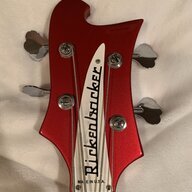
You can get a custom set of singles from D'Addario.


Balanced?Are there any bass string roundwounf sets that come 40-55-75-100? I like the stock Rickenbacker strings 45-55-75-105 that came on my 4003S for the most part, but I'm wanting something a little more balanced.
GHS Boomer L3045 (40-55-75-95) is as balanced as you can get in a factory set.
G 040 - 33.6 lbs.
D 055 - 35.2
A 075 - 35.9
E 095 - 36.1
Or, GHS Balanced Nickels 40-56-76-101...
G 040 - 43.2 lbs.
D 056 - 42.9
A 076 - 43.5
E 101 - 42.7
The OP is asking about a roundwound set.


Gauge does not directly equate to tension.
These are about as close tension wise as I've seen, and close to what you're asking for.
 www.sweetwater.com
These are about as close tension wise as I've seen, and close to what you're asking for.
D'Addario EXL220BT Balanced Tension Nickel Wound Bass Guitar Strings - .040-.095 Super Light Long Scale | Sweetwater
Only at Sweetwater! ✅ FREE Shipping for your D'Addario EXL220BT Balanced Tension Nickel Wound Bass Guitar Strings .040-.095 Super Light Long Scale!
www.sweetwater.com
D'A "balanced tension" set is actually not quite as balanced as the Boomer set I mentioned earlier.Gauge does not directly equate to tension.
These are about as close tension wise as I've seen, and close to what you're asking for.
D'Addario EXL220BT Balanced Tension Nickel Wound Bass Guitar Strings - .040-.095 Super Light Long Scale | Sweetwater
Only at Sweetwater! ✅ FREE Shipping for your D'Addario EXL220BT Balanced Tension Nickel Wound Bass Guitar Strings .040-.095 Super Light Long Scale!
G 040 - 32.42 lbs.
D 055 - 34.69
A 070 - 31.21
E 095 - 31.66

I was going to say GHS Balanced Nickels are close, 40-56-76-101, but @michael_t beat me to it.

And if you want that specific gauge (or close), you can get it if you buy singles from
GHS
Singles - Bass Boomers ,
Singles - Bass Super Steels
or SIT Single Strings - S.I.T. Strings
or others.
Getting singles to create your own custom gauge set from SIT costs about the same as any of their off-the-shelf sets, so that's always nice.
And remember, balanced tension does NOT always mean balanced tone. With some balanced tension strings, I feel like the G is too thin and/or the E is too thick. I like 45-100 whose numbers are all over the place tension-wise (per the tension numbers at GHS, D'Addario, others), but that's what my hands and ears like in terms of feel. I can "think less, bass more." But, yeah, there is merit to the tension numbers, especially if your bass neck is at a point where it can't handle the heavy "bridge cable" strings.
GHS
Singles - Bass Boomers ,
Singles - Bass Super Steels
or SIT Single Strings - S.I.T. Strings
or others.
Getting singles to create your own custom gauge set from SIT costs about the same as any of their off-the-shelf sets, so that's always nice.
And remember, balanced tension does NOT always mean balanced tone. With some balanced tension strings, I feel like the G is too thin and/or the E is too thick. I like 45-100 whose numbers are all over the place tension-wise (per the tension numbers at GHS, D'Addario, others), but that's what my hands and ears like in terms of feel. I can "think less, bass more." But, yeah, there is merit to the tension numbers, especially if your bass neck is at a point where it can't handle the heavy "bridge cable" strings.
Last edited:


I sensed a disturbance in the force... kinda late, actually. Sorry about that.
Anyway, as has already been noted, D'Ad EXL220BT or EXL170BT are well-balanced, as are various GHS offerings. The EXL170BT is probably close enough to balanced that nobody could tell it wasn't exact. For GHS, I wish the A string on the light Pressurewounds was a bit lighter (like a 70 instead of 76) and they'd also be great.
You can also build well-balanced sets by ordering singles. Different strings have different unit weights so you can't go entirely on gauge but some folks do publish charts so you can work it out.
For example, a Curt Mangan 45-60-80-110 set is 46.5 - 45.1 - 46.8 - 46.4 which is darn close to perfect; even better than the EXL170BT. They're a little spendy but go on sale often (right now it's spring sale, 20% off).
Anyway, as has already been noted, D'Ad EXL220BT or EXL170BT are well-balanced, as are various GHS offerings. The EXL170BT is probably close enough to balanced that nobody could tell it wasn't exact. For GHS, I wish the A string on the light Pressurewounds was a bit lighter (like a 70 instead of 76) and they'd also be great.
You can also build well-balanced sets by ordering singles. Different strings have different unit weights so you can't go entirely on gauge but some folks do publish charts so you can work it out.
For example, a Curt Mangan 45-60-80-110 set is 46.5 - 45.1 - 46.8 - 46.4 which is darn close to perfect; even better than the EXL170BT. They're a little spendy but go on sale often (right now it's spring sale, 20% off).
This is why the traditional Fender "golden age" strings had gauges of @ 50-100: So the G string wouldn't twang, the D and A strings were thick enough to have the same volume over the flat J-bass poles on a 7 1/2 inch radius neck, and the E string wouldn't thump.And if you want that specific gauge (or close), you can get it if you buy singles from
GHS
Singles - Bass Boomers ,
Singles - Bass Super Steels
or SIT Single Strings - S.I.T. Strings
or others.
Getting singles to create your own custom gauge set from SIT costs about the same as any of their off-the-shelf sets, so that's always nice.
And remember, balanced tension does NOT always mean balanced tone. With some balanced tension strings, I feel like the G is too thin and/or the E is too thick. I like 45-100 whose numbers are all over the place tension-wise (per the tension numbers at GHS, D'Addario, others), but that's what my hands and ears like in terms of feel. I can "think less, bass more." But, yeah, there is merit to the tension numbers, especially if your bass neck is at a point where it can't handle the heavy "bridge cable" strings.

I'm a fan of the SIT singles - if you order a set of four they package them up in a box for you, just like a standard set, and they're about the same price as a standard set. SIT is also a company that does, or at least used to do, business with Rickenbacker as an OEM (though John Hall once said that D'Addario is another, so you can't go wrong there either).And if you want that specific gauge (or close), you can get it if you buy singles from
GHS
Singles - Bass Boomers ,
Singles - Bass Super Steels
or SIT Single Strings - S.I.T. Strings
or others.
Getting singles to create your own custom gauge set from SIT costs about the same as any of their off-the-shelf sets, so that's always nice.
And remember, balanced tension does NOT always mean balanced tone. With some balanced tension strings, I feel like the G is too thin and/or the E is too thick. I like 45-100 whose numbers are all over the place tension-wise (per the tension numbers at GHS, D'Addario, others), but that's what my hands and ears like in terms of feel. I can "think less, bass more." But, yeah, there is merit to the tension numbers, especially if your bass neck is at a point where it can't handle the heavy "bridge cable" strings.
What I like about the SIT strings is that they're the smoothest feeling roundwounds I've used, compared to GHS, D'Addario, and DR.
@iiipopes That makes sense. And I assume that's why Ernie Ball's Regular Slinky is 50-105 and the "standard" 45-105 is Hybrid slinky.
@Isaac_James SIT strings are great. They're not as popular as GHS or D'Addario but they are terrific and, like their competitors, do a lot of private label strings for various makes. I used to love their Silencers (I'm one of the few on TalkBass who liked those better than GHS Pressurewounds or Ken Smith Compressors, the competition). I remember their Power Steels being smooth for steels. And though I wasn't into their Power Flats (too stiff for my tastes), they did impart a throaty slap tone (unlike GHS Precision Flats which were great for vintage fingerstyle but thlubby when slapped).
I definitely want to try SIT's Foundations strings. I tried their closest competition (Dunlop SuperBright Steels) and hated those Dunlops. I liked the feel of the Dunlops but they went dead on me quicker than Ernie Balls (EBs last maybe 3 days for me, those Dunlops went fully dead after 3 hours. And Dunlop Hybrid Nickels went dead on me after one gig. I'm a Dunlop destroyer). So, since I've had good experiences with SIT strings, I want to give Foundations a shot.
@Isaac_James SIT strings are great. They're not as popular as GHS or D'Addario but they are terrific and, like their competitors, do a lot of private label strings for various makes. I used to love their Silencers (I'm one of the few on TalkBass who liked those better than GHS Pressurewounds or Ken Smith Compressors, the competition). I remember their Power Steels being smooth for steels. And though I wasn't into their Power Flats (too stiff for my tastes), they did impart a throaty slap tone (unlike GHS Precision Flats which were great for vintage fingerstyle but thlubby when slapped).
I definitely want to try SIT's Foundations strings. I tried their closest competition (Dunlop SuperBright Steels) and hated those Dunlops. I liked the feel of the Dunlops but they went dead on me quicker than Ernie Balls (EBs last maybe 3 days for me, those Dunlops went fully dead after 3 hours. And Dunlop Hybrid Nickels went dead on me after one gig. I'm a Dunlop destroyer). So, since I've had good experiences with SIT strings, I want to give Foundations a shot.
Last edited:
I like the Pressurewounds/Compressors (they are both made by GHS, aside from a few minor details like gauge, tapered B, and scale length they're otherwise exactly the same) but haven't yet tried the Silencers. Might have to give them a go.@iiipopes That makes sense. And I assume that's why Ernie Ball's Regular Slinky is 50-105 and the "standard" 45-105 is Hybrid slinky.
@Isaac_James SIT strings are great. They're not as popular as GHS or D'Addario but they are terrific and, like their competitors, do a lot of private label strings for various makes. I used to love their Silencers (I'm one of the few on TalkBass who liked those better than GHS Pressurewounds or Ken Smith Compressors, the competition). I remember their Power Steels being smooth for steels. And though I wasn't into their Power Flats (too stiff for my tastes), they did impart a throaty slap tone (unlike GHS Precision Flats which were great for vintage fingerstyle but thlubby when slapped).
I definitely want to try SIT's Foundations strings. I tried their closest competition (Dunlop SuperBright Steels) and hated those Dunlops. I liked the feel of the Dunlops but they went dead on me quicker than Ernie Balls (EBs last maybe 3 days for me, those Dunlops went fully dead after 3 hours. And Dunlop Hybrid Nickels went dead on me after one gig. I'm a Dunlop destroyer). So, since I've had good experiences with SIT strings, I want to give Foundations a shot.

Getting singles to create your own custom gauge set from SIT costs about the same as any of their off-the-shelf sets, so that's always nice.
You can order custom gauge sets/ individual strings from SIT - they're pretty reasonably priced.
Big +1 to ALL of that!What I like about the SIT strings is that they're the smoothest feeling roundwounds I've used
I’ve been using SIT Nickel on my #1 bass for the past 5 years; they’re inexpensive, last a long time, and feel smoother than any other roundwound strings.
I don’t like their stainless strings as well, but I’m playing bright sounding basses through full-range cabs.

Passinwind
I know nothing.
- Dec 3, 2003
- 23,042
- 45,890
- Disclosures
- Designer/Toaster Tech @ Passinwind Electronics
I'm another person who sometimes prefers Silencers to Pressurewounds, but for me it's situationally dependent.@Isaac_James SIT strings are great. They're not as popular as GHS or D'Addario but they are terrific and, like their competitors, do a lot of private label strings for various makes. I used to love their Silencers (I'm one of the few on TalkBass who liked those better than GHS Pressurewounds or Ken Smith Compressors, the competition).

Many string companies can get custom single strings if you could wait for it. Personally I prefer Rotosound for roundwounds, and you could probably get these gauges if you wait a bit.
Personally I've thought of 45-60-80-106.7 strings as "mathematically balanced" assuming for the same specific mass for each string. Personally I now find 45-105 or similar gauges a bit too heavy, and it could sort of scale down to about 41-54-72-96 (round to 40-55-70-95) if you will.
Personally I've thought of 45-60-80-106.7 strings as "mathematically balanced" assuming for the same specific mass for each string. Personally I now find 45-105 or similar gauges a bit too heavy, and it could sort of scale down to about 41-54-72-96 (round to 40-55-70-95) if you will.


