
Hipshot Ultralite U.S.A tuners made my six string schecter stiletto studio playable after setting it down for a while because it was just too neckheavy. Elastic guitar straps like what Buckethead has help alleviate some neck dive as well.

TalkBass has been independent since 1998. Add your voice.
Create a free account to reply to discussions, view embedded media, and browse with fewer display ads.
Join free Log in
Want zero display ads or expanded classifieds tools? Compare plans.

Alrighty then!Actually, the centre of gravity (centre of mass) is exactly the same. What moving the strap button does is the raise the neck somewhat. This reduces the moment arm for the mass of the neck (around the centre of mass), reducing the torque that would cause the bass to rotate under gravitational force. [If you want to visualize this, think about the bass standing with the neck vertical. There's no tendency of the bass to rotate since the moment arm for the gravitational force (horizontal distance from the centre of mass of the instrument to, say, the centre of mass of the neck) is zero—they're aligned vertically.
View attachment 3214412

My situation is that I really want a Mustang PJ, but I'm afraid of neck dive, and not being able to fix it. Trying the tuner and strap button suggestions will surely make it impossible to take it back, so I'll like to be as sure as possible that it can be dealt with.
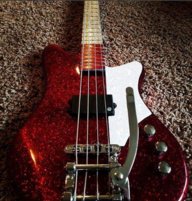

 To be honest - I've never tried to "solve" neck dive. I only have a couple 3 basses - out of 24 - that I'd consider "perfect", in the sense that they hang where I put them, in any situation. The rest either like to hang in certain positions (which is OK with me), or are so lightly forward- biased that I can "fix" it with a grippy strap - or else just ignore it. I don't consider having to hold up something the weight of an Egg McMuffin all that much of a struggle. And in my book, that ain't really neck dive, anyway. This Kramer 450B is the only bass I own that really is a Neck Diver - and aluminum-necked Kramers are famously bad ones, too. There really is no "Fixing" the Kramer - short of cutting another control-sized cavity in the lower body, and adding about 5 lbs of lead to it. Which, considering that it weighs 10.5 lbs. already, ain't really much of a solution...


Hi, I've read a lot about people saying they changed the strap button placement and/or tuners to help with neck dive. However, very rarely people actually says whether or not it had fixed the issue.
So, I'm asking what have your actual experience been with trying either changing the strap button placement and/or tuners?
My situation is that I really want a Mustang PJ, but I'm afraid of neck dive, and not being able to fix it. Trying the tuner and strap button suggestions will surely make it impossible to take it back, so I'll like to be as sure as possible that it can be dealt with.


Guaranteed no neck dive!Nothing better than this one for doing away with neck dive if you wear it wrong side out.
Sure, it ruins your shirt so I’d suggest cheap T-shirts, but the pain really brings out the best in your playing.
View attachment 3214994


I think the PJ is overall a bit heavier all around. It has a slightly bigger neck and the bodies on Japanese Mustang always felt impossibly light. Less so on the MIM.Ultralights did the trick for my CIJ Mustang. I don't imagine the PJ is that much different in terms of headstock mass.
I don't find Mustangs to be tremendously bad w/neck dive, but w/the ultralights there's none at all now.
GT

Hey Bruce,
if you make your neck plate extensions out of 6061T6, it will be stronger, stiffer
and
you can get a nice polish on it!