
Enjoy the benefits of a premium membership!
Upgrade Account
-
TalkBass has been independent since 1998. Add your voice.
Create a free account to reply to discussions, view embedded media, and browse with fewer display ads.
Join free Log in
Want zero display ads or expanded classifieds tools? Compare plans.
You are using an out of date browser. It may not display this or other websites correctly.
You should upgrade or use an alternative browser.
You should upgrade or use an alternative browser.
More options
Who Replied?

Yep, new tuners solved some minor neck dive on one of my old Yamahas, and tuner replacement and moving the left strap button came close enough to solving it on another bass.

This looks like a good idea but you'd have to get your neck bolt exactly the right length for it not to go in too far.
View attachment 3214098
I've used that method on several basses. Never had a problem finding a screw of the proper length at the hardware store.

And, there's always this solution, for those really tough neck dive cases:

It's made from 1/8" aluminum plate, bolts on in place of the original neck plate, and moves the strap button out to the position it needs to be to get the balance. It works best with the strap button facing forward, and up along the bass side of the neck. Really hard for the strap to pop off, and the thumb doesn't hit it.
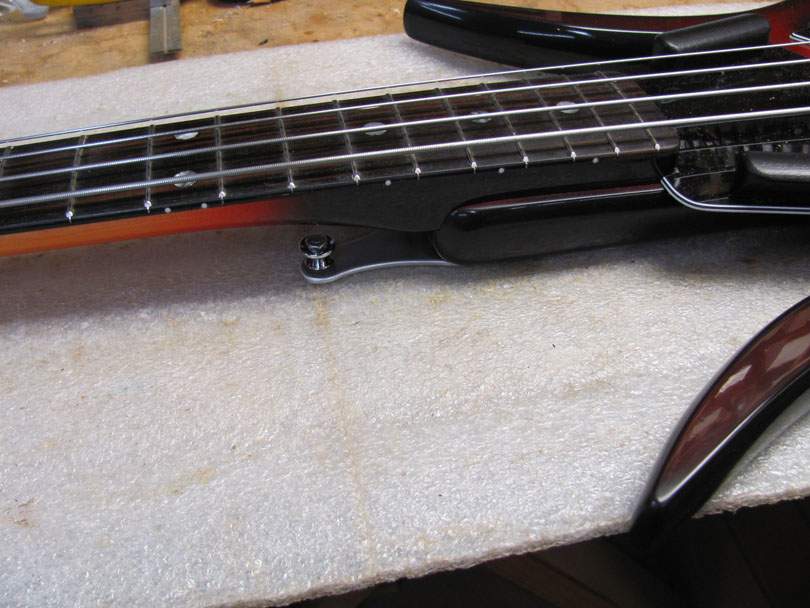
You can easily make this yourself at a home workbench with hand tools. I usually just satin finish them, hand sanding in a straight pattern with 400 grit paper. A few, I've polished up and had plated.
It's made from 1/8" aluminum plate, bolts on in place of the original neck plate, and moves the strap button out to the position it needs to be to get the balance. It works best with the strap button facing forward, and up along the bass side of the neck. Really hard for the strap to pop off, and the thumb doesn't hit it.
You can easily make this yourself at a home workbench with hand tools. I usually just satin finish them, hand sanding in a straight pattern with 400 grit paper. A few, I've polished up and had plated.
Last edited:

JeezyMcNuggles
Inactive
- Feb 23, 2018
- 14,723
- 20,970
- Disclosures
- I suck, but nobody really notices
The wider, more grippy straps work to a point, but the weight pulls on you differently because the neck is still trying to fall. And you still will have "pick back up" moments throughout the night. Weight, and center of gravity are the only things that are actually going to stop it. My talman is neck heavey. It bugs me. But, I've gotten used to it for the most part. Its 80 bucks for lighter tuners, so I havent splurged on them yet. Just a couple different straps off line. They help, but not fully. They do make it better though. Adding, taking away, or shifting weight is the only thing that is going to stop it. Gotta just try a few things, and figure out what works for you.@JGbassman yeah that's true. Kinda forgot to add that to my post. Im going the SS way partly because Ive some injury to my shoulder and neck area, and I kinda figured the friction from a wider strap with rubber or the like would still give 'pull' towards the neck, or maybe im wrong?
@jd56hawk Alright, Ill be sure to try that out!

Remove two tuners and see if it balances.
- If yes, lighter tuners (half the weight) will solve your neck dive.
- If no, other options listed on this thread should do it.
- If yes, lighter tuners (half the weight) will solve your neck dive.
- If no, other options listed on this thread should do it.

Alright, thanks a lot for sharing your experiences, and the extra suggestions!
Seems most people have experienced that it can be solved. I'm therefore going to buy my mustang pj today
Seems most people have experienced that it can be solved. I'm therefore going to buy my mustang pj today

And, there's always this solution, for those really tough neck dive cases:
View attachment 3214176
It's made from 1/8" aluminum plate, bolts on in place of the original neck plate, and moves the strap button out to the position it needs to be to get the balance. It works best with the strap button facing forward, and up along the bass side of the neck. Really hard for the strap to pop off, and the thumb doesn't hit it.
View attachment 3214177
You can easily make this yourself at a home workbench with hand tools. I usually just satin finish them, hand sanding in a straight pattern with 400 grit paper. A few, I've polished up and had plated.
I did something similar, but using Dunlop Straploks, is removable...
Strap Button Extension

I got a Roadworn Jazz bass from LA TBer Sparkdog that had two mods mentioned above; Res-o-lite tuners and a (Dunlop) strap lock pin added a few inches north from the stock position. (The original strap pins were replaced by Dunlops so there are now two at the butt of the bass; the one in the original position and a new one a few inches north.) No neck dive. Great bass.

No offensive, but there are some pretty hideous looking solutions to solving neck dive on this thread. And honestly, I'm a bit baffled why companies would design instruments with such obvious flaws.
Last edited:

No offensive, but there are some pretty hideous looking solutions to solving neck dive on this thread. And honestly, I'm a bit baffled why companies would design instruments with such obvious design flaws.
I have to agree.
I can't find it anymore, but I once saw a thread where a guy from Newfoundland had made an extension for his SG-shaped bass that matched the neck bolt pattern, and the end was a wrench - it gave the whole thing the perfect metal / garage rock look and was very nicely done. It is the only tasteful-looking fix to this problem that I've ever seen, personally.

The answer is that there is sufficient demand from folks who want the flawed instruments anyway. Whether it’s for the esthetics, the sound, or the panache, folks buy reverse Firebirds, short-horned Gibsons, Casadys, etc. It’s sort of like driving a car in which the steering pulls to the right or left if you let go of it.No offensive, but there are some pretty hideous looking solutions to solving neck dive on this thread. And honestly, I'm a bit baffled why companies would design instruments with such obvious design flaws.

No offensive, but there are some pretty hideous looking solutions to solving neck dive on this thread.
 ha! for some players: playability is what matters. some TB folks want 'lookers'. some want 'players'. some want both: but will choose playability over 'looks' without batting an eye...
...i honestly believe that the gigging bassist is more concerned with how the thing plays. YMMV.


mackb12
Supporting Member
I've used Gotoh Resolites on a vintage J and a custom P with really good results. Obviously, keep anything you change out, but I would not hesitate to do it again. I'm playing basses that I loved but felt so annoying that I avoided them. I was worried about tone change but didn't notice any at all.
I have ultralights on two that really helped. On another, a mid-scale Tele bass which cost less than new tuners, I moved the button button to the back approximately behind the bridge. Worked great.
I ain't adding no additional weight to a bass!
I ain't adding no additional weight to a bass!

I agree, specially if we speak about expensive basses, I had a Warwick thumb 5 BO, from 2002, has terrible neck dive, this is unacceptable for the price they sell it.No offensive, but there are some pretty hideous looking solutions to solving neck dive on this thread. And honestly, I'm a bit baffled why companies would design instruments with such obvious flaws.
Last edited:
On 50's and 60's vintage style Fenders, you have nothing to lose (other than the $100 or so in cost) and several gains by replacing the stock tuners with Res-O Lites. They typically look exactly like the originals and the screw holes line up exactly with those of the old large-plate tuners. Great tuners.I've used Gotoh Resolites on a vintage J and a custom P with really good results. Obviously, keep anything you change out, but I would not hesitate to do it again. I'm playing basses that I loved but felt so annoying that I avoided them. I was worried about tone change but didn't notice any at all.

No. I had a Spector Rebop5 briefly that I loved the sound of. Playing while seated was great, but standing tried to dive to the floor. The body was too light for the neck and the placement of the upper horn and bridge made it a challenging reach with the left hand. Read a bunch of suggestions about moving this or that and straps (already had good strap) etc., but didn't want that hokey pokey, so....returned it. Would love to find a Spector that doesn't do this, but seems inherent in the design.

Moving the bottom strap button higher helps the balance a little. It's not going solve an extreme imbalance, but it will shift the center of gravity a little bit.
View attachment 3213790
Actually, the centre of gravity (centre of mass) is exactly the same. What moving the strap button does is the raise the neck somewhat. This reduces the moment arm for the mass of the neck (around the centre of mass), reducing the torque that would cause the bass to rotate under gravitational force. [If you want to visualize this, think about the bass standing with the neck vertical. There's no tendency of the bass to rotate since the moment arm for the gravitational force (horizontal distance from the centre of mass of the instrument to, say, the centre of mass of the neck) is zero—they're aligned vertically.

Of course it’s easy to fix neck dive on a Mustang by replacing tuners. At the very worst you save half a pound of weight and improve weight distribution. How is there any downside at all?


