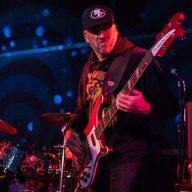
Lets have another angle to it, from a real pro, Colin Edwin of Porcupine Tree:
"
MPc: You play four-string basses primarily and sometimes tune down as low as C, F, Bb, Eb. Why not just play a five or six string bass?
CE: I have thought about that. I have a five string fretless that I use at home, but I’ve always really enjoyed playing a four-string and I’ve never felt the need, until Steven [Wilson, Porcupine Tree singer/guitarist] started down-tuning, and that’s the same time I got this low-tuned Spector that you’re talking about with that tuning. I never really felt the need to go lower than a D. And I’ve always felt a bit uncomfortable playing some of the five-strings with the string spacing a bit closer together. If you think about it, there are only three low notes you’re not getting. You’re not getting B, C, and C#. I can comfortably get to D on my four-string. And I didn’t feel that there’s a trade-off between the low notes and the extra weight, and I’m not particularly tall or anything (laughs) so the extra weight and the extra size of the fret board, I never really felt comfortable with any of the ones I’ve tried so far. I might change my opinion, but I don’t ever find myself thinking, “Oh, I need a lower note.” And I’m also a fan of octave pedals, so I’m quite happy to use an octave pedal if I need to go low.
And as for going up the other end of the bass, going higher, I don’t really find myself having a call for that or playing that kind of chording style that six-string players do. I think that comes from playing in Porcupine Tree for such a long time, it’s very sonically dense. I ‘m actually quite aware of going above the first five frets a lot of the time or playing quite high. It’s something that in an ensemble, you have to be very careful that the bottom end would disappear."
No money above the fifth fret. Again. That catchphrase seems popping up ever so often.
Invalid Link Removed