• TalkBass has been independent since 1998. Add your voice.
    Create a free account to reply to discussions, view embedded media, and browse with fewer display ads.
    Join freeLog in
    Want zero display ads or expanded classifieds tools? Compare plans.

Anyone moved away from bothering with a B-string?

What I tend to find is that the B sounds weak by comparison on passives, while on actives the you can get a strong B with EQ, but that leaves it sounding fake and lifeless compared to the higher strings. You also tend to get weird bell-like sounds on the B string, especially on the higher frets.

Incidentally I've never had this problem people talk about with a 'floppy' B... it's just the sound.
The weird bell sound could be your hand inadvertently fretting the G string when playing up the neck on the B string. I have shorter fingers and have to watch for this.
I would go back to a 4 because of wrist reasons but no cash and I have my Lakland bass modded and setup up exactly how I like it. Still main reason is cash.
 
The weird bell sound could be your hand inadvertently fretting the G string when playing up the neck on the B string. I have shorter fingers and have to watch for this.
I would go back to a 4 because of wrist reasons but no cash and I have my Lakland bass modded and setup up exactly how I like it. Still main reason is cash.

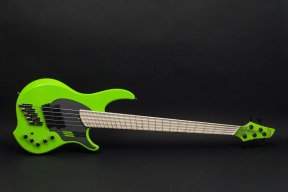
I wonder if you've ever tried a Dingwall or multiscale bass with fan frets. I have not that bell sound, and I am constant vigilant about stray drone notes from the rest of the strings. So I agree with you there. Instead of inadvertently fretting I use deliberate damping of my fretting hand to damp strings I am not playing. On bass, when you play rest strokes and normal fingering you can't damp that much with picking hand. And I don't use thumb/slap techniques that much. You cant use palm mute as guitarists do. Ever so often I use my barre finger a damper and fret with the rest of the three fingers. Vigilant about the harmonic spots too so they don't "ring" when stopping or muting a note.
 
I don't know of an official name for that "bell" or what we call "steel drum" like quality of the upper notes on a B string but it's caused by the string being too thick or having too much mass to produce harmonics in tune with the fundamental. Like an out of tune piano the pitch warbles. For this reason throwing a heavier string at the B-string problem may solve the tension issue but will more than likely make the "steel drum tone" problem worse and at lower frets.
 
  • Like
Reactions: BurningSkies
I'm about to give up on five strings. When I get home from work I'm going to post up my Victor Bailey Jazz V in the classifieds. There's a unique four string I've just become aware of that I kind of need to acquire...
 
Didn't read past page one.

Since I've been playing I always hated that G string. 'G' stands for guitar, & conversely 'B' for bass. I recently opted to lose the G and modify for a B ... but I use it veerrryyy sparingly. When I do hit one of those low notes, people notice, and it does add a depth that I couldn't reach before. I'm still finding out, through trial & error, that using that low B requires a different finesse than the other strings to make it articulate. I'm still experimenting with strings ... currently using DR lowriders because they have more tension, but I would like to find something even tighter (if anybody has any suggestions.)
 
  • Like
Reactions: Sartori
You could always go for Circle Ks.
They're a little stiffer, you say?

I actually met Skip from Circle-K a few months ago at the Seattle TB GTG, & he offered to file the nut and string her up. When I tried to contact him soon after thru the website, I got no response. Though, I believe they were in the midst of a name change and trying to play catch up with the biz. Apparently I missed the thread posted about it.
 
  • Like
Reactions: Sartori
Since we have - by now - covered all caveats from people why they're dissing their 5-ers and go back, to 4 with standard tuning, it may be like those last posts says? The low B-string isn't that APPROPRIATE, and the high g-string belongs to guitar? The open G-string on bass is actually the third fret on a ordinary guitars 6th E-string.

So there: 3 strings will be "bass territory" enough. Given the "no-money-above-5th" catchphrase.

You have too much funny "bell" sounds, and inharmonics on a low b, regardless of it being fanned frets, or not, and not fixed by any change in gauge. And then the g-string, which some people gladly could be without. Are those remaining three, in the most appropriate bass range?

I don't think I'll hear benefits of a huge grand pianos lower notes, either, they just "clonk" (clang tone) and you'll hear some upper harmonics, that has to be stretched anyway. But that's it. Some percussive mallet striking something bell like. IMHO.
 
You could always go for Circle Ks.

They're a little stiffer, you say?

I've switched to Circle K's, and I actually found Circle K's to be pretty flexible. What I have found is that the balanced tension sets have both restored my love of the G string and brought the B string's harmonics closer to "normal."

Re the original thread question from ancient history: I switched back to 4 strings and switched back back to 5. :)
 
Really? What would you call what people like Paul McCartney, James Jamerson, Carol Kaye, etc were playing?

Whether or not a bass is 4 or 5 string is just a matter of preference. I own 4 and 5 string and use them according to what I need for the song. However, the truth is that you really do not need a 5 because all you really gain are 5 notes in a lower octave. They do sound better in some songs but one problem is that many people who play 5 string use the low B too much and as a result they just "muddy" the sound of the band.
I disagree with gaining only 5 notes in a lower octave. You also gain the ability to play your 1st position notes, such as your first-fret F, farther up on the neck. This makes them sound much more round and fat, in my opinion. You also don't have to drop-tune to play SRV songs!
 
I found after a few different tries that a tapered .130-135" works best for me at 34" scale for both tone and playabiliity.

KMonk's statement about using low notes excessively works if referring to every beginning or clueless 5 player. The increased ability to play in position is the real gain, not the 5 notes. Listen to Travis Carlton, for example.

I stopped playing 5s for a bit, but it was because I needed wider string spacing than I had on my MIM Jazz 5.
 
Last edited:
I disagree with gaining only 5 notes in a lower octave. You also gain the ability to play your 1st position notes, such as your first-fret F, farther up on the neck. This makes them sound much more round and fat, in my opinion. You also don't have to drop-tune to play SRV songs!

You are right you gain more than 5 low notes you don't ever use. You gain a clanky floppy out of tune B string that gets in the way of playing. You get string sets that most local music stores won't carry in your favorite brands. You get strings that cost more. you get a wide neck you can't comfortably wrap your fist around. You gain a bass that costs more, weighs more, and sounds worse. Jaco and Jamerson only needed 4 strings. I used to play 5 strings and then I went back to 4 strings. It was like coming home!

Of course then I remembered just what a major pain it the butt it was living at home!
:)
 
You are right you gain more than 5 low notes you don't ever use. You gain a clanky floppy out of tune B string that gets in the way of playing. You get string sets that most local music stores won't carry in your favorite brands. You get strings that cost more. you get a wide neck you can't comfortably wrap your fist around. You gain a bass that costs more, weighs more, and sounds worse. Jaco and Jamerson only needed 4 strings. I used to play 5 strings and then I went back to 4 strings. It was like coming home!

Of course then I remembered just what a major pain it the butt it was living at home!
:)

:eyebrow: Wow....
 
I've been personally going back and forth a little on this of late; and IMO, this is kind of a circular discussion.

I play both the 4 with the HipShot as well as 5's and 6's. I like them each for different reasons that I see people kind of debating here.

The HipShot lets you stay with the 4 and get some really pure sounding low notes on a long string. If you are covering, it seems a lot of tunes were perhaps recorded with the Drop D, and the phrases lay really well. You don't have to go out and buy a new bass to cover most recent material.

That said, there are now a lot of good B strings out there which have minimal floppiness and play very evenly. A big advantage of the B is that you get the low notes with more straightforward fingering patterns which are much more intuitive. Plus a well made 5 or 6 is just going to sound good all around. This is a good choice for a player who just wants a straightforward approach.

Really, with a little effort, both are good options; and let's face it: the main thing is to go out and play well and have fun. Either option has some benefits and lets you do just that.
 
  • Like
Reactions: catcauphonic
They're a little stiffer, you say?

I actually met Skip from Circle-K a few months ago at the Seattle TB GTG, & he offered to file the nut and string her up. When I tried to contact him soon after thru the website, I got no response. Though, I believe they were in the midst of a name change and trying to play catch up with the biz. Apparently I missed the thread posted about it.
A lot of players in the stoner/doom metal community seem to be switching to those. Lots of low tunings going on there.