• TalkBass has been independent since 1998. Add your voice.
    Create a free account to reply to discussions, view embedded media, and browse with fewer display ads.
    Join freeLog in
    Want zero display ads or expanded classifieds tools? Compare plans.

Are balanced tension strings the answer here?

catcauphonic

High Freak of the Low Frequencies
Mar 30, 2012
6,221
45,710
Seattle WA
I've tried about ten different sets of strings since I started playing bass. Mostly rounds, but at least two sets of flats as well. I am primarily a rock bassist ... don't find myself doing a lot of vibrato or bends. I do seem to enjoy playing the thicker strings with plenty of tension. The problem that I hear (as well as feel), is that my D & especially the G string almost sound too 'guitarish' ... for lack of a better word.

I know that playing the same notes on a lower string should have more thump to it, and more twang going in the upper direction. My issue is that when (for example) I'm playing a scale that uses three strings, My ears can tell which string I'm on ... Whereas I'm wanting more uniformity in sound as I move across strings. It would be nice to have thicker G & D under my fingers as well.

Is this something that a 'Balanced set' would cure? Or a lighter gauge?? (lighter seems counter intuitive.) Are there other factors I may be missing as far as the instrument goes???
 
I think there is a sticky on here about adjusting pickup height. Sounds like that could be part of the problem (especially if you've tried a wide variety of strings)?????? Have you tried a different bass through your amp? Have you tried your bass through a different amp?
 
I don't know much about balanced tension strings but I believe balanced tension strings actually have lighter d and g strings as they are the strings that have the highest tension on them. (Correct me if im wrong).

Another thing to try might be a compressor or EQ to smooth out the tubby bass on the thicker strings and have them a little more uniform.
 
I've been using balanced tension for a few years now. It's definitely more of a feel thing, I just happen to really like how the strings sound too. I think you're always going to run into the problem of your higher strings having a twangier sound than the same note on lower strings, it applies to guitars too. Right hand technique can get you half-way there, but if it's that much of a concern and you're not playing super technical stuff just move up the neck instead of jumping strings. Good to be able to do both!
 
Balanced tension will let you even up the tension on all strings and let you play them all with the same technique.

As stated earlier in this thread, a slightly looser top end will give your treble strings a bit more girth.

What gauges are you using now, and at what tunings?
 
The OP hasn't volunteered enough info yet. As a tech, I've been asked to help a number of customers with this issue, and the causes have been all over the map:
- Heavy attack causing fret clack
- Action set too low and/or uneven across the strings
- Heavily scooped or bass-boosted amp designs (ie: Fender tone stack)
- Smiley-face EQ on amps
- Tone control bypassed or left wide open on a bright passive bass
- Poor pickup choice
- Cabs with poorly integrated tweeters
- Over-use of onboard EQ
- Players who thought they needed an active bass, but whose ears were calibrated for passive P-basses
- Bright SS strings on a gig (or with gear) that called for something smoother-sounding
- Wrong string gauge for the player's touch/attack

I don't do enough tech work to have a statistically valid sample, but the most common causes IME are a.) counter-productive EQ, b.) aggressive cabs, and c.) aggressive attack.

Gear combos that seem most prone to this complaint (once again, my sample is only a few people per year): Music Man basses, active Jazz basses, SD QP pickups, various cheap and/or aggressive onboard pre's, SWR and Trace Elliot heads, scooped cabs like the early Peavey 410's...

I have found that a good start for many people, is to play their basses through something relatively flat in response, to re-calibrate their ears. Bass boost and mid scoops are so prevalent these days, that it can be hard to find something suitable. A powered PA cab like a Presonus K-series and a mixer with the EQ set flat is good.

Next, listen to your tone through that setup for factors like whether the D and G strings sound too bright all over the fingerboard, just in the upper register, or not at all. Try adjusting your attack, onboard tone controls, and raising your action slightly, to see what helps or hurts. Armed with that baseline, you'll be in a much better position to make an intelligent decision as to whether a string change is going to be enough to get the deed done.

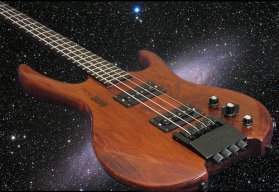
All that said, my Dingwall has a built-in variation on the string gauge suggestions made in previous posts, thanks to the fanned-fret system: shorter scale on the treble strings for lower tension/more fundamental, and longer scale on the bass side for more tension/brightness/articulation, and more balanced overall string tension.

The end result is an unusually good ratio of low-end growl to upper-register sweetness, to the point that it spoiled me for my parallel-fret basses.

With that in mind, while I had always been sceptical about the whole Circle K balanced-tension thing, I recently took advantage of a sale at Bass Strings Online to pick up a set of D'Addario BT's for my Squire VM P-bass. They definitely moved it in the right direction.
 
Bass is a Spector Forte-X (T-Bird style. Click on my profile to see it.) It's Active with a somewhat aggressive pre (Aguilar OBP2), though it does have major bottom end. Pups are EMG-DC Soaps.

I primarily play fingerstyle with a fairly light touch, though it can get more aggressive when the band is rocking. The bass is professionally set up with pretty low action, and it's actually really smooth all over the board ... no clanky frets whatsoever. It plays as smooth as a babies bottom unplugged.

I'm currently strung with GHS B52 Boomers. These sound a little mid scooped to me compared to others I've tried. I think the Black Beauties were my fave so far, though I wish the G was a little thicker feeling under my fingers.

I never scoop the mids from my amps. Instrument has B/T knobs which I usually set at center detent, though I do boost or cut the treble somewhat dramatically at times.

What if I were to reverse the angle of both pups? Or am I am prime candidate for BEAD since I rarely touch the G anyway??
 
Also after a few sets of 'standard' gauges, I started buying the 105/85/65/45s because I like the thicker feel.

Maybe I should look into a custom set with more uniformity? But that most likely wouldn't solve my sound & feel problem with the G.
 
I was an EMG user for over 20 years, a good part of that time with DC's.

In the end, my feeling was that the baked-in upper mid peak of the DC's was too much, especially in the bridge position. The CS is fatter, and a little more tame up top, but my fave ended up being the 40P5. More complex midrange, and a little less congested than the CS.

The fact that you liked Black Beauties, suggests that you might be having the same issue. Used EMG's are easy to find. If your Forte has the late-model push-on connectors, you could experiment with pickups without having to break out the soldering iron.

Maybe try just one initially, to see what you think?
 
The middle of the set you specify is very heavy - 42.5 50.2 50.3 46.5. A .043 will land you at a comparable tension with the .105 - a .040 might be too light but you could try it. If you like the .105 then see if you can find a .080, .060 and something between a .040 and .045 to see what it does for you.

Going BEAD is a reasonable solution - the G string from near-every manufacturer is actually a guitar string by construction and design. Nudging it a little one way or the other isn't going to have a grand affect, though it will affect it some. Bringing it in line with the low E is the most beneficial. Having the treble side of your pickups closer to the neck heads you in the right direction as well.

Different manufacturers will yield different sonics off of the strings - there is no right or wrong here, just preference - swapping brands for a bit may prove fruitful too. This is a slippery slope as some well-known brands are made by larger manufacturers (albeit likely to different design/manufacturing specs) so this will require a bit of homework and some time/money.

EDIT - there is a bass gathering next week Sunday in the city - Paddy Coyne's - 2801 Alaskan Way Suite 103, Seattle - one block from Edgewater Hotel. Think you might be able to attend? You could bring the bass in question. I'd love to hear what you've got going on.
 
The middle of the set you specify is very heavy - 42.5 50.2 50.3 46.5. A .043 will land you at a comparable tension with the .105 - a .040 might be too light but you could try it. If you like the .105 then see if you can find a .080, .060 and something between a .040 and .045 to see what it does for you.

I'm a little confused by those numbers: 42.5 50.2 50.3 46.5.

the G string from near-every manufacturer is actually a guitar string by construction and design.

Well, that explains the 'Guitarish' sound!

swapping brands for a bit may prove fruitful too. This is a slippery slope as some well-known brands are made by larger manufacturers (albeit likely to different design/manufacturing specs) so this will require a bit of homework and some time/money.

Interesting. I'm going to have to learn who makes what then. Is there a comprehensive chart anybody knows of?

EDIT - there is a bass gathering next week Sunday in the city - Paddy Coyne's - 2801 Alaskan Way Suite 103, Seattle - one block from Edgewater Hotel. Think you might be able to attend? You could bring the bass in question. I'd love to hear what you've got going on.

I've been following the Seattle GTG thread and I'm totally going to make it for the second year in a row.
Looks like I'll be bringing me Spector and keeping an eye out for you :D


Thanks everybody for your reponses!
 

Latest posts