• TalkBass has been independent since 1998. Add your voice.
    Create a free account to reply to discussions, view embedded media, and browse with fewer display ads.
    Join freeLog in
    Want zero display ads or expanded classifieds tools? Compare plans.

Are Carbon Fiber Rods Necessary?

Ok, thanks for the information.
Sorry to be a little OT but what about a multi-laminated neck with some Ipe wood in it (it is slightly harder than african ebony and about 1.5 heavier than hard maple).
And here in Belgium, I have more chance to find that kind of wood than CF rods.
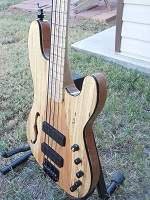
 
I can't prove the CF rods are why my two new basses are more stable than my older non-CF rod basses, but if that is the intent of the design, my experience shows that it is effective.

I am curious regarding the way the necks on my Fender Am Dlx basses are constructed.

Does anyone have a diagram or photo that shows how the Fenders are built?

(These are the recent Am Dlx basses, with CF rods, and a double-acting truss rod).
 
I think aluminum would be a waste of time, its not a very rigid metal. I wouldn't think that using a different wood would be much different either. The steel rods from Warmoth aren't all that heavy. They are 1/8" x 1/4" by about 20" long.
 
Pure aluminum isn't used very much because it's actually not that hard(there are different measures of hardness). Aluminum alloys can be very stiff. And they tend to be stiffer than steel, pound for pound. Pure aluminum is relatively soft in other ways, though.
 
I believe older Danelectros used an aluminum u-channel, two of them beneath the fretboard. And they got away with leaving out the truss rod on some old the really old Dan-o's. That said, if it were my bass, I'd use cf.
My Ovation Magnum has three strips of carbon graphite (different than cf but still it's in there for stiffness): two below the fretboard on either side of the truss rod and one down the back of the neck. It is very stiff for a mahogany neck. The only thing that'll ever warp it is leaving it in a hot car.
 
As a player, I have a vague and unfounded feeling that they improve stability and evenness, but detract a bit from the resonance and character of the sound.
Am I completely off-base?

All I know is this: once you find an instrument that feels stable, even, and has resonance and character, do NOT ask what it's made of.
 
I made it a point to not talk tone any more because everyone has their own opinions and nothing anyone on the internet says, can sway them.

But I have to ask, how does a neck feel any differently with rods vs without? I would understand if the neck was thicker because of the channel the rods are in, but I have gotten necks plenty thin with rods in them.

I don't even know ho to describe it. Maybe it's just psychological.
I just like my basses simple and necks made from one piece.:)
 
I begin to tire of the TalkBass LC. Yet another thread full of misinformation and "I've heard this" and "I feel that" from people who've never built an instument, in spite of the patiently repeated advice from a few experienced luthiers.
I suppose I should just have a little more willpower and not open these threads after the first time.
 
I begin to tire of the TalkBass LC. Yet another thread full of misinformation and "I've heard this" and "I feel that" from people who've never built an instument, in spite of the patiently repeated advice from a few experienced luthiers.
I suppose I should just have a little more willpower and not open these threads after the first time.

The problem is that few of those who ask really know what they are asking about. No matter what anyone answers someone will "feel" that it's wrong, and and some will "feel" that your answer is correct.

It's like all the discussions about finding a "good tone". I'm yet to see a firm definition (or even any definition) on what "tone" should sound like... ;)


It could be worse, though. Join a tech forum and ask what's best; A PC or a Mac. :smug: (I probably shouldn't even have said that here either. There may be techies around :hiding: )
 
I begin to tire of the TalkBass LC. Yet another thread full of misinformation and "I've heard this" and "I feel that" from people who've never built an instument, in spite of the patiently repeated advice from a few experienced luthiers.
I suppose I should just have a little more willpower and not open these threads after the first time.

I know your pain. People like to believe they know what they are talking about. So they just repeat what they hear from others as though its fact. When most of the time its nonsense
 
Pure aluminum isn't used very much because it's actually not that hard(there are different measures of hardness). Aluminum alloys can be very stiff. And they tend to be stiffer than steel, pound for pound. Pure aluminum is relatively soft in other ways, though.
1. Hardness has absolutely no bearing in this discussion.
2. Steel has roughly three times the density of aluminum. Steel has roughly three times the stiffness of aluminum. So, pound for pound, they are roughly equal.
3. Soft in other ways? Ok, whatever.


I begin to tire of the TalkBass LC. Yet another thread full of misinformation and "I've heard this" and "I feel that" from people who've never built an instument, in spite of the patiently repeated advice from a few experienced luthiers.
I suppose I should just have a little more willpower and not open these threads after the first time.
Agreed in general, although I have known experienced luthiers to make incorrect technical claims, when they'd be better off sticking to what their actual experience has shown them, rather than speculating as to root causes.

I know your pain. People like to believe they know what they are talking about. So they just repeat what they hear from others as though its fact. When most of the time its nonsense
Agreed.


If a person does not have a clear and accurate knowledge of what hardness, stiffness, and strength actually mean, and how they apply to bending and to elastic and plastic behavior of materials, then they should not enter a technical discussions on the subject making claims and calling vague material property references when they don't even know what it is that they are claiming.
 
How did I misquote anything. You said "It's not" and what I quoted was "It's not" :rolleyes:

Before you mis-quoted me I said that carbon is heavier than wood. After you mis-quoted me I was supposed to have said that wood is stronger than carbon which is ludicrous.

So... just stop it. I don't know what else to tell you.

I really don't get what the difficulty is in me asking you to stop quoting me, after you got it wrong every time. I know that you just don't get it, neither when you are quoting, nor what is wrong with it. But it is a form of harassment and I will have to ask moderators to sort it out if you don't stop it.
 
Before you mis-quoted me I said that carbon is heavier than wood. After you mis-quoted me I was supposed to have said that wood is stronger than carbon which is ludicrous.

So... just stop it. I don't know what else to tell you.

I really don't get what the difficulty is in me asking you to stop quoting me, after you got it wrong every time. I know that you just don't get it, neither when you are quoting, nor what is wrong with it. But it is a form of harassment and I will have to ask moderators to sort it out if you don't stop it.

I quoted exactly what you said. How is it possible to misquote the two words "It's Not" go ahead and tell the mods on me. I have said nothing at all offensive to you. If you get upset when I call out bad advice and misinformation thats on you.
 
1. Hardness has absolutely no bearing in this discussion.
So you're saying that rigidity of an item is not a measure of hardness. So, you would argue that hardness, is not the property of a material to resist stresses? In this case, "stiffness", is resistance to bending.
2. Steel has roughly three times the density of aluminum. Steel has roughly three times the stiffness of aluminum. So, pound for pound, they are roughly equal.
1. I didn't say it was a large difference.
2. I also made it clear that different alloys of aluminum and steel have different properties.
3. Soft in other ways? Ok, whatever.
You said "Steel has 3 times the stiffness" and then imply that aluminum is not soft. Which is it?

Agreed in general, although I have known experienced luthiers to make incorrect technical claims, when they'd be better off sticking to what their actual experience has shown them, rather than speculating as to root causes.

Agreed.


If a person does not have a clear and accurate knowledge of what hardness, stiffness, and strength actually mean, and how they apply to bending and to elastic and plastic behavior of materials, then they should not enter a technical discussions on the subject making claims and calling vague material property references when they don't even know what it is that they are claiming.

Is that aimed at me? First, I don't claim to be a luthier. Second, hardness, as I said, is a term that has many meanings in general using. It is also not just dependent on a particular alloy, but also on the tempering of the object.
BTW, Correcting me, when I'm wrong is fine, but try not to be a dick about it, mmkay? Thanks, buh-bye