• TalkBass has been independent since 1998. Add your voice.
    Create a free account to reply to discussions, view embedded media, and browse with fewer display ads.
    Join freeLog in
    Want zero display ads or expanded classifieds tools? Compare plans.

Are Carbon Fiber Rods Necessary?

Depending on how many laminations you're using on the neck, it is less likely to need support additional to the truss rod(s).

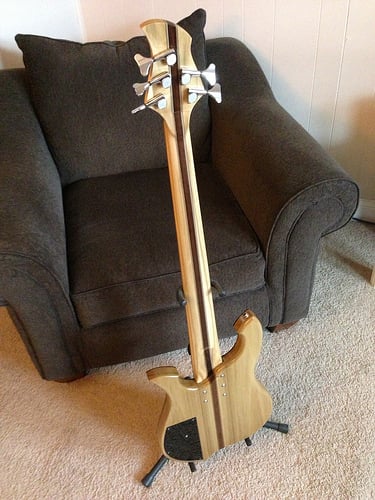
This bass which I built last winter has quite a few laminations that make up the neck. Once it was carved, finished, and strung up it didn't require ANY tension on the TR to maintain proper relief. It is a 5 string fretless with only one 2 way TR, and it is compose of walnut and mostly poplar.
8304969616_4fb9aeddae.jpg

IMG_0725 by PhendyrLoon, on Flickr
 
Depending on how many laminations you're using on the neck, it is less likely to need support additional to the truss rod(s).

This bass which I built last winter has quite a few laminations that make up the neck. Once it was carved, finished, and strung up it didn't require ANY tension on the TR to maintain proper relief. It is a 5 string fretless with only one 2 way TR, and it is compose of walnut and mostly poplar.

8304969616_4fb9aeddae.jpg

IMG_0725 by PhendyrLoon, on Flickr

While a laminated neck is often more stable. I dont believe the number of laminations has any effect on this. A two piece neck with opposing grain, at least as far as my understanding goes, should be as stable as a neck with multiple lams.

A neck made from a single piece of wood can be as stable as a laminated neck. If the wood its made from is stable and not prone to twisting


That is a beautiful instrument by the way.
 
bruce johnson has a very interesting take on this, to not use CF rods, but the raw bundles of CF itself, to get the stiffness where he wants it. apparently, when laid down into a slot in the wood and then epoxied up, you get something that conforms better to the wood and is stronger than a pre-made block of resin with some CF strands floating in it.

I personally don't like the carbon fiber bars because they are essentially a block of plastic. The bars are not solid strips of carbon fiber; they are bundles of carbon fiber stranding which are formed into a rectangular shape by pulling them through a bath of polyester resin. ...

the cool looking black bar is basically a block of plastic with some carbon fiber stranding inside.

Don't get me wrong; I like carbon fiber, and I use it quite a bit. But I buy it in rolls of the raw stranding, which is called TOW. When I want to reinforce an area of a neck, or a repair or something, I make up a bundle of the TOW strands and set them in epoxy in a small groove or hole. I can put the carbon fiber right where I want it to have the most effect, and it's very strong and compact. A little bundle of carbon fiber, less than 1/8" diameter, placed down deep in the neck will increase the stiffness more than one of those big rectangular bars.
 
It would make sense that epoxying to the groove would be stronger. It would be similar to a laminated neck being stronger than a single piece, or the reason composites(such as carbon fiber) are stronger than the components. Carbon fibers themselves are not stiff. They are very fine threads that can be bent and twisted. Epoxy resins are somewhat rigid, but not strong. Mix them, and you get something more rigid and stronger. Add a wood casing and now all three pieces must most together in new ways.
 
I may have some insight.

:)

The rods are in our necks (can't and won't comment for anyone else) to create OVERALL stability, and they DO. We have built necks without the rods, they flat flex more under tension.

Back to the OP's question: are they NECESSARY?

No, they are not. Millions of bass guitar necks have been built without graphite reinforcement rods, and a significant portion of those have been just fine. They will need to be adjusted far more often, and they will not have the same (in my OPINION: better) tone, but they work just fine.

There are many facets of what makes a neck stable/stiff and sound good, graphite rods are just one, other factors are (as mentioned above) curing, and grain orientation (quartersawn versus slab or flat sawn for example). But, to discount the ability of graphite rods on adding stability to a neck is just incorrect - it definitely and demonstrably adds to the stability. It may not be what you are looking for tonally, or you may wish to avoid doing it for other reasons (financial, philosophical), but doing so will ensure that all other things being equal, one of the necks will move more than the other.

Thank you for your response, I think that pretty much summarizes the debate.
 
walterw, are you saying epoxying strands in the slot is stronger that the rod. Say a rod .125"x.250" epoxied in or a slot .125"x.250" filled with strands and epoxied in.

Tedward
i'm not an authority on this at all! it's just that what bruce says makes a lot of sense:
...another reason why the small bundle of carbon fiber TOW is stronger than those danged bars is the glued surface area. When you set the raw fibers down into liquid epoxy in a channel in the neck, the epoxy is surrounding and bonding to the outside of every one of those teeny little fiber strands. Add it up and it's a lot of surface area. In comparison, when you glue to the bars, the only surface area you've got to bond to is the flat sides of the plastic resin.