Well, hand drums are, anywayDrums are definitely digital.
View attachment 4693948
 .
.
TalkBass has been independent since 1998. Add your voice.
Create a free account to reply to discussions, view embedded media, and browse with fewer display ads.
Join free Log in
Want zero display ads or expanded classifieds tools? Compare plans.
Well, hand drums are, anywayDrums are definitely digital.
View attachment 4693948
.
Also, it depends on the specific amplifier. I have a GK 800RB that has no limiter (that I know of) and is designed to overdrive gracefully. It's as loud in practice, maybe even louder, as a Markbass Little Mark (first gen, the traditional ones, all yellow with black text; they weren't sold outside of Italy, AFAIK), which is 150W more powerful. But the Little Mark has a non-defeatable limiter and it is also always clean (well, it's the Markbass sound signature), while the 800RB tends to have some grind to it (which is fantastic, but not always what you want). Of course, they are both Class AB amps, and both well designed.I haven't found this to be true when comparing using the same speakers, with the same LF extension and sensitivity.
It is sort of a bad methodology this, though. Also because who knows what is "correct gain", even in the presence of a clip LED. But mostly because you are doing things and expecting to see a result.

I think it's just because Johnny Rotten has such a soothing voice
At face value it does seem weird. I'm pretty sure it was more about what the warmth of the McIntosh did for the sounds of Levene and Wobble and how the sound filed the space.

When it comes to watts at least. Was watching a video with the President of Boss talking about the new Boss Katana bass amps. Him and the interviewer were saying that while the 60 watt 1x10 and 160 watt 2x10 amps sounded low in watts, you have to account for the fact that you need 5 times the watts for a digital Class D amp to match an analog A/B amp. So using Class D ratings equivalency, that would make the 1x10 a 300 watt amp and the 2x10 an 800 watt amp?

Yup. It might be a good idea to see if Andy could write a summary with useful references that could be stickied up above. That would at least provide an easily referenced thread for when these Q's come up.
In fairness, Class D operation is not generally intuitive. The confusion is understandable.

Johnny spent hours sitting at a picnic table chatting with everyone who wanted to talk to him and smoking.It was a little raggedy last Sunday….
View attachment 4693965
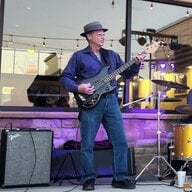
Always the wiseguy, he quipped "I'm getting on and I need my electrolytes"; sure enough, he had his Gatorade bottle. The bass player was no Jah Wobble, but he hit his mark.
Not sure if this has already been said but:
1. Class D is NOT digital. However, many Class D amps use a digital Switching POWER SUPPLY. I believe this is the origin of confusion (well, this and because people regurgitate marketing BS as a means to falsely portray a modicum of technical understanding).
If you are completely new to how amplifiers work, think of it this way (this is a gross oversimplification, but basics are needed): a power amp (not inclusive of a pre-amp stage) consists of at least (usually) 2 main parts - a) a gain stage using devices such as tubes or semiconductors that amplify a signal, and b) a power supply that takes the 110 volts from your wall outlet and converts AC/DC, and regulates/adjusts the voltage that feeds the aforementioned gain stage device.
Class D, Class A, Class A/B etc. is a references to the gain stage (the circuit that actually AMPlifies the signal of your instrument). In Class D, just like in Class A, Class A/B etc., the gain stage is analog, not digital.
Two very popular forms of power supplies are: a) Linear Power supplies - they use a (relatively) big transformer mated to a series of capacitors and resistors, and b) Digital switching power supplies that perform voltage adjustment and AC/DC rectification via tiny microprocessors (not big transformers or capacitors, etc.)
Class D Amplifier circuits have the benefit of being small, powerful and very efficient. Digital switching power supplies also have the benefit of being small, lightweight and very efficient. As such, the two are very commonly paired together, thus providing users with a small, lightweight package that provides a lot of power relative to its size.
A designer/manufacturer can ABSOLUTELY pair a digital switching power supply with a heavy Class A amplifier circuit (I have actually built two amps with this configuration). Alternatively, a tiny Class D module can absolutely be paired with a large, relatively heavy linear power supply.
2) A Watt IS a Watt. The perception of more power from Class A/B likely has to do with a) higher distortion levels, and b) the fact that Class D are overwhelmingly mated to Digital Switching Power supplies. Remember, I said Digital Switching power supplies do NOT have the big capacitors? Well, the benefit of large capacitors is that they have the capacity to temporarily store electricity. This means that a linear supply that has a bunch of big capacitors has the ability to deliver very large amounts of current for millisecond long, instant transient spikes. A digital power supply can not do this to the same extent. In practice, it means an amp with a linear supply can provide 100 watts continuous power into an 8 ohm load, but extremely short burst power (dynamic headroom) of over 200 watts. Conversely, that same gain stage paired with a digital supply can provide the same 100 watts continuously into an 8 ohm load, but only 125 watts of transient spike power.


It was a little raggedy last Sunday….
View attachment 4693965
Always the wiseguy, he quipped "I'm getting on and I need my electrolytes"; sure enough, he had his Gatorade bottle. The bass player was no Jah Wobble, but he hit his mark.
Not sure if this has already been said but:
1. Class D is NOT digital.
2) A Watt IS a Watt.
Johnny spent hours sitting at a picnic table chatting with everyone who wanted to talk to him and smoking.
I noticed he lost a bunch of weight recently, fortunately. A couple years ago he looked ready to pop.
No! And thanks you for bringing it to our attention!
Not to Johnny it wasn't, I'm sure! After that lawsuit over the Disney show, he has not been happy with any of the others.Matt, the English Beat sax player, posted an Instagram pic of he and Johnny back stage, and Johnny looked like his face was melting.
I was knocked out by how great Debbie Harry looked after being in a similar situation. Clem was an animal, and Glen Matlock sitting in on bass was a pleasant surprise.
I'll bet they kept their distance at the event.Not to Johnny it wasn't, I'm sure! After that lawsuit over the Disney show, he has not been happy with any of the others.

Is it though? A 50 watt all tube guitar amp is A LOT louder than a 50 watt digital guitar amp. Its not even close. Why is that?
What if a tube amp and a class D amp of same/similar stated wattage were played through the same cab and measured with a decibel meter? Would that be a fair comparison?
His reply would have made more since if you had read the entire thread, but I don't blame you for skipping over all 5 bajillion pages. He wasn't being rude to you… just poking fun that you basically came in and corrected the OP in the same way that at least 20 other people had done, and yet there was still confusion and debate over the first couple of pages.Not sure I understand your intent, but thanks for the reminder as to why I rarely visit Talkbass the last several years (after being very active 16/15 years ago).
Sorry, I don't mean to run you off. It's just that that comment has been made repeatedly over the last 14 pages. I guess I was sarcastically commenting on the tendency for folks to post before they actually read what's going on in the thread.Not sure I understand your intent, but thanks for the reminder as to why I rarely visit Talkbass the last several years (after being very active 16/15 years ago).

If I have a STV CL plugged into a good cab like a Barefaced Big Twin I can be louder than anyone really needs to be. If I try to use a 300 watt GK MB or Aguilar TH SS head into the same cab, it will not perform well against a pair of 412 half stacks and a heavy drummer.I haven't found this to be true when comparing using the same speakers, with the same LF extension and sensitivity.

Try with an Ampeg SS amp, not another brand.If I try to use a 300 watt GK MB or Aguilar TH SS head into the same cab, it will not perform well against a pair of 412 half stacks and a heavy drummer.