• TalkBass has been independent since 1998. Add your voice.
    Create a free account to reply to discussions, view embedded media, and browse with fewer display ads.
    Join freeLog in
    Want zero display ads or expanded classifieds tools? Compare plans.

Are the big amps history?

Would it be up to me I would play through the Wall of Sound every night. But even they got tired of lugging that around. Would that I have an SVT and 810, it would stay right where it is because I could never move it on my own. Maybe when I was 20-something, maybe. I moved my Peavey TNT and 15 custom cab. And hated it for its mass. It feels great to play in front of a rig taller than I am. Getting it there and getting it back is teh SuXoRz. Is Big Iron dead? I don't care. I travel as light as I am able and all the happier for it.
 
It's not about the reproduction of 30 or 40 Hz - I'm with @JimmyM on this - there's no replacement for displacement.

However, my situation is a unique one. I play exclusively for my church, and in our theater we set up our gear and it seldom moves. When our old bass amp fried, my pastor bought my entire rig - a Mesa 400 and a PR810h cab (I think it's the heaviest 810 in existence - 220 lbs!) So, without a good place to store the cab, I added it to the stack (quite literally) and powered the Hartke cabs with a power amp we had.

My pastor is an old rock-n'-roller and as such is old-school. Our guitarists play through full Marshall stacks. The drum kit is ginormous. He likes good stage presence, and he was a bassist himself. That said, the rig 'is what it is'. For shows we travel to, I take the 400 and the fridge, which is plenty for any venue really - but even bigger road shows get the full treatment. And it helps when we're outdoors.

I'll admit we have a stage volume much louder than required, but we try to balance our volumes to match without frying the folks on the front row of seats. I do use earplugs (mainly for the drum kit next to me) but the full rig idles most of the time. Sounds awesome though!

(Please refrain from mixed-cab flame posts! :spit:)
View attachment 1172148
HOW BIG IS YOUR CHURCH?!?!?!?!
 
I was a 16 year old kid, saw Ten Years After and The Stooges who opened for them in 1969 at a place called The Boston Tea Party. The stage was all Marshall heads and cabs, don't know how many each had but there were many little red lights on, I'd say conservatively each member had 4 heads and probably double that many cabs. Those bands sounded GOOD, it was probably the best sounding concert I've ever been to in my life. There are certainly a lot of advantages to the way sound is done nowadays but when a band really used those walls of sound back then, the sound was very clear and you really knew you were listening to a band not a big giant muddy stereo with everything mixed into the same speakers, talk about separation.

I had a similar experience at the Airbourne gig at MetalFest in Pilsen/Czech Republik, in June.
Apparently, they did use their back line - even hundreds of meters away, you could enjoy the sound of the backline. Then, the next band used PA only, and the magic was away. A pity. Of course, hardly any band could afford such a backline.
But as a listener, I'd encourage every band who has the choice, to play with a strong backline, especially open air! \m/
 
GetFileAttachment


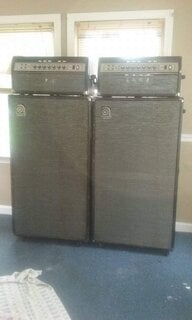
This thing is so effin loud, definitely big stage backline material

never mind the old hippie dude photo bombing my amp pic , don't know where he came from
 
And I don't even ever knew if Ray Brown used Polytone or not. I think he couldn't give a ...

Pretty sure Ray endorsed Polytone, I remember their little plant on North Hollywood in the day.

Also pretty sure that Ray played un-amplified many times, certainly in the early days, and he may not have cared that much about gear; or...maybe he did!:roflmao:

At any rate,
1) He was a fanatic golfer
2) He made some big $$ in Real-Estate investments I understand, in SoCal. Smart man; superb bassist.
 
It's not about cheating physics, it's about taking better advantage of advances in the engineering behind the physics. There was a LOT of potential performance given up in many of the older designs that, had the designers known more, they never would have done that way (me included).

Totally understandable. However, wouldn't the added size and heft affect resonance and timbre to the point of creating an entirely distinctive quality of sound?
 
Totally understandable. However, wouldn't the added size and heft affect resonance and timbre to the point of creating an entirely distinctive quality of sound?
Not necessarily, not if the engineering is done right, though it does open up some additional possibilities IF that's what the designers are interested in.
 
Would it be up to me I would play through the Wall of Sound every night. But even they got tired of lugging that around. Would that I have an SVT and 810, it would stay right where it is because I could never move it on my own. Maybe when I was 20-something, maybe. I moved my Peavey TNT and 15 custom cab. And hated it for its mass. It feels great to play in front of a rig taller than I am. Getting it there and getting it back is teh SuXoRz. Is Big Iron dead? I don't care. I travel as light as I am able and all the happier for it.

They're not as difficult to move as you think, I roll my 8x10 everywhere or use a two wheeler, never lift it and I have a good two wheeler for the head, never lift that alone either, I always get a friend to hoist it on top of the cab, that's the only hard part. The two wheeler goes right down stairs. I throw it all in my Roadmaster Station wagon, goes right in easily.
 
Last edited:
  • Like
Reactions: Michael Schreiber
They're not as difficult to move as you think, I roll my 8x10 everywhere or use a two wheeler, never lift it and I have a good two wheeler for the head, never lift that alone either, I always get a head to hoist it on top of the cab, that's the only hard part. The two wheeler goes right down stairs. I throw it all in my Roadmaster Station wagon, goes right in easily.

My days of hauling heavy gear (with or without band members / roadies / steroid-enhanced jarheads ) are come and gone. The day they show up asking for the privilege to haul my rig is the day I own 80+ kilograms of amp and cabs. All of which is irrelevant to the OP. Big iron dead? There's a big difference between mostly dead and completely dead.
 
My days of hauling heavy gear (with or without band members / roadies / steroid-enhanced jarheads ) are come and gone. The day they show up asking for the privilege to haul my rig is the day I own 80+ kilograms of amp and cabs. All of which is irrelevant to the OP. Big iron dead? There's a big difference between mostly dead and completely dead.

Well maybe they're dead in Ireland but certainly not here. I do see class D rigs here near Boston but I also see big amps.
 
People often forgets it's not only about this. While NEODYNIUM speaker cabs still takes up the same kind of space their weight is reduced by 2/3 more often than not. It's maybe not so much about the actual dimensions as it is about their weight. If someone had to lug around a small dimension digital grand piano that weighted as much as the real thing no one would do that either. It's moreso the weight than actual dimensions.
In fact... I at least tend to look at the cabs differently than the heads; though I will grant you that there are somewhat similar factors driving product development. We all want light weight AND tonal heft, right?

Ten+ years ago, or so, when the micros initially made the scene, I was gigging a Berg NV610 driven by a TE Hexavalve. It was a good rig, plenty toneful. The cab fit in the trunk of my Honda Accord and was plenty easy to move. I was using a Schroeder 15+L for a portable cab, and picked up one of the early Shuttle 6.0's from Jorg here on TB. A couple years later, the Shuttle 9.0 made the scene, and being somewhat impressed by the 6.0, I picked up a 9.0. Surprisingly (or not), in my A/B's with the TE, the Shuttle 9.0 actually sounded as good, and had a bit more power. I let the TE go, and gigged the Shuttle 9.0 on top of the NV610 for a couple of years. It looked kind of funny; but, anyone claiming the micros can't slam should try that rig some time before being categorical.

Few years later, my wife and I became empty nesters and downsized our AZ house. An unfortunate consequence was that the NV610 simply had too large a footprint with our limited (non-existent) AZ storage space. I most reluctantly let the NV610 go, and replaced it with a 2nd AE212. Turns out 2 AE212's fit in my designated closet spot. Anyhow, I completely still miss the NV610; but, 2 x AE212's most definitely will pound on the same level as the fridge. So, for me, the migration to neo speakers has been more about my footprint constraints than anything else. The weight is certainly a BIG plus.
 
So, basically, to the extent that it happened in old designs, it was probably inadvertent, driven by the limits of the technology of the day?
Yes and no. For a long time designers struggled with the tradeoffs required to retain decent high frequency extension while also being able to drive a higher moving mass in order to reproduce extended low frequencies at higher and higher SPL.

A good example of this is the original use of the JBL D/K/E-130 and D/K/E-140 speakers for bass guitar. They have a very nice, player friendly HF extension and worked fine for the low frequency expectations (and power levels) of the day. As the demands for LF extension and SPL increased, along with the increase in power levels that amps were able to deliver, the moving mass had to become heavier, suspension components became more rugged and HF extension suffered. An example of this would be the JBL 2225 speaker, which have MUCH better low end extension and control, power handling, maximum LF SPL but loses almost an octave of HF extension. It used to be that the inductance and HF flux management of a typical ceramic magnet motor was acceptable, but with the additional mechanical LF rolloff of the heavier moving mass (and cone composition and other aspects of more modern drivers) designers were looking for ways to offset these losses.

The Neo motor, due to the placement of the magnetic slug (rather than a ceramic ring) and the geometry of the structure allowed for additional HF response via reduced HF electro-magnetic losses. Early on in the Neo speaker history, SOME designers went way overboard, which contributed to the urban myth that all Neo speakers were terribly bright and harsh. Clearly, this is not by definition true as there are plenty of other examples by designers who understand the technical and engineering reasons behind Neo motors and speakers, and have made MUCH better choices in the overall design of Neo transducers, and thus the speaker systems that they are used in.

Hope this helps.
 
Well maybe they're dead in Ireland but certainly not here. I do see class D rigs here near Boston but I also see big amps.

There's a big difference between mostly dead and completely dead.

^ Joke. See: The Princess Bride.

I have no clue if big amps are history. Depends on where and when we look? Seems we can add Schrödinger's cat to the Heisenberg discussion.

For me, big amps aren't going to exist on my timelines owing to $AmpWeight + $AmpMass / ($MyStrength +/- $MyRoadies)
 
  • Like
Reactions: bobyoung53

Latest posts