

Enjoy the benefits of a premium membership!
Upgrade Account
-
TalkBass has been independent since 1998. Add your voice.
Create a free account to reply to discussions, view embedded media, and browse with fewer display ads.
Join free Log in
Want zero display ads or expanded classifieds tools? Compare plans.
You are using an out of date browser. It may not display this or other websites correctly.
You should upgrade or use an alternative browser.
You should upgrade or use an alternative browser.
Are you a union member?
- Thread starter neo 7
- Start date
More options
Who Replied?
Philosophically, I think unions make perfect sense in a capitalist economy. Everything is negotiated, not dictated from on high. Don't fool yourselves into thinking your company values you. On the books, you're a liability, not an asset. Companies have their own best interest at heart, not yours. Strength in numbers.
It sounds like you might be suggesting the companies get together for some of that strength in numbers
Michigan?
Home to Detroit and the UAW. I imagine they have issues.
Ok.
"Right to work" state employees earn less than labor friendly states. Can we agree on that?
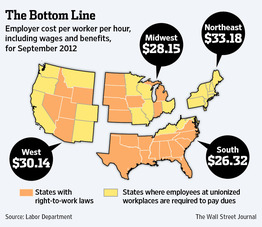
Not claiming causation, but if you look at the map, the more yellow you see (pro union states) the better the pay and conversely, the more "right to work" states the lower the pay.
How about this one?
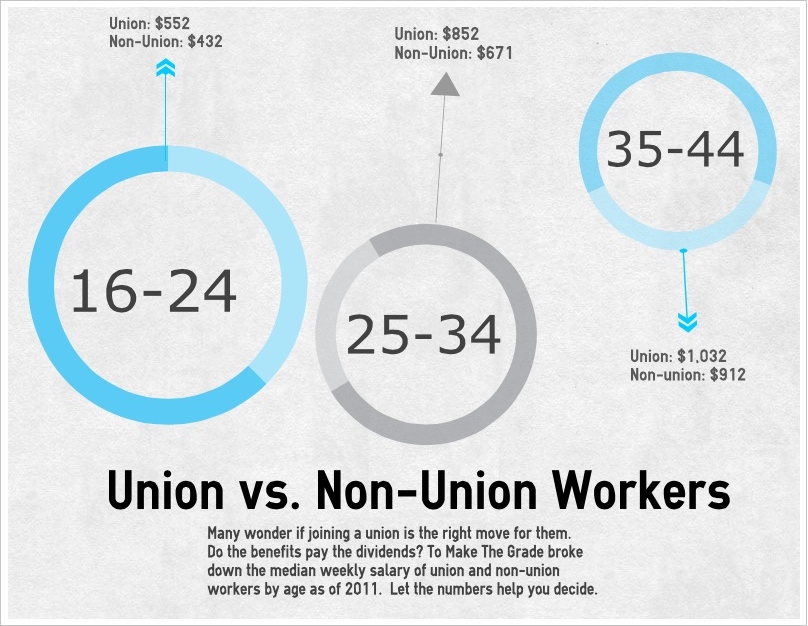
It doesn't show the pay rate of "right to work" states, but union jobs have a higher median pay rate.
We know that manufacturers are moving to states with less labor restrictions as a way of reducing their costs. I don't see how this is extreme conjecture to suspect that as states compete to become more "business friendly" by removing worker protections American workers are getting lower and lower quality compensation as a result.
They also negotiated you a contract that hopefully pays you better than your non-union equivalent and have clear, defined rules that protect you from being treated unfairly.
Just because you're not actively using the union's services doesn't mean you're not benefiting from the work that they've done on your behalf.
I would rather have a job making 60K a year than not have a job making 80K a year.
Business friendly is job friendly

Home to Detroit and the UAW. I imagine they have issues.
I thought you were looking for an example of a right-to-work state, that's all.


That may have been true at that time. But that list is woefully out of date now. The five right-to-work states they cite as having the lowest unemployment rates in the US now rank 30th on average--in other words, a little below average.Invalid Link Removed
Invalid Link Removed

Unrepresented
Something Borderline Offensive
If we tolerate undercutting then yes, business will typically opt to pay their employees $60K rather than $80K. That's my point as well.I would rather have a job making 60K a year than not have a job making 80K a year.
Business friendly is job friendly
That doesn't make that a better salary, that just means that some states are doing a better job at appeasing corporations than others.
China is a race to the bottom. They've got limited demands in terms of environmental standards, workers' rights, minimum wage protections, workplace safety, etc. "Right to work" states are trying to emulate the worst parts of Chinese manufacturing here stateside.
That may have been true at that time. But that list is woefully out of date now. The five right-to-work states they cite as having the lowest unemployment rates in the US now rank 30th on average--in other words, a little below average.
Invalid Link Removed
It's my understanding that the top 3 on your list are clearly right to work states. I'm surprised that Vermont and New Hampshire aren't RTW.
http://en.wikipedia.org/wiki/Right-to-work_law
I thought you were looking for an example of a right-to-work state, that's all.
As I understand that's within the last couple of months. And it's union strong holds like Detroit that are the issue
Unrepresented
Something Borderline Offensive
It's my understanding that the top 3 on your list are clearly right to work states. I'm surprised that Vermont and New Hampshire aren't RTW.
http://en.wikipedia.org/wiki/Right-to-work_law
Why would the Northeast want to reduce its citizens' income levels, pension provision, and healthcare levels?
"Right to work" states are largely the deep south and the mountain region, where incomes are low and they're trying to attract business by offering up their workforce at lower cost.


So 3 of the top 5 are RTW, and 6 of the top 12. In other words, it's pretty much a wash.It's my understanding that the top 3 on your list are clearly right to work states. I'm surprised that Vermont and New Hampshire aren't RTW.
http://en.wikipedia.org/wiki/Right-to-work_law

I would rather have a job making 60K a year than not have a job making 80K a year.
Business friendly is job friendly
the way we are headed you have a job making $20k a year...
Business friendly may be job friendly but that doesn't correlate to labor friendly .
Why would the Northeast want to reduce its citizens' income levels, pension provision, and healthcare levels?
.
So they can still have jobs and pay taxes
So 3 of the top 5 are RTW, and 6 of the top 12. In other words, it's pretty much a wash.
Actually I count 4 out the top five slots. North Dakota South Dakota Nebraska Wyoming. And the top three are all RTW. That isn't my idea of a wash.
Hawaii is an anomaly. The have a huge tourist industry that is a natural resource most states don't have. And except for a few pineapple farms not much real industry.
Not that that's bad but comparing it to another state without these natural resources might not be fair.

Unrepresented
Something Borderline Offensive
So they can still have jobs and pay taxes
The poverty rate in the northeast (labor friendly) is significantly lower than the deep south ("right to work" ). Those states typically rank among the top in median income.
If we're throwing out "anomalies", we'd better toss RTW state North Dakota into the pile, too. Tiny population base/low-density, and the economy is dominated by farms and the oil industry.Actually I count 4 out the top five slots. North Dakota South Dakota Nebraska Wyoming. And the top three are all RTW. That isn't my idea of a wash.
Hawaii is an anomaly. The have a huge tourist industry that is a natural resource most states don't have. And except for a few pineapple farms not much real industry.
Not that that's bad but comparing it to another state without these natural resources might not be fair.


