• TalkBass has been independent since 1998. Add your voice.
    Create a free account to reply to discussions, view embedded media, and browse with fewer display ads.
    Join freeLog in
    Want zero display ads or expanded classifieds tools? Compare plans.
Ash or Alder does it matter to tone?

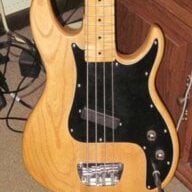
My number one bass is swamp ash...still haven't found another solid-body bass lighter in weight, but heavier in tone.

Big +1! My '84 Peavey Fury (see my avatar) is made of Southern Swamp Ash, and it's the best sounding bass I've ever played. Plus, it weighs only 8.5#.

That said, I also think it's fair to say that there are a number of other factors (especially player, strings, and pickups) that have a greater impact on tone than tonewood.
 
  • Like
Reactions: Lackey and jd56hawk
Im in the market for a p-bass. Does it matter whether it’s ash or alder as far as tone? Thanks!

I would start with do you like how it sounds before thinking about wood. Wood you can choose. Your musical sensibilities for the most part are fixed.

Over decades I’ve had Basses made from mahogany, maple, ash, poplar, babinga, and basswood. Maple necks, rosewood, and wenge. If it was a well made useful instrument that sounded good to me, that’s all that mattered.
 
  • Like
Reactions: Durham52
From Alembic website:
ASH
Ash bodies are popular on many brands of bolt-on basses and guitars, and contributes to the focused midrange that folks who play these instruments enjoy. The effect is the same for Alembic instruments as well, and is greatest on our set neck models. Ash is found in a great variety of densities, and this will affect the tone greatly. The more dense, the brighter and snappier the sound, especially in the upper midrange. Ash is the standard wood for Excel basses, and an optional wood for any Alembic instrument.

ALDER
Alder is the least bright wood we have available for body construction. Not to be used if you are looking for a typical Alembic tone, as the highs are reduced and fundamental sustain is diminished.
 
How the 2 ends of the string (one is the bridge on the body, the other is a fret on the neck) move affects the string's vibration, so yes, the neck and body do (at some level) affect the tone of the instrument.

Is it significant? That we can argue about all day.

Which affects the tone more? That's actually fairly easy to answer - you can (using several different techniques) measure which moves more, and...yes, the neck moves more (actually that makes perfect sence as it's lighter and less stiff). Since it moves more, it affects the string's vibration more, so.... on that basis, the neck matters more.

You can also argue that, strictly speaking, it's not the string's vibration alone that pickups sense. What they pick up is the motion of the string relative to the body - if either one moves, they will pick that up. And of course, both do move. So, yes, they are picking up body vibrations, but again, the string moves more than the body, so it's primarily string motions that they sense.

I think it would be very difficult to design an blind experiment to test the influence of body, so we are likely just left with our opinions. Mine is that you are right, the body influences the movement if the strings in some way. I think that if you put your ear to the body of an unplugged bass and pluck a string, you will hear something about the character of the bass that will be recognizable when the bass is plugged in. I had an ash tele bass years ago that was just amazing. If piezos or contact mics had been available I would have tried to amplify that body sound.

But I don't think that anyone can predict how a specific species affects that sound relative to another, and in fact the people who do think they have definable characteristics don't agree on what those characteristics are.

I also play saxophone, and for that instrument there have been peer reviewed studies, more than one, which prove that the body material does not make an audible difference. Yet there are many people, even top manufacturing cos, who claim that even the plating makes a difference. Or that a bare brass horn sounds different than a lacquered horn.

The question will never be answered. Just get one made of Basswood.
 
  • Like
Reactions: Kubicki Fan
Im in the market for a p-bass. Does it matter whether it’s ash or alder as far as tone? Thanks!

The short answer is no.

The long answer is as follows:

No. The differences between Alder and Ash will mostly only be weight and the appearance of the wood, if you can see it through the finish. Ash bodies will on average be a little heavier, so if I have a choice of Ash for a reasonable upcharge, I'll usually choose Ash. Because I tend to prefer heavier bodies for balance reasons.

So just pick whichever body wood you like on the preferred instrument. Eg. whichever one looks better to you and has the desired weight (or lack of weight).

As for which P bass, of course, that's a whole nother topic... I have two Fender Tony Franklins and they've more or less ended my GAS for any other P bass. I don't remember what the wood type on the body is (I believe it's Alder but I'm drawing a blank right now. Looks like Alder).

L
IMG_9508.jpg
 

Attachments

  • IMG_0442.jpeg
    IMG_0442.jpeg
    905.1 KB · Views: 28
Well, I wasn’t going to weigh in here, given the plethora of comments, but I am going to jump in. As some have said, sure - body woods and neck woods DO make subtle but definite differences in overal sound/tone of the bass. But, so do pickups, preamps, strings, nuts, frets, bridges - and something I don’t think anyone mentioned - THE PLAYER! Now add the amp, speakers, cord. SO many variables, do the woods wind up really impacting the sound? Eh, maybe a touch. But, I say, buy what you like, consider weight if you want/need to and just enjoy. The best bass is the one you play a lot - and that makes you smile and want to play that extra song or practice that extra 10 minutes... (drop mic).
 
  • Like
Reactions: Lackey
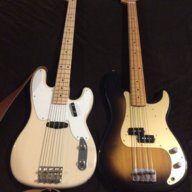
I have 2 P's. One is a 2011 60th Ann. model, which is ash, I believe, with a laquer finish. The other is a 2000 MIM model, which us alder, I presume, and poly-finished, I presume.
Both basses are exactly the same electronically; pickups, pots, caps, jack.
Both basses have the same strings, same gauge.
The MIM Bass has always sounded better to me.
Since the pandemic, I have been playing with headphones. I am always picking up the MIM, and once a week or so, will pick up the American just to check my brain.
I give the nod to the MIM. It sounds so much better to me; so much so that I instinctively play better.
The ash model is noticeably lighter.
Go figure.
I could swap necks to compare, I suppose., and I guess I would if somebody paid me $100 for my time.
The CAR American is my beauty queen and my MIM is my clydesdale.
It is what it is. I won't sell either one. Nobody would know which was which in a live, amplified band setting, but I know, and that's what counts.
 
  • Like
Reactions: Jim C
I think a lot of people really want wood to effect the tone in a significant, predictable way. Not just part of the equation, but “wood X necessarily provides tone Y, and the up charge I spent on wood X is worth it.”
 
  • Like
Reactions: lomo
My experience with swamp ash is that it is freaking heavy.
Ash is a wood with highly variable density. If you have a very heavy bass, it may be ash, but it’s not swamp ash. Swamp ash is selected for low density ( it typically comes from low on the tree). I have some basses made from swamp ash. One is 6.6 pounds, the other is a five string that’s 7.1.
 
Ash is a wood with highly variable density. If you have a very heavy bass, it may be ash, but it’s not swamp ash. Swamp ash is selected for low density ( it typically comes from low on the tree). I have some basses made from swamp ash. One is 6.6 pounds, the other is a five string that’s 7.1.

I was about to say the same thing. Northern ash can get really heavy, but most of my lightest basses have been swamp ash.
 
  • Like
Reactions: Lackey

Latest posts