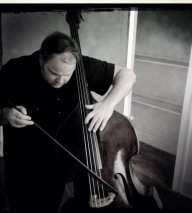
hmm... i've been working on this suite for a couple months now and have come up with some fingering ideas that i'm not seeing here. i played all of suite 3 for my senior recital (in G, as is standard i believe), which i worked on for over a year, and doing so honestly solved most of the issues in suite 1 before i ever got to them.
first off, the whole thing is playable at pitch with absolutely no changes. that's the way i'm working on it and while some passages are not easy, it's not all that difficult either. pizzacato may be a little strange in this register, haven't tried it that way.
all the broken chords that resemble the first bar can be played with open G, then the next note on the D string, so as to let the G ring out and have the open impression you hear on the cello. This is also the way that i play the 4th bar (no cheating with the g harmonic! i think it ruins the sound, and isn't all that much easier). this also requires the use of thumb position in the lower register for the C chord near the middle of the piece (i play it 0G-2C-1E-TD-1E, etc.)
the scales after the fermata i play all in thumb position with the exception of the one that starts on A - i shift to the A harmonic and play it all on the D string, catch the low A with the thumb (on the D string) making it easy to musically finesse the G-F#-E that follows.
the only other thing worth mentioning is the last few bars. i use the G harmonic, shift back to 2B and thumb on the D harmonic, then shift up to the G harmonic again and play the B's with 1. The next bar uses the same idea - play the G harmonic, shift back to 1A-TD, shift up to G and play the A harmonic with the thumb on the D string. sounds crazy, but it totally works for me. took a lot of practice, but well worth it for the quality of sound. In the last two bars, i shift back to 2 on the F# harmonic on the D string (a tritone down from the C), play the C with 3 and the D with the thumb (all in one position, no ****!). if you use the F# harmonic, be aware that the C will have to be low to be in tune with the F#. The low C sounds fine with the D, and the F# sounds great as a low leading tone because the G resolution is displaced down an octave. the final chord, i use the open G, and shift up to first finger B and harmonic G for the 6th. I take this chord in two bows. If you time it right and roll the chord, you can really make a big sounding chord! It's a difficult shift up to the B, but if you worked it out 3 bars earlier, it's not much more difficult. intonation is just more exposed because of the double stop. i figure that exposed intonation is just an opportunity to learn to play better in tune anyways.
i really hope this makes sense. this is unfortunately off the top of my head, as i don't have the music available at the moment. if anyone tries this and has success, let me know. i've never seen anyone else use these fingerings exactly, but i'm sure it's been done plenty of times.



 (hint - not anything like R Kelly is doing, and there's no wig involved)