• TalkBass has been independent since 1998. Add your voice.
    Create a free account to reply to discussions, view embedded media, and browse with fewer display ads.
    Join freeLog in
    Want zero display ads or expanded classifieds tools? Compare plans.

BAII Conundrum, Please help

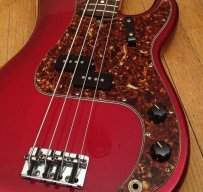
Ok, long story short, I bolted a BAII bridge i got for Christmas onto my bass without filing the slots at all, because my teacher had told me to (he apparently didn't know that they're unslotted). I then realized that I've gotta file slots for the best results.

I do not want to pay for this to be done, I would rather do it myself for future reference.

I found this, and was thinking of following these instructions

[Invalid or Expired Link Removed]

However, this method requires making various measurements of the original bridge and filing the BAII BEFORE installing.

What do I do? Do I reinstall my old bridge, make measurements, and proceed? Or could this damage my bass?

Any other suggestions?

Thanks
 
Seriously, it makes very little difference where the notches are. You can let the strings lie where they will fall naturally, and notch them there. The strings will be perpendicular to the frets no matter what, and you string spacing will be fine. Setting the action and intonation are the important parts. The reason they don't have notches from the factory is so that you can place the strings in the optimal position for the pickups. If that isn't possible, then you need to use your best judgement.
 
Plenty of math here.

1. Locate the outside string slots by positioning them so that there is a 1/8" margin along the edge of the fingerboard from nut to the end of the fingerboard.
2. Mark the outside of the string.
3. File a thin notch centered between the lines in the outside saddles to hold the strings under light tension.
4. Measure the distance between the outside strings.
5. Add the thickness of the inside strings.
6. Subtract the number from step 4 from the number in step three.
7. Divide this number by the number of inside strings plus one, i.e. a four string instrument has two inside strings so two plus one equals three.
8. The resulting number is the distance between each string.
9. Once you've accomplished this, use the dial calipers to hold each inside string apart from the outside string.
10. Mark the position on either side of the inside strings. File small notch between the lines.

At this point, if you're happy with what you see you can deepen the slots to half the depth of the strings. Utilizing a small notch at the beginning of the process will give you the ability to shift a miscalculated string position.

Ideally, the tools needed are nut files, dial caliper, pencil, pad, and calculator. That's about a hundred US dollars. If you're only going to do this one time it is probably not cost efficient.

This is an advanced technique. As always, if you are not seriously handy, have to look in the kitchen to find your tools, or think the stuff from Harbor Freight is totally awesome, please take your instrument to a pro.
 
Plenty of math here.

1. Locate the outside string slots by positioning them so that there is a 1/8" margin along the edge of the fingerboard from nut to the end of the fingerboard.
2. Mark the outside of the string.
3. File a thin notch centered between the lines in the outside saddles to hold the strings under light tension.
4. Measure the distance between the outside strings.
5. Add the thickness of the inside strings.
6. Subtract the number from step 4 from the number in step three.
7. Divide this number by the number of inside strings plus one, i.e. a four string instrument has two inside strings so two plus one equals three.
8. The resulting number is the distance between each string.
9. Once you've accomplished this, use the dial calipers to hold each inside string apart from the outside string.
10. Mark the position on either side of the inside strings. File small notch between the lines.

At this point, if you're happy with what you see you can deepen the slots to half the depth of the strings. Utilizing a small notch at the beginning of the process will give you the ability to shift a miscalculated string position.

Ideally, the tools needed are nut files, dial caliper, pencil, pad, and calculator. That's about a hundred US dollars. If you're only going to do this one time it is probably not cost efficient.

This is an advanced technique. As always, if you are not seriously handy, have to look in the kitchen to find your tools, or think the stuff from Harbor Freight is totally awesome, please take your instrument to a pro.
Thanks!!!

Might have to take this to a pro lol...
 
here's the math you actually need to know:

a replacement set of BAII saddles are a good $30-$40. (once you've cut a notch in the wrong place you can't "un-cut" it.)

a set of the proper bass nut files you'd need to cut nice round slots are at least that much.

you'd need to try this at least a few times to learn how to do it.
 
I'm gonna take it to GC. Yeah, I know, it's guitar center, but the pro luthier i contacted quoted me $130 for a setup and filing. GC said $45.

Keep in mind this is a Squire modified vintage jazz bass, which is $300. I don't wanna spend to much on it.
 
i'd be nervous about what i was getting for $45. if the slot is cut in the wrong place it's cut in the wrong place.
Actually it's 30 for the setup (cause i have a bowed neck right now) and 15 for the slotting.

Should I maybe go to the luthier from before for the slotting? He said 35 for slotting, 85 for a setup (I would have done this but they raised the prices on me when I got to the place).
 
Actually it's 30 for the setup (cause i have a bowed neck right now) and 15 for the slotting.

Should I maybe go to the luthier from before for the slotting? He said 35 for slotting, 85 for a setup (I would have done this but they raised the prices on me when I got to the place).
man, it's a tough call.

sight unseen over the internet, the obvious answer is "go to the luthier to get it done right". the thing is, the guy at the GC could be a great bass player who's set up his own instruments for years while the luthier could be a guy who builds classical guitars and hates electric instruments of any kind.

i guess the thing to do is call each one and ask him about how he does it, so you can try to get a feel for whether they're into basses and know what they're doing.
 
man, it's a tough call.

sight unseen over the internet, the obvious answer is "go to the luthier to get it done right". the thing is, the guy at the GC could be a great bass player who's set up his own instruments for years while the luthier could be a guy who builds classical guitars and hates electric instruments of any kind.

i guess the thing to do is call each one and ask him about how he does it, so you can try to get a feel for whether they're into basses and know what they're doing.
I know for a fact that the luthier makes basses. They specialize in this kind of thing, even pointing out to me that I needed my bridge slotted (I'm a complete newbie).

I think I'm still gonna take it to GC tomorrow and get it set up. Then prolly the luthier for the bridge.

I'll talk to the guy at GC though
 
if so, save your money, get it done once and done right by the bass maker guy. paying for a "setup" when the slots aren't cut and the strings are sliding around on the bridge is a waste of your money.

a real pro set up by a master will make your bass play better than it ever could otherwise.
 
if so, save your money, get it done once and done right by the bass maker guy. paying for a "setup" when the slots aren't cut and the strings are sliding around on the bridge is a waste of your money.

a real pro set up by a master will make your bass play better than it ever could otherwise.
Dang man, I understand, I just don't know...I mean, true, it is a one time thing, but their setup price went from 65 on the phone to 85 at the place. That kinda put me off.

So a setup at GC and then filing by a pro wouldn't make sense? They kinda go hand in hand then?

Thanks for the help
 
You don't need to take measurements. You just place the slots such that the strings line up with the pole pieces on the pickups.

Good god, NO.

I'm gonna take it to GC. Yeah, I know, it's guitar center, but the pro luthier i contacted quoted me $130 for a setup and filing. GC said $45.

Keep in mind this is a Squire modified vintage jazz bass, which is $300. I don't wanna spend to much on it.

$130 seems reasonable for a good setup and a BadAss filing, especially if the guy is good. GC is, well... mostly populated by kids who don't know very much. You really want a minimum wage employee working on your instrument? You want fries with that?

On the GC techs: recently GC setup a repair program, specifically designed to try to put real techs out of business. Their pricing scheme is this: find the cheapest guy in town, then undercut them - even if that tech was working out of that GC location! Then they took some guitar sales people, "trained" them for a few hours, and let them loose on the world as "certified techs". The tech at my local GC is a good guy, but he doesn't know how to do anything. They won't even LET him file nut slots!