• TalkBass has been independent since 1998. Add your voice.
    Create a free account to reply to discussions, view embedded media, and browse with fewer display ads.
    Join freeLog in
    Want zero display ads or expanded classifieds tools? Compare plans.

Band looking to go IEM. Need advice.

Sep 14, 2016
2,380
5,963
My band is looking to go IEM. I’m looking for some basic knowledge/recommendations. For instance, what are all the pieces I need to pull this off? And how does it typically interface with the house PA on stage?

Something with individual mixes is preferred. I’ve heard there’s units that let you Bluetooth your phone and set your own levels remotely?

Not sure if it matters, but I’m looking at 5 users… 3 guitar/vocals, bass, drums.

Thanks
 
Having done it, I think this video gives what seems like a decent overview, and there are others like it. I'd suggest trying to gather up as much of a basic understand as you can from these kinds of videos and reading posts that have already been made, and then (re)start here with more specific questions. Surely other people will reply, so with very detailed explanations, but when the question is broad, responses can get unwieldy.

 
Last edited:
Getting individual mixes is a matter of your PA, not the IEM. Whatever your mixer can send to a wedge, you can send to an IEM, and whatever you can't, you can't. What an IEM means is that instead of sending the signal to a wedge, you send it to a transmitter, and band members wear a receiver (typically on their belt) and a set of earbuds. If you have a digital mixer, like a Behringer XAir or a Soundcraft Ui16 or something, it's possible for band members to access it with their phones and adjust their individual settings - but again, that's the mixer, not the IEM, they could do the same thing if they're on wedges.

Mugshot Monday does this the cheapest way I know of, using XVive U4s. We get individual mixes from our system but it's analog rather than digital so we can't do our own adjustments. The U4 works fine for us, the main thing to be aware of is that it runs on the same frequencies as cell phones and stuff so it's vulnerable to interference.

You want quality earbuds to monitor with. You can spend hundreds or even thousands on custom ones, and it's worth it, but to start out something like Shure SE215s will work - you want sound isolation and decent audio quality.

One other thing - it's a good idea to set an additional "ambient" mic to pick up the room. Run its signal ONLY to the monitors, not to FoH. The most common complaint about going to IEMs is feeling isolated, and the ambient mic helps with that. Once you get it mixed in right, IEMs are a huge improvement, you can hear everything more clearly and control volume so you're not making yourself deaf.
 
My band is looking to go IEM. I’m looking for some basic knowledge/recommendations. For instance, what are all the pieces I need to pull this off? And how does it typically interface with the house PA on stage?

Something with individual mixes is preferred. I’ve heard there’s units that let you Bluetooth your phone and set your own levels remotely?

Not sure if it matters, but I’m looking at 5 users… 3 guitar/vocals, bass, drums.

Thanks

Congrats! Once you get used to them (which takes a little time) you will really enjoy them, I think.

A few questions.... (The answers will help us help you.)

1) What does your monitor mix look like now? How many mixes/channels?

2) What kind of mixer do you currently use?

3) Does your band jump around the stage? Or are each of you pretty much in a small(ish) area? (Like a ten foot circle each or less).

4) Roughly, what's your budget?

5) What's your collective experience with production matters? How tech savvy are you?
 
Last edited:
  • Like
Reactions: _Some Dude
xair_rack_front.jpeg


This is our IEM Rack.
Essential bits from the bottom up:
-T.racks Signal Splitter Eight + Mulitcore
-Behringer X-Air 18 mixer
-IEM units

Luxury bits:
-Fisher Amps battery charger
-19" WiFi Router

The idea is simple:
All the signals come together on the signal splitter. We can make do with 8 of them because we use electronic drums. When your acoustic drum kit needs more mics, you need more channels.
One path of the splitter is connected to the multicore that comes out of the back will go to the stagebox for FOH, the other path is connected to the X-Air 18 inputs.
The Aux outputs connect to the IEM units.
If you want to run stereo mixes, you'd need 10 Aux outputs, which would probably mean that you'd have to get something like the X32 rack unit. If you want to run mono, two people can share one sending unit.
 
A few questions.... (The answers will help us help you.)

1) What does your monitor mix look like now? How many mixes/channels?

Non existent.

2) What kind of mixer do you currently use?

It’s a Yamaha 16 channel. Not sure the model, but looks similar to the MGP stuff on their website.

3) Does your band jump around the stage? Or are each of you pretty much in a small(ish) area? (Like a ten foot circle each or less).

I think we can wire everyone except the lead singer, who doesn’t wear his guitar the entire time. Some of these stages well be lucky if the entire band isn’t within the same 10 foot circle, but they’re the best venues.

4) Roughly, what's your budget?

Not well defined at this point. I threw out some costs based on what I saw in the videos above and no one broke out sweating.

5) What's your collective experience with production matters? How tech savvy are you?

I can handle the tech side. Production I normally leave up to the soundman but I know enough to not be terrible at it. When I first started this thread an IEM rig was this mystery black box with headphones. Now that I see it’s a splitter, mixer and (if required) individual sending units it’s pretty straight forward.


Basically, this is a project that’s been on ice for two years because of COVID, and I’m a replacement for the bassist that went crazy on them. I did a count last night of 14 inputs (3 vox, 3 guitar, bass, 7 drum). First gig is coming up around the end of June.

The singer has assembled a PA (tops and subs) during the downtime, but it has no monitors yet. He was looking at floor wedges, but asked the band what we thought about IEM. One of the music shops in town will swing him deals. I’m doing the research.

I’ve suggested that the band all chip in on the splitter, mixer, and cabling, and that each individual be responsible for their own headphone and (if required) sending unit. I pitched the X Air 16 and they were receptive. The singer already knows what sending unit he wants (Shure), and most of the others were pretty happy when they found out they could be wired for a fraction of the price, which has opened some headroom on other purchases.

Are their other options that provide a similar functionality? The big selling feature for me is the ability for individual users to control their own mix.

Any recommendations on the part that actually goes in the ear?
 
Are their other options that provide a similar functionality? The big selling feature for me is the ability for individual users to control their own mix.

Any recommendations on the part that actually goes in the ear?

When I was putting a PA together, I went for the Soundcraft Ui rather than a Behringer XAir, simply because I use an android phone and Behringer only worked with iPhones, the Soundcraft could work with either. That was a few years ago so check if it's still true. Also Soundcraft's feedback cancellation was a lifesaver for a noob like me, again I don't know if Behringer has the same feature.

I think I mentioned earlier, but a good starting earpiece is the Shure SE215. Does the job and not too pricey. I could do just fine with them on a gig, but lucked out that my sister bought me a set of Alclair customs in thanks for JP'ing my nephew's wedding.
 
1) What does your monitor mix look like now? How many mixes/channels?

Non existent.

2) What kind of mixer do you currently use?

It’s a Yamaha 16 channel. Not sure the model, but looks similar to the MGP stuff on their website.

3) Does your band jump around the stage? Or are each of you pretty much in a small(ish) area? (Like a ten foot circle each or less).

I think we can wire everyone except the lead singer, who doesn’t wear his guitar the entire time. Some of these stages well be lucky if the entire band isn’t within the same 10 foot circle, but they’re the best venues.

4) Roughly, what's your budget?

Not well defined at this point. I threw out some costs based on what I saw in the videos above and no one broke out sweating.

5) What's your collective experience with production matters? How tech savvy are you?

I can handle the tech side. Production I normally leave up to the soundman but I know enough to not be terrible at it. When I first started this thread an IEM rig was this mystery black box with headphones. Now that I see it’s a splitter, mixer and (if required) individual sending units it’s pretty straight forward.


Basically, this is a project that’s been on ice for two years because of COVID, and I’m a replacement for the bassist that went crazy on them. I did a count last night of 14 inputs (3 vox, 3 guitar, bass, 7 drum). First gig is coming up around the end of June.

The singer has assembled a PA (tops and subs) during the downtime, but it has no monitors yet. He was looking at floor wedges, but asked the band what we thought about IEM. One of the music shops in town will swing him deals. I’m doing the research.

I’ve suggested that the band all chip in on the splitter, mixer, and cabling, and that each individual be responsible for their own headphone and (if required) sending unit. I pitched the X Air 16 and they were receptive. The singer already knows what sending unit he wants (Shure), and most of the others were pretty happy when they found out they could be wired for a fraction of the price, which has opened some headroom on other purchases.

Are their other options that provide a similar functionality? The big selling feature for me is the ability for individual users to control their own mix.

Any recommendations on the part that actually goes in the ear?

Honestly, the X Air 18 is only a few more bucks. Then you can forget the splitter and use one tiny mixer for bot front of house AND monitors. Carrying two mixers these days seems like a hassle, especially when we're literally talking about $150 difference between the 16 amd 18. We have the M18 (Midas version). I run my monitor mix from my phone. I LOVE it.

The Behringer P2 for $45 is an excellent hardwired monitor pack.

Wired is the way to go. I have a wireless bit rarely use it.
 
Are their other options that provide a similar functionality? The big selling feature for me is the ability for individual users to control their own mix.

Just addressing this aspect, there are several options to the Behringer/Midas X Air. There are popular models with the same by Soundcraft, Allen & Heath, Mackie, Zoom, Presonus (Possibly another/others that I'm not thinking of for some reason).

Your main concern is the number of inputs and outputs. From your channel count, you'll have 5 (or 6) on IEM's?
Unless you'd be willing to have some shared IEM mixes (which is sub-optimal to undesirable but workable), your mixer needs to have enough aux outputs. It sounds like sometimes you'll be running mains and sometimes this will be an IEM rig split to FOH, so the mains outputs won't be available for an ear mix.

That being the case, you'll need to keep your consideration to models with 6 or more aux outputs.

Another consideration pointed out by @hrodbert696 is the android vs iOS support/preference.
 
Honestly, the X Air 18 is only a few more bucks. Then you can forget the splitter and use one tiny mixer for bot front of house AND monitors. Carrying two mixers these days seems like a hassle, especially when we're literally talking about $150 difference between the 16 amd 18. We have the M18 (Midas version). I run my monitor mix from my phone. I LOVE it.

The Behringer P2 for $45 is an excellent hardwired monitor pack.

Wired is the way to go. I have a wireless bit rarely use it.

If I go this route, I assume I’ll still need a splitter if I patch into the venue’s FOH? I think this is an easy sell, but if I need the splitter I want to order it as part of the initial build.


And I appreciate everyone’s comments. I’m making notes as I go. I’ll probably post a proposed list once I’m ready to purchase and have you guys go over it to make sure I’m not doing anything stupid.
 
Just addressing this aspect, there are several options to the Behringer/Midas X Air. There are popular models with the same by Soundcraft, Allen & Heath, Mackie, Zoom, Presonus (Possibly another/others that I'm not thinking of for some reason).

Your main concern is the number of inputs and outputs. From your channel count, you'll have 5 (or 6) on IEM's?
Unless you'd be willing to have some shared IEM mixes (which is sub-optimal to undesirable but workable), your mixer needs to have enough aux outputs. It sounds like sometimes you'll be running mains and sometimes this will be an IEM rig split to FOH, so the mains outputs won't be available for an ear mix.

That being the case, you'll need to keep your consideration to models with 6 or more aux outputs.

Another consideration pointed out by @hrodbert696 is the android vs iOS support/preference.

Currently, 5 on IEM, although it would be nice to not be maxed out on capacity.

If I understand the pic correctly (haven’t dug through manuals yet), the XR18 recommended above can do 2 mains and 6 Aux outs?

Behringer X Air XR18 18-channel Tablet-Controlled Digital Mixer
 
  • Like
Reactions: drpepper
Would this work/is the quality sufficient? And I assume I’d need two of them?

Behringer Ultralink MS8000 Microphone Splitter

Yes and yes, but you would need snake cables or deal with bundling your own (or deal with a spaghetti pile).

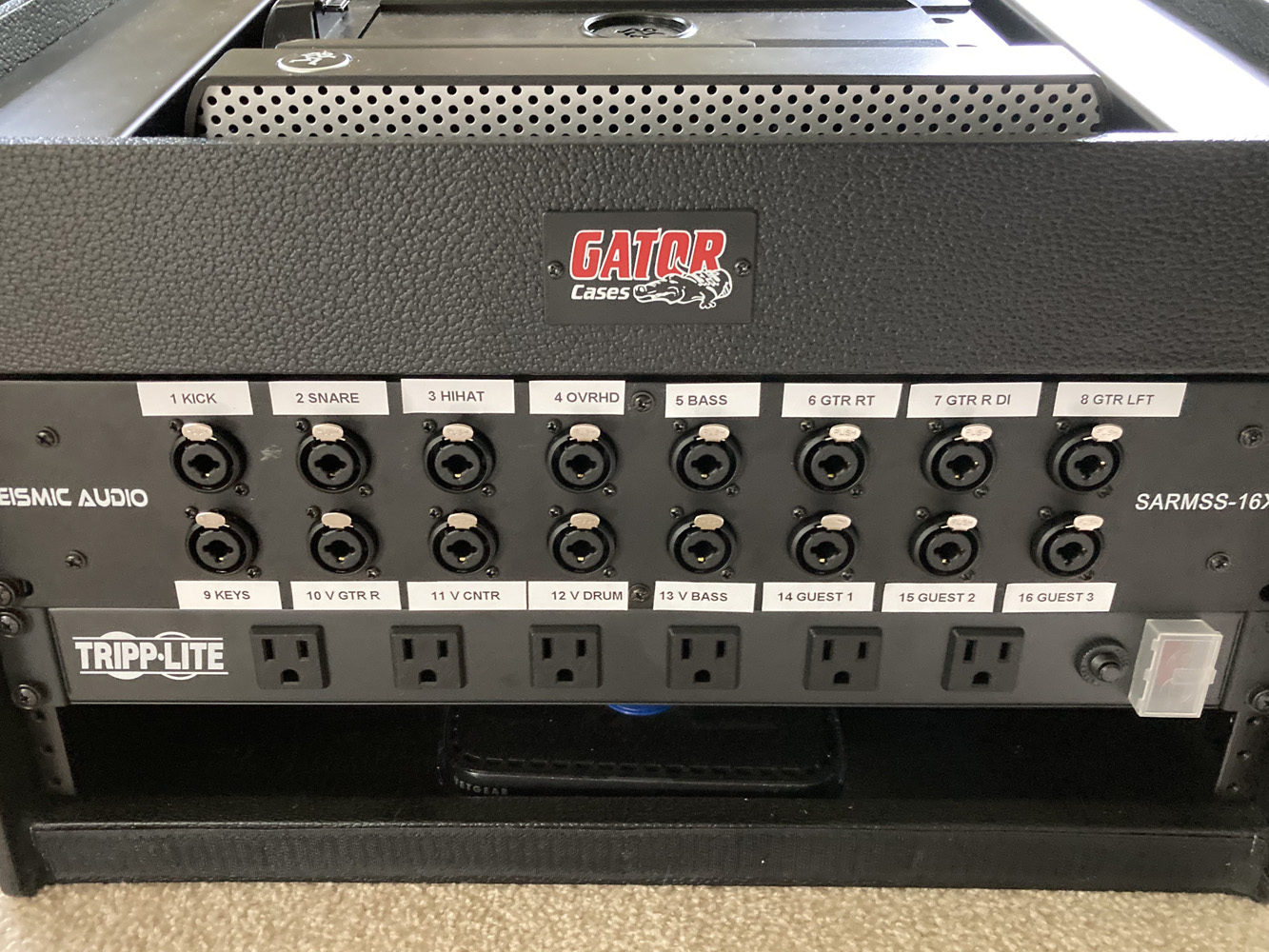
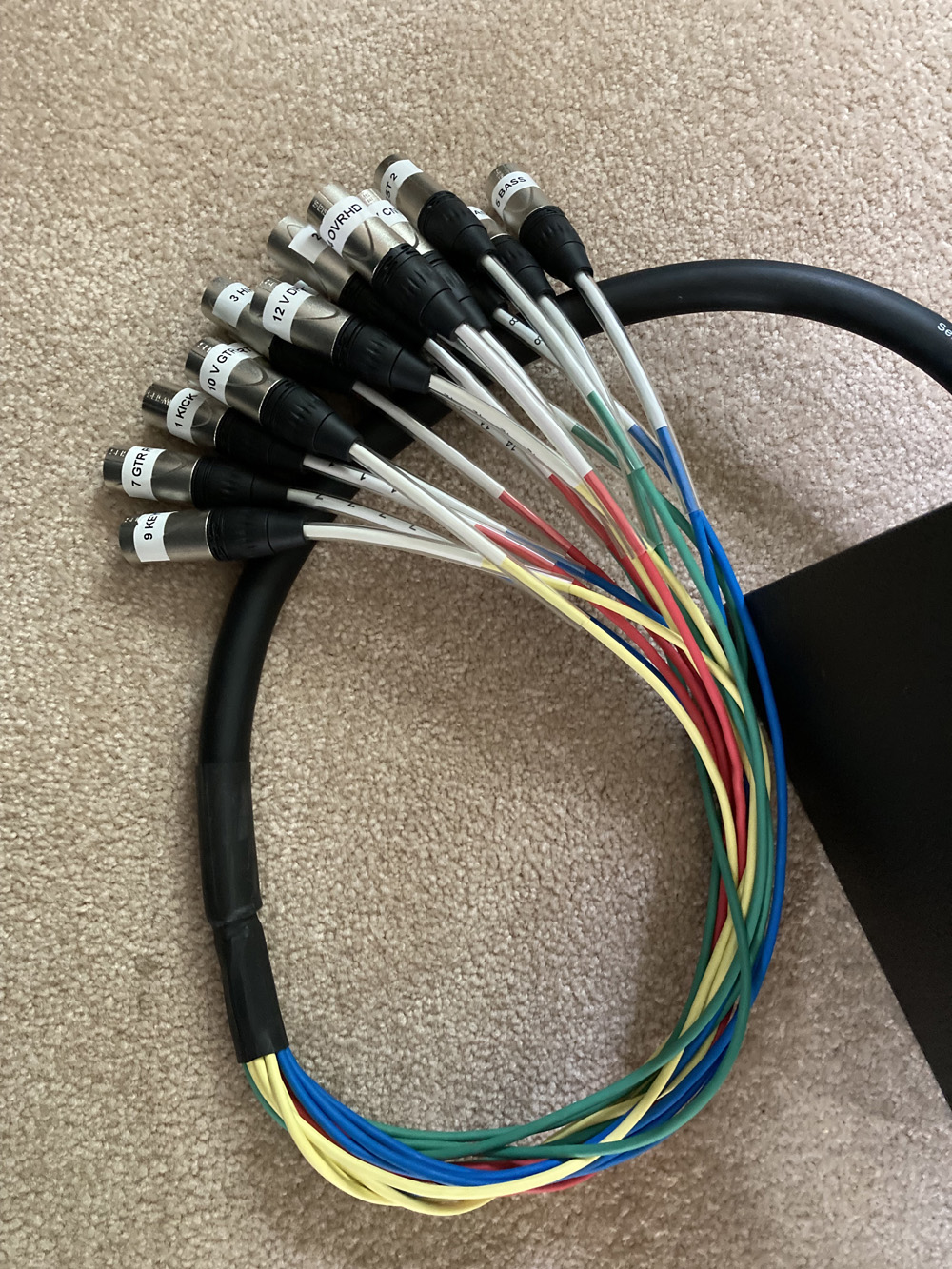
You might consider a rackmount splitter snake. I have one from Seismic Audio with 5 and 15 foot tails.

SARMSS-16x515 - 16 Channel XLR TRS Combo Splitter Snake Cable - 5' and 15' XLR trunks

I caught it on sale and from Amazon for ~$160. 5 feet is obviously more than needed to go from the splitter to the mixer inside the rack case and the 15' tail has been more than needed 90% of the time. When working with house sound, we ask where they want the IEM rig to go and they run it to a stage box (and less frequently run a split to it). It's varied, but on/next to the drum riser where the monitors would be has happened a few times.

This has come up in a recent thread where Seismic Audio was view negatively. Higher tier brands like Caldwell Bennett and Whirlwind are ~$600 and there's a middle of the road brand that has a price that splits the difference (no pun intended).

A note that I learned along the way is that you can run any channel order that you want, but it can be helpful/appreciated if you group and order/label your splitter inputs by the order that is used as a standard. There can be some variation...some people do slightly different orders, and you don't skip channels for things that don't apply to you. If you work with certain people regularly, I'd suggest checking with them as you're setting things up and do a google search for "standard mixer input order". The rough order of groups for a typical 4-5 piece rock band are 1 - Drums (kick, snare, hi-hat then others depending on what's mic'd) 2 - Bass 3 - Guitars 4 - Keys 5 - Vocals (often ordered from stage right to stage left so the channels visually match from FOH and they don't need to spend time on who's who when mixing). 6 - Other.

(we only run 4 drum channels on the splitter, and no one has them all in their mix...other drum mics just bypass the splitter and go directly to the stage box or stage inputs)

IEM2.jpg


IEM3.jpg
 
Last edited:
The fundamental challenge here is there are TONS of options.. with mixer alone. Add in mono vs stereo, house splits, etc... and it can be a mess!
We have X32R - same nbr of AUX busses as XR18, but I added an SD8 to the rack to give us 24 inputs and 16 output busses, so we can run multiple sets of STEREO IEM's.
We have 3 stereo IEM's, one DP48 mix that connects via AES50 (CAT5 cable); one guy on a wedge, and drummer (depending on WHICH one we have) on a P16M [using Ultranet] or MONO or STEREO feed (from SD8). Each of us has full control of our monitor mix via phone or tablet (see Router in pic)
I run FOH when we send MAIN outs to House, and mute mains and mute groups during breaks!

For House provided PA gigs..
1. We take a split from House - assuming they have a split feed, mapping their inputs to ours. So Kick might be #9 on the splitter, but goes into #1 on the X32.
2. We use our 16-ch splitter snake to feed the house. Same thing as 1. above. Kick goes into #1 on splitter box, then #1 on House split goes to #9, and #1 on our split goes to #1 on X32.
3. We connect everything up to the X32R and send MAIN OUTS (7/8) to House.

Here's a pic of our OLD (-1) setup. One wedge replaced by DP48 w/ AES50 connection.

IEM_Split_Config.png
 
Friends don't let friends use the Shure 215 buds. Get some KZ's from Amazon.

I wish we could bury this meme already. The ZS10s punch above their price point, but are large and have a thick nozzle, not going to fit everyone. Stock cable and tips are not great, so more $$ required there (Comply T-500 foams fit).

I've recommended the SE215 to many people with universal satisfaction. They're small and light, and come with a variety of tips to get a good fit and seal for most people. The included cable is shared by Shure's entire pro IEM range, and is of good quality. They don't sound great at high volume, though, so you need to be careful with your monitor mix.

I advise people to put in their monitors only what they need to hear, rather than what they want to hear. The less stuff you put in, the clearer the mix. For most people, this is their own instrument/vocal, some lead vocal, and backing tracks. Maybe a little bit of one guitar if you don't get enough bleed from stage amps (or if using modelers).

You can usually hear drums just fine on a small club stage, but you can add a little of the overhead that picks up more hi-hat, if needed. It's the same thing with low frequencies, don't try to compete with stage rumble. If you must have kick or bass, high-pass it. Just search for some Muse IEM mixes on YT and note how light on bass they are.

Would this work/is the quality sufficient? And I assume I’d need two of them?

Behringer Ultralink MS8000 Microphone Splitter

No experience, but many complaints about low-quality connectors and picking up EMI in reviews. Probably does the job, but doesn't exactly inspire confidence.
 
Good advice here already. I would only add: don't overlook the Presonus mixers, and get a good router. I use a rack mount splitter box and find that on the small stages we play on I don't need a splitter snake. I put the mixer rack next to the drums and everyone runs their XLRs there, and then the house snake can be placed next to the rack. If you play on larger stages then a splitter snake may be more useful, though.
 
Friends don't let friends use the Shure 215 buds. Get some KZ's from Amazon.

This is not an affiliate link.

Amazon.com : kz zs10 pro

I think that's rather hyperbolic and pretty unhelpful in this context. Many people are well served by the SE215, and by most measures, it can generally be described as a "good" or "decent" IEM at its product line tier, price point and for it's designed uses. It's an unfortunate bent of forums that hype and buzz from a handful of the most vocal members drown out comparative reason and create the appearance (and ultimately "forum fact") that because X can be judged, often on subjective bases, better than Y in some aspect or aspects, that this means that Y is necessarily bad and should be run down.

Most of the chi-fi IEMs are designed for general/consumer use. That some have found favor and been adopted for use in live music performance as entry-level, ultra-budget choices is just a happy coincidence. That various chi-fi IEMs are necessarily, hands-down superior to the SE215 for live music is simply an opinion, and I believe in broader terms than forums or youtube videos, it's a minority opinion, and further, where some objective measure apply, it's not arguably supported by facts.

Fit is a subjective matter, but it's very high in terms of relative importance pretty much across the board...it doesn't much matter how particular IEMs sound if they don't fit or are uncomfortable, and fit also can impact performance. The SE215 has a relatively small shell and small diameter nozzle. In being "universal," these aspects give them a better chance of providing a good and comfortable fit in more ears than the larger, large nozzle KZ ZS10. Does this mean that no one will find the KZ to be comfortable or even prefer its fit? No, it means that more people will find find the Shure to fit better and potentially work better on that basis. Personally, while I don't find the KZ ZS10 shape to be flatly uncomfortable, I find that relative to Westones that are similar in form factor to the Shures (both shell and nozzle size) they are bulky and constantly felt.

By design or by happenstance, the relative levels of isolation impact performance. Again, this can be a subjective matter with objective aspects. One source I found puts the measured outside sound reduction at -24.6 dB for the SE215 and -16.5 dB for the KZ ZS10 Pro. That's quite significant. And further, isolation varies with frequency, and in lower frequencies, the KZ's rejection of outside sound is virtually non-existent (only -2 dB). This means that the sound profile is going to fundamentally change based on the level and type of outside sound. Because live music limits the ability to closely A/B IEMs, listening to recorded music is a typical comparison method. These different levels of isolation have very different impacts on comparison made when listening to recorded music in a quiet room versus a stage with amps and drums in a room with a PA.

The unavoidable fact is that to approach the same relative levels in stage use, the KZ will have to be run at a higher level, which is opposite of the usual goal of minimizing IEM levels and in my opinion pretty much eliminates potential sound quality differences in listening to recorded music. As with fit, this does not mean that no one will adjust to, work with and feel well served by that level of isolation. Actually there is the perfect setup for this to happen. For me, it's easy to envision that many people become enamored with some of these IEMs because of recorded music listing comparisons, reviews (based on recorded music listing comparisons) and forum hype (also largely based on recorded music listing comparisons), that by the time they are using them to play live music, they are simply primed to hear them as being awesome and they end up not realizing that the lower level of isolation is actually forcing them to run at a higher volume.
 
Last edited:
As an Amazon Associate, TalkBass may receive commissions from qualifying purchases made via links on this site.

Latest posts