
Enjoy the benefits of a premium membership!
Upgrade Account
-
TalkBass has been independent since 1998. Add your voice.
Create a free account to reply to discussions, view embedded media, and browse with fewer display ads.
Join free Log in
Want zero display ads or expanded classifieds tools? Compare plans.
You are using an out of date browser. It may not display this or other websites correctly.
You should upgrade or use an alternative browser.
You should upgrade or use an alternative browser.
Bass amp DI to PA using wireless
- Thread starter sysgfh
- Start date
More options
Who Replied?

I did gigs at a Casino using my wireless into a DI but the folks used to plug the XLR right into my wireless receiver but I preferred to use the DI. So....yes, you can use your wireless directly into the PA.

- Feb 12, 2006
- 60,978
- 5
- 220,736
- Disclosures
- Development Engineer-Mesa Boogie, Development Engineer-Genzler (pedals), Product Support-Genz Benz
Wireless to the PA rather than cabled DI?
Even the most reliable wireless is less reliable than reliable than a typical (as in reasonable) quality cable. That's one important reason IMO.
Even the most reliable wireless is less reliable than reliable than a typical (as in reasonable) quality cable. That's one important reason IMO.


If you're running wireless bass to amp, and a second wireless amp to PA then that's doubled the latency, so better have higher quality kit.
- Feb 12, 2006
- 60,978
- 5
- 220,736
- Disclosures
- Development Engineer-Mesa Boogie, Development Engineer-Genzler (pedals), Product Support-Genz Benz
Only an issue w/ digital wireless, and even then it may not be an issue in practice.If you're running wireless bass to amp, and a second wireless amp to PA then that's doubled the latency, so better have higher quality kit.

As I get older, I’m trying to reduce the number of cables that I have to lug around and deploy. I currently run an XLR cable between my bass amp DI to our PA, but I’m thinking about trying wireless. Is there any reason that I should not do this?
Most of the higher quality wireless will have a 1/4" instrument out and an XLR. No need for a DI IMHO, unless you are using something like an Avalon U5 or A-Designs REDDI to generate some sort of mojo.
If you're running wireless bass to amp, and a second wireless amp to PA then that's doubled the latency, so better have higher quality kit.
Better to buy one wireless that can feed both your amp and the PA.

Most of the higher quality wireless will have a 1/4" instrument out and an XLR. No need for a DI IMHO, unless you are using something like an Avalon U5 or A-Designs REDDI to generate some sort of mojo.
They are wanting to remove the XLR cable completely from the setup, not re route it to another device.Better to buy one wireless that can feed both your amp and the PA.
View attachment 7483481
View attachment 7483480
View attachment 7483478

I'm not sure I see how a wireless transmitter and receiver are less kit than a simple, dependable XLR cable.


They are wanting to remove the XLR cable completely from the setup, not re route it to another device.
 What do you base this on?
I'm not sure I see how a wireless transmitter and receiver are less kit than a simple, dependable XLR cable.
Wireless is definitely not more reliable. However, if you run ampless and your wireless receiver lives with FOH, it eliminates the need to run an XLR from stage to the mixer. It also means no amp or DI to cart around. Not really clear this is what the OP means though.
I’m trying to reduce the number of cables that I have to lug around and deploy.
I currently run an XLR cable between my bass amp DI to our PA, but I’m thinking about trying wireless.
One way to totally eliminate the need for the XLR cable is to stop running the bass through the PA.
Otherwise, just because the OP doesn't want to carry an XLR does not mean an XLR is not required to inject the signal into the mixer. If the wireless receiver is at FOH, a cable is still required to connect the receiver to the mixer. Usually the cable will be an XLR. In some cases it could be 1/4" TRS, but that is less common. I suppose there are other possibilities, but they are even less common than TRS.
If the wireless receiver is racked as a permanent part of the PA, then the need for the bassist to carry the cable is eliminated, but the cable is still required. Also, the bassist has to deal with the wireless beltpack, batteries, etc; which is more hassle than simply dealing with the XLR.
IMHO, if the need to carry an XLR breaks the camels back, perhaps it's time to throw in the towel.
Thanks for your response’s. I’m an old guy (75) in a band that still lugs our PA to every gig (no FOH). We are trying to find ways to make setup and take down as easy as possible. I understand that wireless could be less reliable, but just wonder if the quality of sound would be greatly degraded with the wireless.

Definitely not an expert, but my band has started using wireless instead of XLR for microphones. I can't tell a difference in quality.
The main difference is making sure each receiver is on the right channel, and that everyone is on different channel! Kind of a hassle honestly...
So, if it's just you, why not! But if your bandmates get jealous, be prepared...
The main difference is making sure each receiver is on the right channel, and that everyone is on different channel! Kind of a hassle honestly...
So, if it's just you, why not! But if your bandmates get jealous, be prepared...
Thanks for your response’s. I’m an old guy (75) in a band that still lugs our PA to every gig (no FOH). We are trying to find ways to make setup and take down as easy as possible. I understand that wireless could be less reliable, but just wonder if the quality of sound would be greatly degraded with the wireless.
If you own the PA and run ampless, you could potentially package the wireless with the PA. This could simplify your set up and reduce the number of items you carry. If you don't package the system well, adding wireless will increase the level of hassle.
IME the sound quality and reliability of wireless can vary significantly. Buy a good wireless and learn how to implement it, and sound quality should be similar to wired. Reliability can be very good, but never quite as good a wired. However wireless does allow you to eliminate tripping hazards that could degrade reliability of wired connections.
I have never run wireless as a bass player. IMHO, the main reason to run wireless is it allows you to roam freely around the stage to put on a better show. Most of the bands I worked with used wireless for the lead vocalist for this very reason. Every one of the bands had random issues with reception, but we felt the enhanced mobility and elimation of mic wires on the stage offset the negatives.
There was a show where I ran wireless both ways to eliminate the need for a snake. I ran vocals only for that show. The vocal wireless receivers were rack at front of house. I had to patch them to the mixer for each setup, but the wires stayed with the receivers. To get the signal back on stage I used some wireless instrument systems. I plugged the output of the mixer in the instrument beltpacks and the receivers were placed on stage and plugged directly into the amp racks. At the time, wireless snakes were available, but expensive and unreliable.

Sounds like more gear to mess with than a simple cable. More batteries or xformers to get things powered.
What I mean by packaging?
Here are some photos of my crappy old mixer rack:
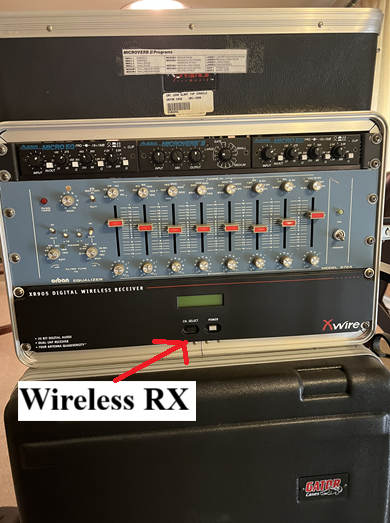
Here is the top of the rack:
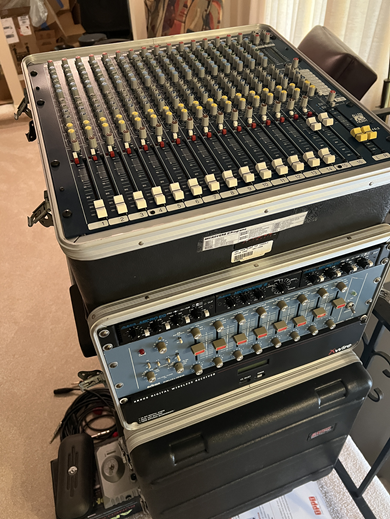
The wireless and processors are wired permanently into the mixer.
Here are some photos of my crappy old mixer rack:
Here is the top of the rack:
The wireless and processors are wired permanently into the mixer.

To agree with some others, I'm not sure I see the vision for the concept that using a wireless for this specific use is any easier or simpler than a cable. It does mean one less cable to get in the way, I suppose, but from every other perspective the setup and maintenance on a wireless unit would seem to be at least nominally more involved than a cable rather than vice versa, setting aside the injection of an arguably more likely failure point compared to cable.
I understand the benefits of wireless on the instrument side for someone who doesn't want to deal with being attached to a cable while they are physically playing, but that is not the same thing as this IMO.
I understand the benefits of wireless on the instrument side for someone who doesn't want to deal with being attached to a cable while they are physically playing, but that is not the same thing as this IMO.


