
Enjoy the benefits of a premium membership!
Upgrade Account
-
TalkBass has been independent since 1998. Add your voice.
Create a free account to reply to discussions, view embedded media, and browse with fewer display ads.
Join free Log in
Want zero display ads or expanded classifieds tools? Compare plans.
You are using an out of date browser. It may not display this or other websites correctly.
You should upgrade or use an alternative browser.
You should upgrade or use an alternative browser.
Bass Cleff - Isobar 410
- Thread starter Numa
- Start date
More options
Who Replied?


I would like to add some considerations that respond in part to some posts.
If isobaric speakers were the perfect solution, they would not have been abandoned and all manufacturers would build them.
The concept "isobaric" is that there is the least possible volume between the two drivers, that's why the stave barrels.
What advantage can such a complex job give? I don't know, I just had fun doing it. What is the advantage of painting a picture or building a bookcase with your own hands? None, just the satisfaction of doing it.
Certainly it would make no commercial sense, it would cost an exaggeration compared to the advantages.
One thing I'm sure of though, it sounds better than many modern cabinets that I've tried, and made myself.
If isobaric speakers were the perfect solution, they would not have been abandoned and all manufacturers would build them.
The concept "isobaric" is that there is the least possible volume between the two drivers, that's why the stave barrels.
What advantage can such a complex job give? I don't know, I just had fun doing it. What is the advantage of painting a picture or building a bookcase with your own hands? None, just the satisfaction of doing it.
Certainly it would make no commercial sense, it would cost an exaggeration compared to the advantages.
One thing I'm sure of though, it sounds better than many modern cabinets that I've tried, and made myself.
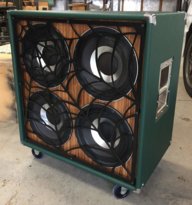
You definitely want the two drivers as close to each other as possible and the least amount of airspace between them. Numa did a good job of that.
As Wasnex stated, half the enclosure volume with same performance, double the power handling, but only same output as one driver. It was popular back in car audio days when woofers weren't being designed to work in small enclosures, today that's not an issue.
As Wasnex stated, half the enclosure volume with same performance, double the power handling, but only same output as one driver. It was popular back in car audio days when woofers weren't being designed to work in small enclosures, today that's not an issue.
You definitely want the two drivers as close to each other as possible and the least amount of airspace between them.
Exactly!

You realize you bought all of the clamps!
The carpenters in my area are all angry...


One feature I forgot to mention is that this strange and peculiar arrangement of the drivers positioned converging at 135° Deg. it has an effect that I really appreciate. Maximum volume with very deep bass is achieved with the cabinet right next to the feet, as is often the case on very small stages.
I often struggle to hear myself when out there they tell me the bass volume is too high, this problem belongs to the past.
I often struggle to hear myself when out there they tell me the bass volume is too high, this problem belongs to the past.

- Feb 12, 2006
- 60,978
- 5
- 220,736
- Disclosures
- Development Engineer-Mesa Boogie, Development Engineer-Genzler (pedals), Product Support-Genz Benz
How does this work when the low frequencies are essentially omnidirectional below 100Hz?
Great question that I don't know the answer to.
It is certainly not a scientific certainty, I am only saying what I have observed by playing and listening.
It could be that the idea of placing the drivers in that position generates counterphases that reduce the volume at a certain distance while having no effect up close.
But mine is just a theory, I'm not an engineer, it should be taken to the laboratory and analyzed, which I have no intention of doing, I'm afraid that the analyzes will ruin my beliefs...

- Feb 12, 2006
- 60,978
- 5
- 220,736
- Disclosures
- Development Engineer-Mesa Boogie, Development Engineer-Genzler (pedals), Product Support-Genz Benz
Sometimes it’s just a perception of something that matters most.Great question that I don't know the answer to.
It is certainly not a scientific certainty, I am only saying what I have observed by playing and listening.
It could be that the idea of placing the drivers in that position generates counterphases that reduce the volume at a certain distance while having no effect up close.
But mine is just a theory, I'm not an engineer, it should be taken to the laboratory and analyzed, which I have no intention of doing, I'm afraid that the analyzes will ruin my beliefs...

Great question that I don't know the answer to.
It is certainly not a scientific certainty, I am only saying what I have observed by playing and listening.
It could be that the idea of placing the drivers in that position generates counterphases that reduce the volume at a certain distance while having no effect up close.
But mine is just a theory, I'm not an engineer, it should be taken to the laboratory and analyzed, which I have no intention of doing, I'm afraid that the analyzes will ruin my beliefs...
AFAIK, angling the drivers like that is usually an attempt to broaden horizontal dispersion. The amount of splay that is optimal depends on the driver's dispersion characteristics and the frequency range you are most concerned with.

the descriptions of these certainly jibe with the handful of iso bass cabs i've tried, that they're about the same overall loudness as the regular cab of the same size and no internal speaker(s), but just have more low end

Could you explain this bit like I was 5?With an isobaric, you don't get the the +3dB of sensitivity, rather sensitivity goes down -3dB.
I always appreciate your comments explaining spl - not that I always necessarily understand them - but I’m struggling to understand how adding two extra speakers to a 2x10 winds up effectively robbing one. It’s the elusive “subtraction by addition”.
Could you explain this bit like I was 5?
I always appreciate your comments explaining spl - not that I always necessarily understand them - but I’m struggling to understand how adding two extra speakers to a 2x10 winds up effectively robbing one. It’s the elusive “subtraction by addition”.
I'll try
 .
.Assume drivers rated for 97dB 1W/1m. This means you feed one driver 1W and you measure 97dB at a distance of 1 meter.
So with a 110 you get 97dB for 1W.
Make it a 210 using the same driver and tuning, and the combined sensitivity of the system goes up to 100dB 1W/1m.
This is not as straightforward as you might think. The drivers are sharing the 1W equally, so each driver is only getting 1/2W and making 94dB. Assuming the drivers are right next to each other, you get near perfect mutual coupling that results in +6dB due to increased radiation efficiency.
The output of the individual drivers is -3dB (due to power sharing), but you get + 6dB (due to mutual coupling). -3 + 6 = +3dB net.
With an isobaric design the power is still shared equally by each driver. The drivers are sharing 1W equally, so each driver is only getting 1/2W and making 94dB. But since only one driver is external you don't get the benefits of mutual coupling...you don't hear the second driver because it's on the inside of the cab.
So the net is -3dB (due to power sharing).
- Feb 12, 2006
- 60,978
- 5
- 220,736
- Disclosures
- Development Engineer-Mesa Boogie, Development Engineer-Genzler (pedals), Product Support-Genz Benz
There is also a penalty from the smaller internal volume.I'll try
Assume drivers rated for 97dB 1W/1m. This means you feed one driver 1W and you measure 97dB at a distance of 1 meter.
So with a 110 you get 97dB for 1W.
Make it a 210 using the same driver and tuning, and the combined sensitivity of the system goes up to 100dB 1W/1m.
This is not as straightforward as you might think. The drivers are sharing the 1W equally, so each driver is only getting 1/2W and making 94dB. Assuming the drivers are right next to each other, you get near perfect mutual coupling that results in +6dB due to increased radiation efficiency.
The output of the individual drivers is -3dB (due to power sharing), but you get + 6dB (due to mutual coupling). -3 + 6 = +3dB net.
With an isobaric design the power is still shared equally by each driver. The drivers are sharing 1W equally, so each driver is only getting 1/2W and making 94dB. But since only one driver is external you don't get the benefits of mutual coupling...you don't hear the second driver because it's on the inside of the cab.
So the net is -3dB (due to power sharing).
You explained this perfectly, thanks.I'll try
Assume drivers rated for 97dB 1W/1m. This means you feed one driver 1W and you measure 97dB at a distance of 1 meter.
So with a 110 you get 97dB for 1W.
Make it a 210 using the same driver and tuning, and the combined sensitivity of the system goes up to 100dB 1W/1m.
This is not as straightforward as you might think. The drivers are sharing the 1W equally, so each driver is only getting 1/2W and making 94dB. Assuming the drivers are right next to each other, you get near perfect mutual coupling that results in +6dB due to increased radiation efficiency.
The output of the individual drivers is -3dB (due to power sharing), but you get + 6dB (due to mutual coupling). -3 + 6 = +3dB net.
With an isobaric design the power is still shared equally by each driver. The drivers are sharing 1W equally, so each driver is only getting 1/2W and making 94dB. But since only one driver is external you don't get the benefits of mutual coupling...you don't hear the second driver because it's on the inside of the cab.
So the net is -3dB (due to power sharing).
- Feb 12, 2006
- 60,978
- 5
- 220,736
- Disclosures
- Development Engineer-Mesa Boogie, Development Engineer-Genzler (pedals), Product Support-Genz Benz
Behind the rear driver.Smaller internal volume between the drivers? Or behind the rear driver?


