I keep trying DI and go back to Mic mainly because DI does not sound as nice if you know how to mic properly.

Enjoy the benefits of a premium membership!
Upgrade Account
-
TalkBass has been independent since 1998. Add your voice.
Create a free account to reply to discussions, view embedded media, and browse with fewer display ads.
Join free Log in
Want zero display ads or expanded classifieds tools? Compare plans.
You are using an out of date browser. It may not display this or other websites correctly.
You should upgrade or use an alternative browser.
You should upgrade or use an alternative browser.
BASS DI OR NOT
- Thread starter lyes4string
- Start date
More options
Who Replied?I've had too many inconsistent experiences with inexperienced sound guys who were to be seen serving behind the bar, trying to use kick drum mics or rattly buzzy DI boxes that have had pints of beer spilled over them to trust them to get anything approaching useable FOH sound.
The first time that I worked with a sound guy even approaching competent, he used the DI from my trace combo and had the best FOH sound i've ever had, so it's amp DI for me normally, unless I know I can trust the sound guy.
The first time that I worked with a sound guy even approaching competent, he used the DI from my trace combo and had the best FOH sound i've ever had, so it's amp DI for me normally, unless I know I can trust the sound guy.
That's the bottom line--amp outs are rarely set anywhere near how they should be, and running back and forth is time consuming and should be unnecessary.
After a few years of this, a lot of soundman give up on bassists.
Maybe this says something about the different personalities of lead and bass guitarists, but I do often feel I put up with a lot of crap from soundmen for the sake of expediency. By contrast, can you imagine how much of a hissy fit a lead guitarist would have if you plugged him into a DI box and told him his amp was basically just a stage monitor? I realise Mr KeithAlanK is a bassist himself, but I just get the impression many soundmen don't appreciate how much an amp colours the sound of the bass. Or how frustrating it is for a bassist when you point them to the house amp, let them get a nice sound out of it and then pull their jack out and stuff it into a DI. If the amp settings are too loud or the EQ's all over the place, tell us and we'll change it - we're bassists, we tend to be more polite about this sort of thing!
I run into a similar issue in the studio. I appreciate that bass can be a challenge to record, but so many times now I've heard a nice list of guitar amps reeled off, and then you ask about the bass: "Oh, we'll just plug that into a DI; we've got a SansAmp."
It's infuriating. So much time is given over to helping the guitarists get a good sound, and we are relegated to plugging straight into the desk via a little box. With apologies to those that like the sound, I'm sorry, I am still not satisfied with the sound you get from blending a DI and a SansAmp. Admittedly, the last studio I was in put me through a rather nice GK preamp, and I was quite pleased with the resulting sound, but so few studios seem to make such a generous concession to the bassist.
The few times I've actually played live with a PA it's been with upright through a mic (jazz big band). One time I plugged the mic into the amp and then used the line out to the PA, but that was because the band couldn't hear me if I didn't use the amp. The second time I went straight into the PA because it was a real concert in a real auditorium so the band could hear me without the amp.

If the amp settings are too loud or the EQ's all over the place, tell us and we'll change it - we're bassists, we tend to be more polite about this sort of thing!
Judging by 99% or the replies I've ever seen on this very topic, most engineers would have better luck asking for your first born than asking you to change "your" sound/eq settings on stage. I know this usually turns into a us vs. them kind of debate, but most bass players in general have no idea what their bass sounds like at FOH. Someone may tell them, or they think they know, but unless they are sitting at the console playing, and listening to a whole nights mix, as the crowd size and location changes, they honestly don't have any idea. Also, most players also have no idea how "their" sound may be a nightmare when trying to get it to mix properly with the rest of the instruments. Of course you'll see the usual, "It's their problem, deal with it" comments, but the FOH mix isn't about the bass, it's about the sum of it's parts.
Of course you'll see the usual, "It's their problem, deal with it" comments, but the FOH mix isn't about the bass, it's about the sum of it's parts.
well, if "my sound" works on recordings and rehearsals, why it should not work live?
anyway, back on topic - if you play clean and use an amp as a transparent amplification of your instrument - DI is you best bet.
if you use effect and your amp is part of your sound - go for microphone.
it's FOH guy's job is to adjust PA in order to present performers' sound the best way possible. not the other way around. and he is paid by band [one way or the other]. at the end - people come for performers, not for FOH guy.
At the same time, the person at FOH can make a good show great, and also make what could have been a great show, a disaster. "Your" sound may be fine, and again could be a deal killer in the house. Take the best engineers in the biz. You think acts retain them forever because no one comes to see them? They know they are as valuable to live performance as they are.well, if "my sound" works on recordings and rehearsals, why it should not work live?
anyway, back on topic - if you play clean and use an amp as a transparent amplification of your instrument - DI is you best bet.
if you use effect and your amp is part of your sound - go for microphone.
it's FOH guy's job is to adjust PA in order to present performers' sound the best way possible. not the other way around. and he is paid by band [one way or the other]. at the end - people come for performers, not for FOH guy.
(see Big Mick Hughes)
Also studio and live have very little to do with each other. Studio recording is a microscope, live sound is a stew.
Judging by 99% or the replies I've ever seen on this very topic, most engineers would have better luck asking for your first born than asking you to change "your" sound/eq settings on stage. I know this usually turns into a us vs. them kind of debate, but most bass players in general have no idea what their bass sounds like at FOH.
That's a very good point - we're all very precious about "our" sound. (But then so are lead guitarists.) A good engineer isn't necessarily asking to change your sound - just to adjust it so it sounds better through the FOH, or is less likely to blow the speakers out. A bad engineer will march up and fanny around with your graphic EQ without consulting you because he "knows how a bass should sound."
I guess it depends how complicated and finely tuned your sound is, of course. I tend to keep mine quite straightforward, so if they want me to ease off certain frequencies then I'm usually quite amenable...but does that make me a rare breed?
That's a very good point - we're all very precious about "our" sound. (But then so are lead guitarists.) A good engineer isn't necessarily asking to change your sound - just to adjust it so it sounds better through the FOH, or is less likely to blow the speakers out. A bad engineer will march up and fanny around with your graphic EQ without consulting you because he "knows how a bass should sound."
I guess it depends how complicated and finely tuned your sound is, of course. I tend to keep mine quite straightforward, so if they want me to ease off certain frequencies then I'm usually quite amenable...but does that make me a rare breed?
Not in my book you're not! I too have been accommodating to engineers as long as I've been doing this. It's kind of like tipping the bartender heavily with your first order. Who do you think will get taken care of first and best next time up??
Also, a guitar rig plays way less havoc with a mix at FOH than bass will. eg. Guitarist puts down his amp, tech plops down a SM57, and boom, your done. A slight bit of EQ usually gets the guitar across nicely. Sounds simple, but this method has worked since it was invented.
The main reason I don't like using a mic is because I want to have the freedom to adjust my amp volume and/or EQ at any time (within reason) and not have it affect what the FOH guy has got going. My first preference as a player is the XLR out of the back of my amp because it's the most streamlined (no box to trip over or extra cords to malfunction). It has ground lift and pre-post EQ switching and I have never had an issue over it with any sound guy.
All I need to be comfortable is a good monitor and my Warrior. I would much rather have my full rig up and running and pumping the tone into the board, but if the sound guy knows what he's doing all the tone is in my fingers.

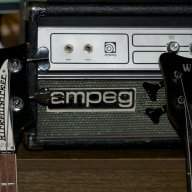
lately i have been enjoying hearing opinions and people bumping heads on them, so i'll try another. i personally hate it when a sound guy trys to make me use a di box instead of running it straight from my head. i feel my ampeg is most of my sound and by using the di its just lost. who agrees disagrees or likes something different perhaps both or just a mic.
This is what we call a "false dichotomy". Why does it have to be either/or? Two channels on a mixing board - one for a DI, one for a microphone on a cab - is not too much to ask...

MM

MysticMichael said:Two channels on a mixing board - one for a DI, one for a microphone on a cab - is not too much to ask...
MM
This is how I do it whenever possible. Running two channels also has the benefit of being a failsafe. If one or the other fails, the sound guy still has the other to work with.
5sg.
From a committed Ampeg user: It doesn't bother me at all... IMO, It's up to the sound man to make the band mix work. I couldn't agree more...
A big part of the problem with live sound is stubborn musicians usually don't want to compromise on anything to make the band mix work! Everyone gets into a loudness war, clashing tones/frequencies, etc... so, if I can make the sound man's job easier by plugging into a DI, then so be it...
I do use my secret weapon though... A sansamp bass driver DI box! I'll always ask a sound man to use it, and they always seem pleased with the results, so...
A big part of the problem with live sound is stubborn musicians usually don't want to compromise on anything to make the band mix work! Everyone gets into a loudness war, clashing tones/frequencies, etc... so, if I can make the sound man's job easier by plugging into a DI, then so be it...
I do use my secret weapon though... A sansamp bass driver DI box! I'll always ask a sound man to use it, and they always seem pleased with the results, so...
It's possible that running out of the head is causing noise in the PA and that is why the sound man prefers that you use a DI. One thing you are not considering is that even if you run out of your head, your sound is still running through the board and therefore, it is changing. The best solution is to work with the sound man to get the same sound through the FOH as you hear onstage.

I've been going out direct from my VT Bass Deluxe every since I got one months ago and it sounds great while still allowing me to use effects. My amp is basically just my monitor\feel and I use a wedge for the rest of the band.
yesterday, went to a gig, the bass amp was blown..
so lucky i brought my aguilar tone hammer. DI to the PA, it sound so right and made me the man of the night ^^
so lucky i brought my aguilar tone hammer. DI to the PA, it sound so right and made me the man of the night ^^

This whole recurring discussion reminds me how I ended up carrying a pedalboard larger than my bass amp, with speaker emulation and DI and all about blending and tone without one "fun" effect. Make it easy for the sound man and, well, he'll probably still use the preset EQ he dialed in for bass DI (with exactly the wrong midrange peak and scoop) and completely ruin your tone, but at least that one time you get a sound engineer worthy of the title, it'll sound good.
I'm just about at the point where I've decided that a good microphone would be easier, even if it doesn't sound good. Who cares? It's not going to sound right through the DI anyway, the amount of grit I'm running, and even a nice condenser mic will be lighter, cheaper, and less complicated than all that other crap. When's the last time I listened to a recording of my own band where I could hear the bass over the kick drum anyway? At least it'll *look* expensive...
I'm just about at the point where I've decided that a good microphone would be easier, even if it doesn't sound good. Who cares? It's not going to sound right through the DI anyway, the amount of grit I'm running, and even a nice condenser mic will be lighter, cheaper, and less complicated than all that other crap. When's the last time I listened to a recording of my own band where I could hear the bass over the kick drum anyway? At least it'll *look* expensive...


