

Enjoy the benefits of a premium membership!
Upgrade Account
-
TalkBass has been independent since 1998. Add your voice.
Create a free account to reply to discussions, view embedded media, and browse with fewer display ads.
Join free Log in
Want zero display ads or expanded classifieds tools? Compare plans.
You are using an out of date browser. It may not display this or other websites correctly.
You should upgrade or use an alternative browser.
You should upgrade or use an alternative browser.
Bass modifications...why?
- Thread starter baltodoc
- Start date
More options
Who Replied?
I've been playing bass since I was 8 years old and I'm now in my 60's. I notice that many, many players make modifications to their basses. I've never had anything but stock basses in all those years. I realize I'm old school, but what is it that you're after that you can't get out of a stock instrument?
I have been playing for 44 years--- just did my 1st bass mod. Picked up a Squier P5 really cheap. Played it for about 8 months to see if it was a keeper (I want at least one bass w/flats, one w/rounds). Love the Squier, but the tuners, though very good, were not high quality--- new tuners installed. The pickup sounded very good though I absolutely love the sound of my "good" bass--- it has Nordstrand pickups, so I installed a
Nordstrand on the Squier P. I just left the bass with a local shop that has a top notch set up guy--- he's doing a setup for me with flats (E~C).\
Hope the pickup replacement lives up to my expectations.
Oh yah, my "good" bass is an Elrick, so although the mods on my Squire won't make it a boutique bass, I'm hoping to make the bass more enjoyable to play. No one but me will notice the upgrades.

people want what they want, I`m finding more and more often that I`m not all that picky about details and that a stock bass is honestly more than fine IMO and IME. The previous statement is not to discredit those who mod, I`m all in support of people doing what they want to an instrument - I just know that, in spite my tinkering nature, modding a bass just isn`t a big deal to me.
However, I got 500 off of an american deluxe fender jazz V because the previous owner put a Seymour Duncan quarter pounder in the bridge position. I`d put it back to stock, but I honestly think it might have been an improvement, giving the instrument just a bit more variety.
However, I got 500 off of an american deluxe fender jazz V because the previous owner put a Seymour Duncan quarter pounder in the bridge position. I`d put it back to stock, but I honestly think it might have been an improvement, giving the instrument just a bit more variety.
Last edited:

I don't mod. I also don't do much repair as power tools just make me bleed faster and more efficiently. On the other hand, it would be fun to buy a cheap SX and out uber pick ups in it, just because
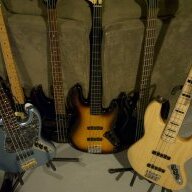
Considering I could only afford a cheap bass, I was shoe-horned into aesthetic options. I was able to get a more satisfying look with a black control plate for cheap, fixed neck dive on another with a heavier bridge and lighter tuners, etc. No mods I've done made any real noteworthy change as far as playability is concerned...
Edit: Pickguards barely belong in this discussion IMHO - such an easy way to differ from the stock flock!

Edit: Pickguards barely belong in this discussion IMHO - such an easy way to differ from the stock flock!
In order to make the unmodified instruments more valuable.
Seriously though, I think a lot of people mod for financial reasons, more so in the old days now that instruments are considerably cheaper relative to disposable income. (Also the options are exponentially greater than they were in the old days.)
If I have instrument Q that's more or less what they want, but lacks XYZ. 2) Instrument that has XYZ costs $$$$, and I'll lose half what I paid if I sell my Q and buy an S.
Seriously though, I think a lot of people mod for financial reasons, more so in the old days now that instruments are considerably cheaper relative to disposable income. (Also the options are exponentially greater than they were in the old days.)
If I have instrument Q that's more or less what they want, but lacks XYZ. 2) Instrument that has XYZ costs $$$$, and I'll lose half what I paid if I sell my Q and buy an S.
When I started playing in HS, I wasn't modding perse, mostly repairing (my Dad (in construction) had good tools, and I took two years of electric shop).
Word traveled fast that I fixed stuff, especially at a time when there were so many crappy entry level instruments out there.
My first gigging band played a show where the rythym guitarists Vox AC30 caught on fire (audience thought it was part of the show), I rebuilt it in shop, and people started handing out my phone number.
When I moved to the wedding/party band (those guys were older than me), word of mouth in school dropped off. They had a sound guy who was in tech school, so all I had to do was perform at that point (though when he installed a humbucker in the bridge of the lead guitarist's Strat, It was OOP, and I fixed it at a rehearsal).
I was almost done with tech school when I split from that band, so after that I started working in manufacturing and repairing things became my job.
I got the odd call through the years to fix/mod things from friends of friends who still had my number, but I wasn't playing much (and not out at all), so eventually the calls stopped.
Fast forward 20 years, started playing again (adding guitar), and had a Squier Strat that had a two point Trem that was installed at the factory too far forward for any string gauge heavier than .009's (even decked). I hard-tailed it, and gave it to my brother. Then I got a Squier '51 and went nuts. Since my job is more computer based now, I don't really get my hands in physical work too much anymore. Repairing/modding/flipping feeds the tech in me.
In the 11 years since then, I've worked on a ton to flip, and repaired/modded more than a few at the request of others. I've built a few parts guitars (and one parts bass), but only kept the bass. I'm less likely to mod a bass than a guitar these days (especially for me). I'm also more likely to do reversible mods, so if I decide to sell it down the road, I can return it to stock.
Sheilding & Star grounding is something I do on almost everthing I intend to keep.
So I guess it comes down to an itch to tinker.
Word traveled fast that I fixed stuff, especially at a time when there were so many crappy entry level instruments out there.
My first gigging band played a show where the rythym guitarists Vox AC30 caught on fire (audience thought it was part of the show), I rebuilt it in shop, and people started handing out my phone number.
When I moved to the wedding/party band (those guys were older than me), word of mouth in school dropped off. They had a sound guy who was in tech school, so all I had to do was perform at that point (though when he installed a humbucker in the bridge of the lead guitarist's Strat, It was OOP, and I fixed it at a rehearsal).
I was almost done with tech school when I split from that band, so after that I started working in manufacturing and repairing things became my job.
I got the odd call through the years to fix/mod things from friends of friends who still had my number, but I wasn't playing much (and not out at all), so eventually the calls stopped.
Fast forward 20 years, started playing again (adding guitar), and had a Squier Strat that had a two point Trem that was installed at the factory too far forward for any string gauge heavier than .009's (even decked). I hard-tailed it, and gave it to my brother. Then I got a Squier '51 and went nuts. Since my job is more computer based now, I don't really get my hands in physical work too much anymore. Repairing/modding/flipping feeds the tech in me.
In the 11 years since then, I've worked on a ton to flip, and repaired/modded more than a few at the request of others. I've built a few parts guitars (and one parts bass), but only kept the bass. I'm less likely to mod a bass than a guitar these days (especially for me). I'm also more likely to do reversible mods, so if I decide to sell it down the road, I can return it to stock.
Sheilding & Star grounding is something I do on almost everthing I intend to keep.
So I guess it comes down to an itch to tinker.
Essentially the reason is to offset cost. I could buy the Bass that has exactly what I want but I don't have thousands to spend. I have 800 now but will have a hundred or so every couple months, so * buy a bass now that feels good and has close to what * want and I'll make changes as funds become available

I've always believed that if the instrument isn't right off the rack, it's not worth buying.
I have made a few mods over the years: swapped out pickups that had become microphonic, replaced worn tuning machines with better ones, rewired a J bass for series
I don't mind buying modded basses (like the P in my avatar) but I never buy one thinking of it as a chassis for hot rodding.
I have made a few mods over the years: swapped out pickups that had become microphonic, replaced worn tuning machines with better ones, rewired a J bass for series
I don't mind buying modded basses (like the P in my avatar) but I never buy one thinking of it as a chassis for hot rodding.

for the same reason that i put spices on frozen pizzas

Doing mods on a stock bass our way of putting "our own stink" unto it.
Doner Designs
Steve Doner
- Jun 2, 2012
- 5,784
- 6,819
- Disclosures
- Doner Designs is an alias for Steve Doner
Personalization, and it's fun.
Exactly.
From a resale value standpoint it almost never works out well, but if viewed as money SPENT (rather than invested) as one would do with any other hobby, it makes a lot of sense. Some would spend $100+ on an afternoon of golf or sports tickets or food/drink for a part at their house. I would rather spend that time and money building or tweaking an instrument.
Doner Designs
Steve Doner
- Jun 2, 2012
- 5,784
- 6,819
- Disclosures
- Doner Designs is an alias for Steve Doner
I agree 100% with the OP.. I've always wondered the same thing! In my opinion Your better off waiting and saving up for what you really want VS guinea pigging your Bass ! if don't like a Bass then why buy it in the first place ..
If you just want to play it, you are right, but as others have said tinkering is a hobby and I think it helps some of us be motivated to play more (gotta test drive it after every tweak).

I'm with the OP, but I can understand others thinking it's fun to tinker with their toys. Different tone, a truly unique bass, something other to do than hang on TB and Facebook. If I want any of that however, I enjoy buying a whole new bass as opposed to swapping out parts. I only replaced the pickups in one bass, a MIM P deluxe. I wound up liking the original pickups more, and it cost me over $100 to make the change.
Something I really can't wrap my brain around is dropping hundreds on different bridges and tuners. I doubt if I'd ever know if you swapped a bridge or tuner on any of my basses (so long as they looked the same) while I was sleeping. Those are parts that to me just do their job, and most do them quite well. Only problems I ever had with tuners were 2 that broke, and the 4 crap ones that came on my late 90s MIA P deluxe. Out of 100s of other tuners I've tuned with, I never had an issue, desire, or need to replace them.
I swapped out my stock Epiphone EB-0 bridge for a Hipshot and noticed a world of difference...in fact, I hated the stock bridge. As far as tuners go, it's more of a personal preference. Even still, personal preference is reason enough alone to modify a bass.
Doner Designs
Steve Doner
- Jun 2, 2012
- 5,784
- 6,819
- Disclosures
- Doner Designs is an alias for Steve Doner
I'm 60 and I remember modifying all my basses back in the 70's. There were only a few bass companies back then, so my '71 P-bass had a Humbucker-Jazz-bass-pickup-badass bridge and no frets.
This is probably part of what led to the proliferation of aftermarket parts makers and made it easier for hobbyists to get into building and modifying.

Smooth_bass88
vaxx!
- Oct 31, 2006
- 12,122
- 16,793
- Disclosures
- have been on nationally released albums, charting on the Billboard 200
I 'modified' my Fender bass with Chromes.
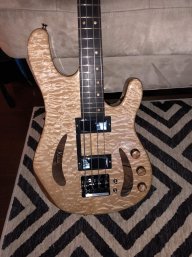
Sometimes discriminating players want a different tone or something changed. When the bass is perfect, there is no reason to modify it.
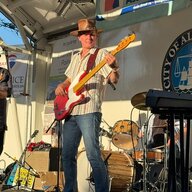
No need to modify my jazz bass, that's telling. It's my number 1.
My fretless P came with a brass nut and a BAII on it. I have actually removed the BA and put a stock fender bridge on, although not period correct, so it still could be considered a modification, although that was not the intent. I am indifferent to the nut. If I felt a need to replace it, it'd put whatever would be current fender material in its place.
Now my Rick, that's another story.
I pulled the bridge pickup cover off as soon as I owned it. A bit later I replaced the awful chrome plate/pickup surround with a flat piece of plexiglass. This was for ergonomic reasons and made it much more playable. Note that years later, pickguardian markets a very similar solution. I also added the bridge pickup capacitor with a mini toggle switch as my Rick was from the era where the bridge cap was no longer stock. The mini toggle functions the same as the push/pull,pot that is now stock on Ricks.
My fretless P came with a brass nut and a BAII on it. I have actually removed the BA and put a stock fender bridge on, although not period correct, so it still could be considered a modification, although that was not the intent. I am indifferent to the nut. If I felt a need to replace it, it'd put whatever would be current fender material in its place.
Now my Rick, that's another story.
I pulled the bridge pickup cover off as soon as I owned it. A bit later I replaced the awful chrome plate/pickup surround with a flat piece of plexiglass. This was for ergonomic reasons and made it much more playable. Note that years later, pickguardian markets a very similar solution. I also added the bridge pickup capacitor with a mini toggle switch as my Rick was from the era where the bridge cap was no longer stock. The mini toggle functions the same as the push/pull,pot that is now stock on Ricks.

Well, let's see...
On my main Carvin LB70, I first stripped off the gloss finish and replaced it with oil. This was my first decent bass, so I didn't know when I bought it that I hated gloss finishes (particularly on the neck). It made a lot more sense to put some labor into a bass I already knew and loved rather than to drop a bunch of money on a new one, doubly so since I am a lefty and good basses are harder to come by. I later swapped out the pickups for Aeros because I came to realize that my ideal bass tone was very close to my Carvin's existing tone, but a bit less "hi-fi." The pickup swap nailed the tone in my head perfectly, and the method I used to get there was certainly cheaper and more reliable than buying other basses. That bass with those mods is still my number one bass, going on 14 years now.
I also had the frets pulled from my Carvin B4 recently. The B4 was my backup bass for a decade, but after I bought a new Zon it wasn't seeing any action. For a while now I've wanted a four-string fretless, since my only fretless for years has been a five-string and I just couldn't bond with it. So, rather than buying a new fretless four, I sold the fretless five, spent less than half of the proceeds of that sale on having a local luthier defret the B4, and ended up with a great fretless and a bit of extra cash. Again, it made a lot more sense to me to spend a little bit of money on converting a bass I am already comfortable with than to drop a lot more money on a new, unknown bass. The B4 fretless worked out amazingly and I play that bass more now than I ever did when it was fretted.
On my main Carvin LB70, I first stripped off the gloss finish and replaced it with oil. This was my first decent bass, so I didn't know when I bought it that I hated gloss finishes (particularly on the neck). It made a lot more sense to put some labor into a bass I already knew and loved rather than to drop a bunch of money on a new one, doubly so since I am a lefty and good basses are harder to come by. I later swapped out the pickups for Aeros because I came to realize that my ideal bass tone was very close to my Carvin's existing tone, but a bit less "hi-fi." The pickup swap nailed the tone in my head perfectly, and the method I used to get there was certainly cheaper and more reliable than buying other basses. That bass with those mods is still my number one bass, going on 14 years now.
I also had the frets pulled from my Carvin B4 recently. The B4 was my backup bass for a decade, but after I bought a new Zon it wasn't seeing any action. For a while now I've wanted a four-string fretless, since my only fretless for years has been a five-string and I just couldn't bond with it. So, rather than buying a new fretless four, I sold the fretless five, spent less than half of the proceeds of that sale on having a local luthier defret the B4, and ended up with a great fretless and a bit of extra cash. Again, it made a lot more sense to me to spend a little bit of money on converting a bass I am already comfortable with than to drop a lot more money on a new, unknown bass. The B4 fretless worked out amazingly and I play that bass more now than I ever did when it was fretted.
for the same reason that i put spices on frozen pizzas
I like my pizza out of the oven (or at least thawed).


