I was wondering if the size (width) of a bass neck affects the tone of the bass and how? This is my dilemma... I have a yamaha trb 4 (92') which i love, but the strong spacing is pretty wide and after a while my wrist begins to hurt. I have been playing a fender jazz deluxe, which has a pretty narrow neck. The yamaha which is overall a bigger bass just has a tone that the fender can't get, in addition to the consistency of the each note. With the fender i feel as though I compromise sound for comfort. In case anyone who has gone through this, i would love to hear any suggestions.. thanks

Enjoy the benefits of a premium membership!
Upgrade Account
-
TalkBass has been independent since 1998. Add your voice.
Create a free account to reply to discussions, view embedded media, and browse with fewer display ads.
Join free Log in
Want zero display ads or expanded classifieds tools? Compare plans.
You are using an out of date browser. It may not display this or other websites correctly.
You should upgrade or use an alternative browser.
You should upgrade or use an alternative browser.
Bass Neck Width and Tone???
- Thread starter achama21
- Start date
More options
Who Replied?
bongomania
Commercial User
Every minute element of a bass- the specific pieces of wood used, the way their grain lines up, their dimensions at all points, the type and strength of the bond between parts, interactive layers of complimentary materials and geometry, etc. etc. all affect the tone in some way.
Unfortunately there is no 1:1 correspondence between neck width and any particular tone.
The difference you're hearing probably has more to do with the electronics, the strings, and the setup on each.
Unfortunately there is no 1:1 correspondence between neck width and any particular tone.
The difference you're hearing probably has more to do with the electronics, the strings, and the setup on each.



I have made two lefty wide necked 5 string basses, 2 are my current performing basses, the third was a righty, and a gift to a longtime friend in The Bronx, N.Y.
I simply dislike the 'squeezed together' feeling I always feel when I play any of the 5 strings like Fender, G&L, and Musicmans, even older Alembics that measure typically 1-3/4" at the nut. I have very big hands, and those feel like 6 string guitars to me...ugh.
I made the first one, as a prototype wide nut model in 1993. It has a 2 piece flamed maple body, and a one piece flamed maple neck with an ebony fingerboard. It measures 2" at the nut, 3" at the body/neck joint. The neck profile is similar to a 1-3/4" early 60-61 rosewood precision bass neck- wide-flat that is. I dig those necks. It has Alembic Wmxy-5 pickups, (3) two pan pots, and The Stanley Clarke tone circuit. It, is a really great sounding bass. The other bass also has a flamed maple body and neck, and a Pau-Ferro board. That bass has 2- Emg 40 DC-5's and the full BQS system in it. The neck is huge on it, it measures 2-1/4" at the nut, and 3-1/4" at the neck/body joint. The three basses are very similar, same shaped bodies and headstocks. The bigger necked one, and the righty one my buddy has, have a slightly bigger headstock. In my experience, Pau Ferro is quite similar to ebony in workability, hardness, and ultimate brightness tone factor wise. The bigger necked bass seems to be more punchy and speaks - well with a bit more balls. This is absolutely audible. Like a truck compared to the 'finesse' of the smaller necked one. The neck size definitely makes a difference in the note, and articulation. This, I feel, is due not just because of the increased mass under the strings, but for the reason I have been saying ever since I started repairing about 35 years ago... the neck's rigidity and stability are the keys to superior tone. The stiffer the neck, the better the instrument, for not just tone and playability, but for the obvious mechanical advantage of reducing neck adjustments and increasing the longevity of the instrument. I built the newer one in 2006. I adjusted the truss rod once during its' initial setup, and haven't touched it since. The 1993 bass, about twice since completion. That's pretty good, I'd say. I use long (for basses) Martin type single acting rods in modified aluminum channels under the board. This also greatly contributes to neck stability. Your experience may vary, but this experiment really convinced me.
I simply dislike the 'squeezed together' feeling I always feel when I play any of the 5 strings like Fender, G&L, and Musicmans, even older Alembics that measure typically 1-3/4" at the nut. I have very big hands, and those feel like 6 string guitars to me...ugh.
I made the first one, as a prototype wide nut model in 1993. It has a 2 piece flamed maple body, and a one piece flamed maple neck with an ebony fingerboard. It measures 2" at the nut, 3" at the body/neck joint. The neck profile is similar to a 1-3/4" early 60-61 rosewood precision bass neck- wide-flat that is. I dig those necks. It has Alembic Wmxy-5 pickups, (3) two pan pots, and The Stanley Clarke tone circuit. It, is a really great sounding bass. The other bass also has a flamed maple body and neck, and a Pau-Ferro board. That bass has 2- Emg 40 DC-5's and the full BQS system in it. The neck is huge on it, it measures 2-1/4" at the nut, and 3-1/4" at the neck/body joint. The three basses are very similar, same shaped bodies and headstocks. The bigger necked one, and the righty one my buddy has, have a slightly bigger headstock. In my experience, Pau Ferro is quite similar to ebony in workability, hardness, and ultimate brightness tone factor wise. The bigger necked bass seems to be more punchy and speaks - well with a bit more balls. This is absolutely audible. Like a truck compared to the 'finesse' of the smaller necked one. The neck size definitely makes a difference in the note, and articulation. This, I feel, is due not just because of the increased mass under the strings, but for the reason I have been saying ever since I started repairing about 35 years ago... the neck's rigidity and stability are the keys to superior tone. The stiffer the neck, the better the instrument, for not just tone and playability, but for the obvious mechanical advantage of reducing neck adjustments and increasing the longevity of the instrument. I built the newer one in 2006. I adjusted the truss rod once during its' initial setup, and haven't touched it since. The 1993 bass, about twice since completion. That's pretty good, I'd say. I use long (for basses) Martin type single acting rods in modified aluminum channels under the board. This also greatly contributes to neck stability. Your experience may vary, but this experiment really convinced me.
Years ago, I had a Fender Precision with a C width neck (1 3/4" at the nut). I felt like I was going to develop wrist problems because it actually hurt to play it. So, I bought a replacement neck that was B width (1 5/8"). Everything else was the same-- both were Fender necks with maple fingerboards and medium jumbo frets, and they had about the same radius.
I immediately put the new neck on and played a gig that night. The difference was drastic, to my ears. The reduction in mass made the tone much less... well, less "massive."
I returned the new neck the next day, telling the music store clerk that I didn't like how it sounded; he gave me a funny look. Then I gradually adjusted to playing the original neck, because the tone was well worth it.
I suppose if you had a skinnier neck with a larger radius (the "baseball bat" effect) it would work out the same. It's the total mass that seems to matter.
That's my experience, anyway.
I immediately put the new neck on and played a gig that night. The difference was drastic, to my ears. The reduction in mass made the tone much less... well, less "massive."
I returned the new neck the next day, telling the music store clerk that I didn't like how it sounded; he gave me a funny look.
Then I gradually adjusted to playing the original neck, because the tone was well worth it.I suppose if you had a skinnier neck with a larger radius (the "baseball bat" effect) it would work out the same. It's the total mass that seems to matter.
That's my experience, anyway.
Based on comparison with a G&L L2500 with several L2000's, I think there is something to this - again, it could be because this was a superior L2500 and also due to different body wood, but it clearly had a deeper timbre on all strings, and there was a solidity to the feel of the neck that seemed to contribute to the difference.
Years ago, I had a Fender Precision with a C width neck (1 3/4" at the nut). I felt like I was going to develop wrist problems because it actually hurt to play it. So, I bought a replacement neck that was B width (1 5/8"). Everything else was the same-- both were Fender necks with maple fingerboards and medium jumbo frets, and they had about the same radius.
I immediately put the new neck on and played a gig that night. The difference was drastic, to my ears. The reduction in mass made the tone much less... well, less "massive."
I returned the new neck the next day, telling the music store clerk that I didn't like how it sounded; he gave me a funny look.
I suppose if you had a skinnier neck with a larger radius (the "baseball bat" effect) it would work out the same. It's the total mass that seems to matter.
That's my experience, anyway.
That demonstrates that different necks sound different. That's true and expected as is the fact that different basses sound different as the OP mentioned.
A better way to determine if the size of the neck matters is to take a large neck and make it smaller. That would eliminate any variables such as differences in wood density, stiffness etc., since it's the same piece of wood.
My experience making over a dozen large necks smaller is that going from 1-3/4", 1-5/8", and 1-1/2" nut widths to a 1-7/16" nut width with the appropriate re-profiling of the back has resulted in no change in tone or sustain. By "appropriate re-profiling" I mean I made certain to remove as little wood as possible especially with regards to the depth of the neck to maintain it's structural integrity and stiffness. As usual YMMV 'cause stuff happens.
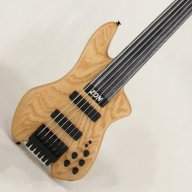
I play a 6, with a nut that's nearly 2" across. 12 stringers can have nuts nearly 4" across. It's not the width of the nut/neck that makes the tone.
That demonstrates that different necks sound different. That's true and expected as is the fact that different basses sound different as the OP mentioned.
A better way to determine if the size of the neck matters is to take a large neck and make it smaller. That would eliminate any variables such as differences in wood density, stiffness etc., since it's the same piece of wood.
My experience making over a dozen large necks smaller is that going from 1-3/4", 1-5/8", and 1-1/2" nut widths to a 1-7/16" nut width with the appropriate re-profiling of the back has resulted in no change in tone or sustain. By "appropriate re-profiling" I mean I made certain to remove as little wood as possible especially with regards to the depth of the neck to maintain it's structural integrity and stiffness. As usual YMMV 'cause stuff happens.
Good point.

I wouldn't be so quick to dismiss the size of the neck in relating to tone. If the necks were exactly the same in other respects, the increased mass of the neck would affect the way the neck vibrates in relation to the body and strings. If adding mass to the headstock a'la a "fatfinger" can increase sustain and eliminate or move the deadspot, then there is ample reason to believe that adding mass to the neck could also affect the tone.
The very large Warmoth p-bass neck I have installed on my Jazz sounds better thicker to my ear than the very skinny 62 reissue fender neck that was previously on there. It has a much more massive fingerboard and neck. It was enough to convince me of the possibility of an effect, but I do realize however, that while they were both maple necks with rosewood boards, there are other differences between the two that may have affected the tone. Poly vs nitro, steel reinforcement rods vs no rods, ultralight tuners vs vintage reissue tuners and small fretts vs med-jumbo fretts.
The very large Warmoth p-bass neck I have installed on my Jazz sounds better thicker to my ear than the very skinny 62 reissue fender neck that was previously on there. It has a much more massive fingerboard and neck. It was enough to convince me of the possibility of an effect, but I do realize however, that while they were both maple necks with rosewood boards, there are other differences between the two that may have affected the tone. Poly vs nitro, steel reinforcement rods vs no rods, ultralight tuners vs vintage reissue tuners and small fretts vs med-jumbo fretts.

When it comes to bass tone, everything matters. Neck width could, as it changes the mass of the neck (and how much maple compared to body wood is in the bass). That would be in an all else being equal situation, though, and all else never is. I'm not sure what body woods the yamaha uses, but that could make a difference, as could differences in the electronics (the Yammy's I found pics of all were either soapbar pickups or P/J rather than JJ. Even if they were JJ, nobody's Js are the same, hence the large aftermarket). Also, basses vary instrument to instrument. Even two identical ones will have variations in tone. Any of these are more likely to be culprits than the neck width.

Ric5
Inactive
- Jan 29, 2008
- 29,772
- 30,452
- Disclosures
- I like 5, 8, 10, and 12 string basses
No 2 necks sound exactly the same ... no 2 pieces of wood are exactly the same. Also there are different ways to construct a neck.

I was wondering if the size (width) of a bass neck affects the tone of the bass and how?
Strictly personal opinion...but...there MUST be more important things to worry about!!
If you really want it to make a difference, you will hear one - whether it exists or not. The human brain is capable of considerable self-deception.
If it actually does make a difference, it's so minor that IMO you'll never hear it.
 Strings and pickups make much more difference.
It's the thickness of the neck that makes the tone!
Older P-Basses with the chunky necks sound better than the new ones.
Even the old Jazzes were slightly more chunky and sounded bassier.
Wide necked basses that are wide but thin have a Jazzier tone, while wide
necked basses with a chunkier neck are more suited for both jazz and rock.
Older P-Basses with the chunky necks sound better than the new ones.
Even the old Jazzes were slightly more chunky and sounded bassier.
Wide necked basses that are wide but thin have a Jazzier tone, while wide
necked basses with a chunkier neck are more suited for both jazz and rock.

The size of the neck certainly affects the way you play the bass, which affects your tone. So, I would conclude that the size of the neck indirectly affects your tone. But the more important consideration here is that the neck affects your playability.
I should have said the size of the neck in conjunction with the woods of both the neck and body. Body size too will also make a difference. Then too, many
people will disagree with everything here and say the sound is in the pickups.
IMO the wood comes first.
people will disagree with everything here and say the sound is in the pickups.
IMO the wood comes first.
It's the thickness of the neck that makes the tone!
Older P-Basses with the chunky necks sound better than the new ones.
Even the old Jazzes were slightly more chunky and sounded bassier.
Wide necked basses that are wide but thin have a Jazzier tone, while wide
necked basses with a chunkier neck are more suited for both jazz and rock.
Huh??? I disagree...the color of your tuning keys and control knobs is a MUCH bigger influence on sound.

In all seriousness, I think it is largely mpossible to attribute tone differences to a characteristic such as neck width. Think about it - a wide neck can very well have the same mass as a narrow neck, and there are so many other factors at play that must be taken into account. Yes, there will be anecdotal stories about individual basses and perceived sound differences from owners, but all things being equal there are a TON of other elements contributing to the tone equation.
Lonnybass
You will drive yourself crazy trying to identify the specific tone impact of an individual design component of a bass. There is SO much variation within wood types, etc. that attributing a 'fat' sound to a lot of neck wood, for example, can result in big disappointment.
My general answer to your question would be 'no'. I've heard just as many thin sounding six strings with huge mass in the neck as totally fat sounding Fender J's with little skinny necks.
My general answer to your question would be 'no'. I've heard just as many thin sounding six strings with huge mass in the neck as totally fat sounding Fender J's with little skinny necks.
If the neck width has any affect on tone, our human ears won't pick it up.
No 2 necks sound exactly the same ... no 2 pieces of wood are exactly the same. Also there are different ways to construct a neck.
Strictly personal opinion...but...there MUST be more important things to worry about!!
If you really want it to make a difference, you will hear one - whether it exists or not. The human brain is capable of considerable self-deception.
If it actually does make a difference, it's so minor that IMO you'll never hear it.
The size of the neck certainly affects the way you play the bass, which affects your tone. So, I would conclude that the size of the neck indirectly affects your tone. But the more important consideration here is that the neck affects your playability.
You will drive yourself crazy trying to identify the specific tone impact of an individual design component of a bass. There is SO much variation within wood types, etc. that attributing a 'fat' sound to a lot of neck wood, for example, can result in big disappointment.
My general answer to your question would be 'no'. I've heard just as many thin sounding six strings with huge mass in the neck as totally fat sounding Fender J's with little skinny necks.
The answers to all discussions regarding tonewoods, type of neck joint, etc.


