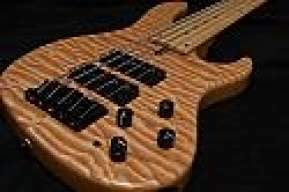
I record a pretty dry signal with a SansAmp then use a combination of EQ, limiter and compressor to dial in the sound I'm looking for. That way the bass track gets layed down fairly quickly and then it's just a matter of tweaking the sound in the mix.

Enjoy the benefits of a premium membership!
Upgrade Account
-
TalkBass has been independent since 1998. Add your voice.
Create a free account to reply to discussions, view embedded media, and browse with fewer display ads.
Join free Log in
Want zero display ads or expanded classifieds tools? Compare plans.
You are using an out of date browser. It may not display this or other websites correctly.
You should upgrade or use an alternative browser.
You should upgrade or use an alternative browser.
Bass recording - what's your chain??
- Thread starter harlon
- Start date
More options
Who Replied?
When doing session work I will normally plug into what ever Pre the engineer prefers. For recording with my band where I am very particular about my tone, it is a little more complicated.
Bass > EBS Multicomp > Boss ODB-3 > SWR Insterstellar Overdrive > SWR Megoliath > AKG C414 Microphone > Emperical Labs Fatso Jr > Board. We also take a direct signal out of the SWR Preamp and mix it in with the wet signal.
Bass > EBS Multicomp > Boss ODB-3 > SWR Insterstellar Overdrive > SWR Megoliath > AKG C414 Microphone > Emperical Labs Fatso Jr > Board. We also take a direct signal out of the SWR Preamp and mix it in with the wet signal.

At home..................Bass--->>>Zoom 506II--->>>Laptop Soundcard. 99% of the demos on my myspace were recorded this way.
In the studio.................Bass--->>>Passive Direct Box--->>>Mixing board. (The 1% on my myspace)
In the studio.................Bass--->>>Passive Direct Box--->>>Mixing board. (The 1% on my myspace)
Had great results going from bass straight to a Fostex DMT-8 ( like 10 years ago) then we bounced it around eq-ing the crap out of it, and added some compression off a cheap multi-fx that was lying around.
I mean astonishing results, still my favourite slap tone I've ever come up with in a studio of any kind; unfortunately I can't entirely replicate it since its creation was aided by certain amounts of a mind expansion plugin that was pharmaceutical in nature. I do have a copy of the resulting demo track so I wasn't imagining the result at least When we did the 'proper' recording the engineer got a very much less exciting bass sound which p*ssed me off, since I'd done so much better in a bedroom studio. Suffice to say I dont have a copy of what he did...
Lately its been SA450 DI out into Mackie line in, warmed up and compressed with a TL Audio 5021. Or straight into a Joe Meek Twin Q, using it entirely as pre-amp compressor, which has given some stunning results straight to an HD24. If you like quite a warm squished tone this is utterly captivating, especially off the bridge pickup, wish I could recreate that live!
I mean astonishing results, still my favourite slap tone I've ever come up with in a studio of any kind; unfortunately I can't entirely replicate it since its creation was aided by certain amounts of a mind expansion plugin that was pharmaceutical in nature. I do have a copy of the resulting demo track so I wasn't imagining the result at least
When we did the 'proper' recording the engineer got a very much less exciting bass sound which p*ssed me off, since I'd done so much better in a bedroom studio. Suffice to say I dont have a copy of what he did...Lately its been SA450 DI out into Mackie line in, warmed up and compressed with a TL Audio 5021. Or straight into a Joe Meek Twin Q, using it entirely as pre-amp compressor, which has given some stunning results straight to an HD24. If you like quite a warm squished tone this is utterly captivating, especially off the bridge pickup, wish I could recreate that live!

I also do the bass -> FMR RNP -> A/D converter thing. I try to avoid colored preamps for the most part when tracking unless the sound is sparse. Those pretty upper frequency harmonics either get washed out entirely in a mix or they clutter things up in those higher registers. I also don't like the natural midrange scooping that tends to happen with some of them (especially ones with "enhance" knobs). I'd definitely dump the Behringer and the POD for the same reason, the noisiness of these devices make them largely unsuitable for bass. The POD can be decent for some guitar stuff in the right context.
If I need any fattening up I run the bass through Sonar's FX2 Tape Sim plugin, set at 15ips and medium saturation to begin with and then I adjust those settings to taste during mixdown. There are some LA-2A type plugins which do "colored compression" which can sound good on a bass track. Ideally you have a vintage LA-2A sitting around (or a reasonable clone), of course...
If I need any fattening up I run the bass through Sonar's FX2 Tape Sim plugin, set at 15ips and medium saturation to begin with and then I adjust those settings to taste during mixdown. There are some LA-2A type plugins which do "colored compression" which can sound good on a bass track. Ideally you have a vintage LA-2A sitting around (or a reasonable clone), of course...

Step 1. Rickenbacker 4001 or Spector NS20004 > Ratty old Ibanez compressor > board
This is for the take, and the compressor just makes life easier. I have a wide dynamic range, the bass itself has a wide dynamic range. I don't play subtle music so the buzz of the compressor is of no concern to me. It gets buried by the time I'm done.
Step 2. Board signal back out through the monitor > Yamaha b115 amplifier > microphone stuck in bass reflex port > bass track 1
--plus--
Board signal back out through monitor > Trace Elliot Commando > microphone in front of single 15" > bass track 2.
I usually throw away or at least archive off to the dead zone the direct signal after I'm happy with my re-amped signals.
There will be times I slip an effect into the chain, either phase, flange, chorus, or distortion, but I'm not a big effects guy and I get the tone I want mostly from my fingers. The main thing is to get the take to the board so I can concentrate, then get nuances of the sound that only an amp will bring from re-amping. Somebody told me there's a bunch of expensive equipment you have to get to do that but I've been very happy with my Wile E. Coyote approach. The big upside is I can preserve that initial take and spend as much time as I like with the re-amped takes. And, I can capture the sound of a huge rig on a take that I did three weeks before at 2:00 a.m.
This is for the take, and the compressor just makes life easier. I have a wide dynamic range, the bass itself has a wide dynamic range. I don't play subtle music so the buzz of the compressor is of no concern to me. It gets buried by the time I'm done.
Step 2. Board signal back out through the monitor > Yamaha b115 amplifier > microphone stuck in bass reflex port > bass track 1
--plus--
Board signal back out through monitor > Trace Elliot Commando > microphone in front of single 15" > bass track 2.
I usually throw away or at least archive off to the dead zone the direct signal after I'm happy with my re-amped signals.
There will be times I slip an effect into the chain, either phase, flange, chorus, or distortion, but I'm not a big effects guy and I get the tone I want mostly from my fingers. The main thing is to get the take to the board so I can concentrate, then get nuances of the sound that only an amp will bring from re-amping. Somebody told me there's a bunch of expensive equipment you have to get to do that but I've been very happy with my Wile E. Coyote approach. The big upside is I can preserve that initial take and spend as much time as I like with the re-amped takes. And, I can capture the sound of a huge rig on a take that I did three weeks before at 2:00 a.m.
At home, it's very simple:
Bass -> Avalon U5 -> MOTU 896HD (interface) -> Sonar
Inside Sonar, I'll add compression (light to moderate) and sometimes EQ.
At other studios, I almost always use the preferred methods and gear of the engineer. That usually means DI, once in a while it means both DI and mic. I have asked for mic'd cabs in the past, but only when I was playing a fully or partial dirty signal. When that has occured, I use whatever mics the engineer likes.
Bass -> Avalon U5 -> MOTU 896HD (interface) -> Sonar
Inside Sonar, I'll add compression (light to moderate) and sometimes EQ.
At other studios, I almost always use the preferred methods and gear of the engineer. That usually means DI, once in a while it means both DI and mic. I have asked for mic'd cabs in the past, but only when I was playing a fully or partial dirty signal. When that has occured, I use whatever mics the engineer likes.

Bass of choice > Boss NS-2 (Noise Suppressor) > Hartke Bass Attack Pedal > Board.
Cleanest signal I can get. Effects and the like can be reamped or printed later.
Cleanest signal I can get. Effects and the like can be reamped or printed later.
Bass-> DMP3-> Converter. I might EQ a bit in the box to suit the material to be mixed (GlissEQ then), and sometime, but rarely, a bit of compression but that's it. I tried reamping and/or recording my amp, but turned out I much prefer the clean dry signal.
Thanks, everyone for all of the info and the great suggestions. Trust me - I'm paying attention. It gives me a lot to consider. I've tried direct into my RNP and straight into Sonar. It doesn't sound bad at all - I just cant get it to sound tight enough after that. No matter what I do it comes out muddy and boomy, which makes the whole mix sound muddy and boomy.
But I'll keep at it. I see a lot of folks using DI's. Any consensus as to which DI is best for recording? I know that's subjective. But would a Countryman or a Radial (for example) be better suited than my RNP for bass? I have an LR Baggs PARA DI, which is great for live acoustic work, but I've tried it with bass in the studio - didn't care for it.
Thanks again.
But I'll keep at it. I see a lot of folks using DI's. Any consensus as to which DI is best for recording? I know that's subjective. But would a Countryman or a Radial (for example) be better suited than my RNP for bass? I have an LR Baggs PARA DI, which is great for live acoustic work, but I've tried it with bass in the studio - didn't care for it.
Thanks again.
No matter what I do it comes out muddy and boomy, which makes the whole mix sound muddy and boomy.
High pass filter around 80, even 100hz. I know as a bassist this is horrifying but it's done all the time. Really helps with muddy and boomy.
Bass choice > Phil Jones Briefcase for the preamp > M-Audio 410 (firewire) > MacBook
I should probably buy a bass buddy, but I've been carrying my briefcase around to studios.
It started when I went to a downtown studio here and had the briefcase in the car and didn't want to leave it there. We started out by plugging my NSDB into the studio's Avalon. After some messing around with their presets, nobody was all that tickled so the engineer asked what I'd brought. He -loved- the sound of the Briefcase's pre so that's what we used.
Love PJB. Thanks, Phil!
--p
I should probably buy a bass buddy, but I've been carrying my briefcase around to studios.
It started when I went to a downtown studio here and had the briefcase in the car and didn't want to leave it there. We started out by plugging my NSDB into the studio's Avalon. After some messing around with their presets, nobody was all that tickled so the engineer asked what I'd brought. He -loved- the sound of the Briefcase's pre so that's what we used.
Love PJB. Thanks, Phil!
--p
I do two tracks: one track from the DI on my Eden head and the other track from a MIC in front of the speaker (Eden 210XLT).
EQ flat on everything. Mix the bass tracks as desired.
EQ flat on everything. Mix the bass tracks as desired.

Last 2 CD's we recorded..Spector NS5XL>Radial JDI. Touch of post production compression al' la' Pro Tools. Sweetness.

Channel 1: Spector NS4CRFM -> Aguilar DB659 (DI Output - Pre-EQ) -> ProTools. (Clean)
Channel 2: Spector NS4CRFM -> Aguilar DB659 -> Mackie 1400i -> Aguilar GS212 -> Shure SM57 -> ProTools. (Dirt)
There's a fan on the Mackie that can't be turned off but levels are up enough to cover it. If there's a rest in my line, I just cut that section out via ProTools anyways for recording. As far as I know (I could be wrong), it's rare to have two channels dedicated to bass but for a 3-piece band it fills it out real nice - especially to have such a meaty overdriven tone going with a solid and full clean underneath it. We have yet to gig but I don't foresee any problems running the same setup live (minus ProTools of course).
Channel 2: Spector NS4CRFM -> Aguilar DB659 -> Mackie 1400i -> Aguilar GS212 -> Shure SM57 -> ProTools. (Dirt)
There's a fan on the Mackie that can't be turned off but levels are up enough to cover it. If there's a rest in my line, I just cut that section out via ProTools anyways for recording. As far as I know (I could be wrong), it's rare to have two channels dedicated to bass but for a 3-piece band it fills it out real nice - especially to have such a meaty overdriven tone going with a solid and full clean underneath it. We have yet to gig but I don't foresee any problems running the same setup live (minus ProTools of course).


Track 1: Bass -> Sadowsky Pre/DI -> Apogee Duet iF -> Comp
+
Track 2: Bass -> Ampeg SVP-CL -> Berg 322 -> AKG112 -> Duet -> Comp
+
Track 2: Bass -> Ampeg SVP-CL -> Berg 322 -> AKG112 -> Duet -> Comp
Bass-->Boss GT-6B-->Mesa400+-->Bergie NV 610 or HT 210-->DI from Mesa + Mic on cab (sometimes)-->Firepod-->Nuendo-->Custom set multi band compressor (on computer)-->EQ (on computer)-->Limiter (yes, again on computer)-->WAV/MP3
Thats pretty much it.
Thats pretty much it.