• TalkBass has been independent since 1998. Add your voice.
    Create a free account to reply to discussions, view embedded media, and browse with fewer display ads.
    Join freeLog in
    Want zero display ads or expanded classifieds tools? Compare plans.

Basses with dummy coils …

… aren't very common. If they reduce or eliminate single-coil hum, why don't all Jazz basses have them? Is it a tone thing? I don't know enough to even guess. Thanks!
Why don't all Jazz Basses have them? I suspect it's more a "We've always done it this way", combined with "it's cheaper this way". And, Fender does put stacked/dummy coil pickups in some Jazz Basses. Their Ultra Jazz Basses are considerably more expensive than a "normal" one. And, like most other companies, they seem to keep these pickups for their active basses. There's no real reason they have to; it just seems to be the thing to do... Alembic has been doing it for... oh, roughly forever; my '95 Epic has them. So does my '24 Schecter Stiletto Studio 4-FL lined fretless.
I suppose that, for Fender, they have lots of customers for whom it is a "tone thing". Although, from the one or 2 times I've noodled around with an Ultra Jazz Bass with those pickups? I've been hard pressed to hear any tone difference. A lot less 60hz hum, but that's about it...:cool:

Although, I've never owned an Alembic. It is my understanding that they are very low impedance. Which makes them have a hi-fi sound. They would hum a lot with the noise canceling pu.

correct me if I'm wrong.
Well, I assume you meant "withOUT the noise canceling p/u's". In which case? No, you are not wrong. I currently own 27 basses, of all makes and kinds, and with all kinds of pickups. I have to say, though; as great as some of them sound? The pickups in my Alembic just... rule them all. Ron Faversham pretty much invented the modern active system we use today, and he wound his pickups to sound fantastic with active electronics. Honestly? Every time I plug that thing in, it doesn't take very long before I start to wonder; "Why on Earth do I even bother with all those other basses?" Yes, there are reasons; pretty good ones, too. But, it's hard to think of those reasons when I play the Alembic...:whistle:
 

Attachments

A notch filter tuned to 60 Hz will do very little to get rid of most hum situations. Hum is from fields that escape things like transformers - the mechanisms usually emit mostly harmonics of 60 Hz, not 60 Hz itself.


Yeah, I think a 60Hz only notch wouldn't quite do it. They also imply there's a bit more going on in there... but that could always just be marketing.
 
That is a good way to do it, but it is not entirely without side effects. In the case of parallel active circuits, what you lose is a bit of signal to noise - the hiss level will be a bit higher. Practically speaking, the reduction in hum is far more helpful that the extra hiss is harmful.

Given that their circuits use a bipolar +/- 22 volt power supply, the hiss is lower. It's pretty negligible.
 
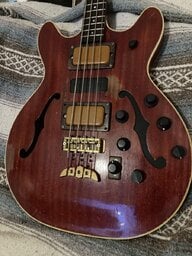
I had one of these briefly. It had separate dummy coil pickups mounted under the Jazz pickups.
IMG_8638.jpeg
 
Although, I've never owned an Alembic. It is my understanding that they are very low impedance. Which makes them have a hi-fi sound. They would hum a lot with the noise canceling pu.

correct me if I'm wrong.

The current crop of Alembic pickups are medium impedance. However, I have a set in my Starfire from ca. 1973 and they measure under 700 ohms each. So, quite low impedance. I think they sound really wonderful.
 
Dummy here: If simple copper-wound Siamese twin single coils cancel-out hum, how do they not cancel out ALL of the sound? What am I missing?
( again, see first word of this post )

One coil has the magnets and the coil winding direction both flipped - that means the signal comes out not flipped, but the noise does. - they both end up with similar signals, but the hum is different in polarity. The hum cancels, but the signal doesn't.
 
So wait. Are Alembic Series basses not truly single coil either? Does their dummy coil sap part of the audio signal?
Yes they are true SCs, and no the DC does not affect the tone of the SCs because they use 3 active buffer channels to electrically isolate the three coils, then they are mixed actively to set up the DC level so that the level of hum and other noise it picks up is at the same level as the SC pickups, just out of phase - this is adjustable on the Series instruments to set the levels exactly, especially if the electrical environment varies a lot.

Because all three coils are isolated/buffered from each other they do not load each other if they are simple coils connected together passively.

Also worth noting is that Alembic Series pickups are very low impedance, ie there is very little wire in the coil, so they are very wide bandwidth (which is the point of the PU and filter design) so potentially they can pick up a lot of radiated rubbish, especially in a modern electrically noisy environment.


Dylan is not an EE, and his explanation was almost painful to listen to, but basically correct.
 
Last edited:
Making the power supply voltage(s) higher increases the headroom. It doesn't reduce noise. They may be quiet circuits, but it isn't from the supply rails being greater.
I'm not understanding why you are making a case that the Alembic circuit has a high level of noise. Have you measured it? Have you gigged a Series I or II bass?

Minimization of noise level was pretty high on Ron Wickersham's design list. More than 50 years ago. Those basses have been used for scores of recording and live dates; and I have never heard a player or engineer refer to them as having significant noise. Quite the opposite.

Perhaps, I am mis-reading your posts. Apologies, if so.
 
  • Like
Reactions: factory presets
I'm not understanding why you are making a case that the Alembic circuit has a high level of noise.

Perhaps, I am mis-reading your posts. Apologies, if so.

I am not making that case at all. Yes, you are mis-reading my post. I am simply stating that increasing the voltage on the power supply does not make a circuit quieter (your assertion). That fact I have measured - MANY times - I developed a LOT of low noise audio circuit in my career. If Alembic has a quiet circuit, I applaud that - far too many active basses have noisy preamps.
 
Here:

Here is my two cents for innovation on bass. Devon is a builder just out of San Antonio. He has been methodically doing some really cool innovative production and super quality basses.

He incorporates a Zero Fret that increases tonal consistency with open strings, earth magnets instead of screws for all the back panel compartments and that offset jack placement that brings your cable right behind the strap.

Brilliant.

Here is an example of one I like a lot.View attachment 3826294 View attachment 3826297 View attachment 3826301
View attachment 3826305 View attachment 3826306

Specifications
  • Body:
  • Solid Swamp Ash
  • Neck:
  • 3-piece maple
  • Fretboard:
  • 24-fret Maple
  • Scale:
  • 34 inch
  • Pickups:
  • Aguilar AG 5J-70 with an innovative feature with a matching "dummy" set in dedicated rear cavity. Coil tap switches allow for switching between single coil and hum-free single-coil tones
  • preamp:
  • Aguilar OBP-3, 18-volt, 3-band with master volume (with push/pull for active/passive), tone, blend, treble and mid (with push/pull for mid-shift switch) and bass
  • bridge:
  • Hipshot A, 19mm
  • tuners:
  • Hipshot
  • finish:
  • Poly translucent white, satin on back of neck
  • Cover:
  • Magnetically-fastened electronics cover
  • Weight:
  • 8lbs, 12oz
www.Devonbass.com
 
I have a fretless F Bass BN5 with their in-house singles, which do have a dummy coil you can access with a push/pull pot. I greatly prefer the tone without the dummy coil. With the dummy the output drops and I need to boost the onboard mid control to get back some of what the noise cancelation cuts out as a byproduct. That is the extent of my experience.
 
  • Like
Reactions: Green Knight
Dummy here: If simple copper-wound Siamese twin single coils cancel-out hum, how do they not cancel out ALL of the sound? What am I missing?

It's kinda like the XLR cable thing, right? ( again, see first word of this post )


Sum & Difference.

The hum is the same in both pickups, but the signal is different for each string.

So for a P pickup, the magnets, and the winding would have a positive polarity for the pickup detecting the E & A strings, and a negative polarity for the pickup detecting the D & G strings.

Then both pickups are connected together in series, summing the + and - content together.

E & A & hum = +

D & G & hum = -

A positive value summed with an identical negative value, cancel each other out.

+1 -1 = 0

In this case, the hum is identical in each pickup, so when two signals of opposite polarity sum together, they null.

The signal generated by the vibration of the strings, is different in each pickup, so it does not cancel out when summed together.

E & A & D & G - hum.
 

Latest posts