• TalkBass has been independent since 1998. Add your voice.
    Create a free account to reply to discussions, view embedded media, and browse with fewer display ads.
    Join freeLog in
    Want zero display ads or expanded classifieds tools? Compare plans.

Bassist and Spinal Issues club

iriegnome

Bassstar style
Supporting Member
Nov 23, 2001
11,263
5,577
61
Kenosha, WI 53140
Well I searched and found a few threads, but all I found is a couple threads. So, I am hoping to put all together a Spinal issue bass player club. Why not..
I have an upcoming fusion of L5-S1 in October. As I understand it, the surgeon will go in on one day from the front, remove the disk and insert a "cage" to replace it and provide support and stability. The next day the surgeon will go in from the back and insert 2 plates and 4 screws to provide strength will the bone paste in the cage grows into my spine completing the process. 6 weeks out and a lifetime of not being able to carry anything over 50 pounds. I have been an active gigging player since 1981. Well over 100 shows per year even now into my 60's. I own all the PA gear. My lightest speaker cabinet in my rig is my DNA 112 which is 46 pounds without the case.. I am about 3 months from the surgery and I am in a panic. I have never been limited on anything and now...

So that is the beginning of my thing. I would love to have other's opinions, stories, recommendations and anything else..
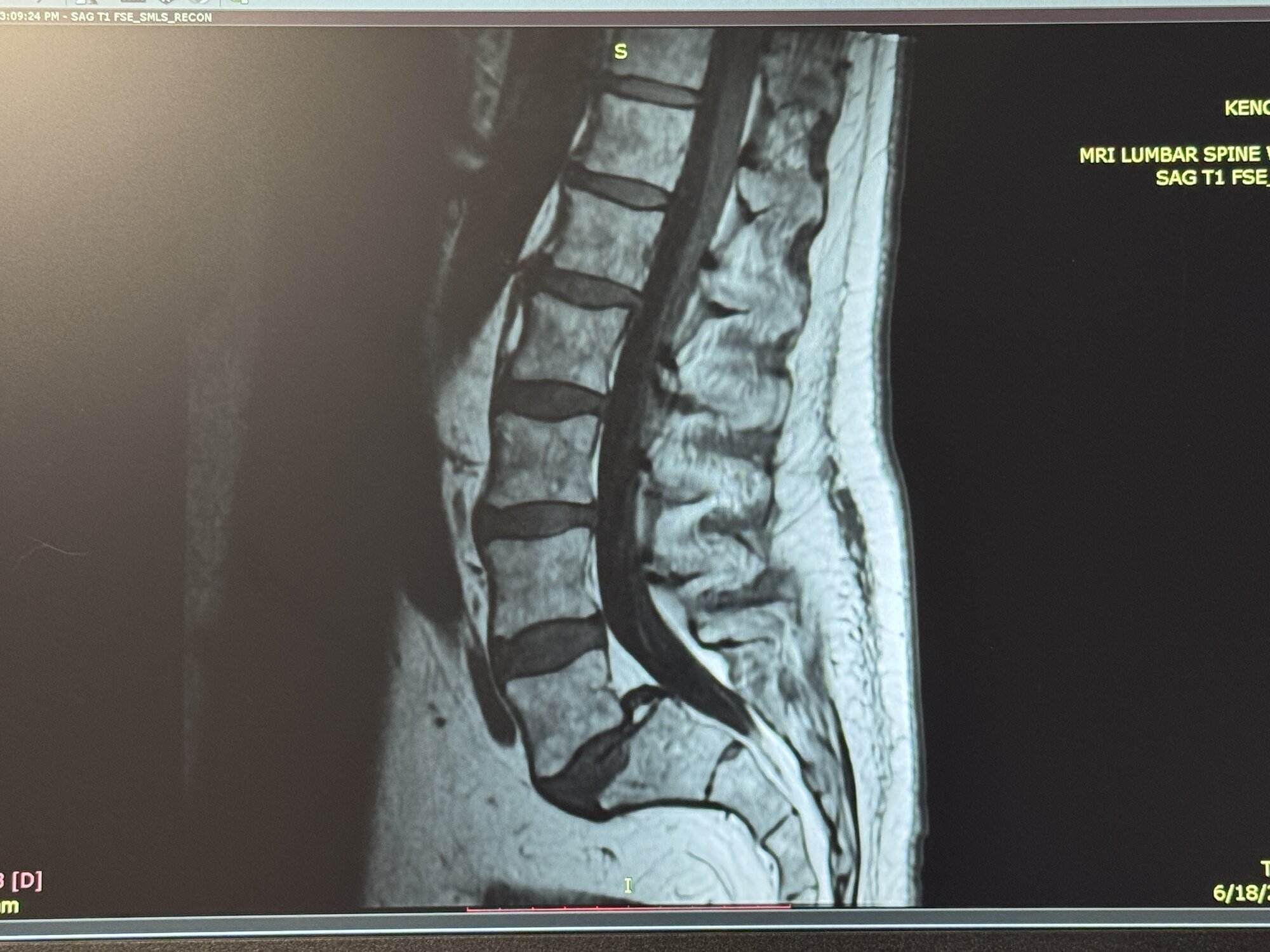
IMG_7019.JPG
 
First, good luck with the surgery and recovery.
Second, do not skimp on whatever rehab is suggested...do the physio, take the time to recover.
For the PA issues, get the bandmates to do the lifting, or hire in somebody.
I've been dumb in the past about recovery from back issues, and am now beyond repair, I can maybe manage a short gig, but that's it.
My fault for not following the advice I just gave you.

Accept the limitations of an aging body, and be smart in working past them.
 
I started PT pre surgery to start getting ready for it. I have an acupuncturist on standby for help with pain management afterwards and I have 6 weeks scheduled off/remote from work. I have a 6 week break in gigs, but I have gigs booked through December and more coming in 2027. I will be going full time IEM's to drop off my portion of the PA gear when needed and I am going to sit down with 2 of my bands to set a line in the sand for the Hammond B3. (yep, I do a lot of heavy lifting)
 
There's some discussion and some resources in the following thread as well:

 
There's some discussion and some resources in the following thread as well:


Excellent. Thanks
 
I’m 64 and at end-stage DDD. Just today I went in for diagnostic blocks on two lowest levels which might qualify me to simply get some of the pain generating nerves ablated. This started in my mid-20s, I’ve had disc surgery in my 40s — twice. and in my belief this was brought on by 70s gear humping. I should have gotten the fusion like you’re going to because it probably would have been a more permanent solution. I think you’ll do well.
 
My lightest speaker cabinet in my rig is my DNA 112 which is 46 pounds without the case.. I am about 3 months from the surgery and I am in a panic. I have never been limited on anything and now...

I’m not limited to a specific weight number by my doc but I’ve had a couple of problems with my spine which have limited what I can comfortably do. I went through the rounds looking for speaker cabs and heads that I could manage. The Barefaced 112 driver cabs were the solution for me. I ended up with a pair of BB2 cabs to use as a PA or use a single as a bass cab. What I found is cab size and weight distribution and handle placement were as important as the simple weight number. Keep that in mind if you go looking for new ones. There are several good options out there these days, so be sure to shop around.

Get a good hand cart or dolly. Work smarter not harder.

Good luck with the surgery and the PT.
 
I had a very physical job. I could see future problems coming and despite that I liked my work and wanted to keep going, I decided it wasn't worth
compromising my future mobility. I retired and now spend my time working on and playing basses, - on the bench.

The B3 is out of the question. If lifting anything other than your instrument is necessary, I would quit entirely now.
 
  • Like
Reactions: red_rhino
Second, do not skimp on whatever rehab is suggested...do the physio, take the time to recover.
Agree wholeheartedly. I’ve reached the age where many friends and family are starting to experience issues like this. Some of them haven’t been as diligent about their recovery as they should have been. They regret it. Don’t phone it in.

set a line in the sand for the Hammond B3. (yep, I do a lot of heavy lifting)
I haven’t seen a B3 in the wild since the 80’s. They’re just not necessary. The only place you should ever encounter one these days is in a studio where it occupies a place of honor, from which it is only moved 5 feet by 4 people (one of which is not me; I’ve done my time.)

Good luck with the surgery. May you have many years of pain free playing. :thumbsup:
 
Hey good luck with your surgery and please take your time to adequately recover!
I've been fighting with a herniated disc for 20 years now, never wanted to get surgery... and I've become very conscious of what I carry around and lift.
I think modularity helps, example: I now carry two lightweight 12" cabs (Barefaced) rather than one big heavy box.
And as for the instrument itself, I was surprised with how much of a difference a mahogany-bodied bass does.
For the PA I'd recommend asking for help from your bandmates or even renting.
 
In 1973 when I was 23, I had Hodgkins Disease, lymph cancer. At that time there was no chemo, only radiation, and they blasted me with it. Over time, the damage it did kept showing up. In the late 1980s, the damage to my neck spinal cord came on, and over time, I had to quit my job as an assistant prop master in the movies. I now can't hold up my head, collars and braces only make it worse, so I have to put my hand under my chin (like the thinker statue) to talk to people.

I have to sit when playing my 21" scale bass ukes, can't play anything longer, and slouch in a stool with a back. I also can't have a strap over my shoulder, so I made a strap that goes around my torso from two Fender Right Height quick adjust straps.
 
In 1973 when I was 23, I had Hodgkins Disease, lymph cancer. At that time there was no chemo, only radiation, and they blasted me with it. Over time, the damage it did kept showing up. In the late 1980s, the damage to my neck spinal cord came on, and over time, I had to quit my job as an assistant prop master in the movies. I now can't hold up my head, collars and braces only make it worse, so I have to put my hand under my chin (like the thinker statue) to talk to people.

I have to sit when playing my 21" scale bass ukes, can't play anything longer, and slouch in a stool with a back. I also can't have a strap over my shoulder, so I made a strap that goes around my torso from two Fender Right Height quick adjust straps.
My lord. As much as I commiserate with you I commend you for adapting to your condition and staying active.
 
Last edited:
Have to say I'm happy to see a 'club' post on this topic as it may mitigate commentary from the usual flock of uninformed TBers.

Back issues are so painful and debilitating that I would never wish them on anyone (well, maybe a few people). Yet if any of this unsympathetic crowd experienced a lower-back spasm and had a condition that caused them to recur three times a year or so, it would almost certainly encourage greater understanding.
 
  • Like
Reactions: iriegnome
Overwhelmingly and resoundingly, PT before and after seem to be the most beneficial and instrumental key to success with any sort of surgical alteration.
In my case, I started my PT 4 months prior to the upcoming surgery and have been working pretty diligently to keep that up. I am also adding some strength training Yoga for flexibility and core building to make sure my body is moving in the right direction and hopefully make recovery that much more possible
 
Question, how many of you changed to lighter weight basses? I play a G. Gould which comes in at 8.5 pounds. I have a Hofner Club that weighs only 5.5 pounds, but alas, it is only a 4 string. I really love playing 5 string basses (If only Hofner would make me a 5 string)

I can’t play standing anymore so weight is only concern if I think I might want to flip the bass someday, knowing that potential buyers will ask. Going back to what I said about weight distribution in cabs, the weight distribution does matter. I have one instrument that doesn’t balance on my leg as well as the others and I find it frustrating. I can tell I’m fighting the balance of the instrument. I’ve read posts from others about feeling the same way while standing and playing. It seems that in general a lighter bass is easier on the neck, shoulders, and back. However, if the weight distribution isn’t balanced well then that can offset the benefit of a lighter instrument.
 
  • Like
Reactions: iriegnome
Who is giving out the club member numbers? I want one!

How I cope:

First: light bass. I love my Mustang. It's light and I don't need to reach out with my left arm

Second: letting the venue's PA do the job. Or bandmates. Don't carry stuff. Use wheels. I carry only my bass, my preamp and IEM gear.

Third: I tend to play lying on the floor with legs on a chair/ball/amp. My bandmates understand sometimes it's the only way.

Fourth: get a gig bag instead of a hard case, if possible. It's lighter, you don't side load your spine and easier to put inside a car/truck. It's less slippery when grabbed not by the handle.

Fifth: when loading the bass on the back seat, lean with one hand above the door opening

Sixth: lift with knees and buttocks. Make it a dead lift. It requires some stretch though. I lift with one hand while the other is on a lap supporting torso weight
 
Last edited: