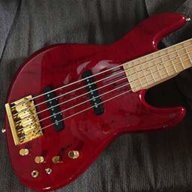
I use an SGFX Beta with the gain turned down to get this kind of effect with my Jazz bass. It still sounds like a Jazz bass, but with an added thickness to the tone.

TalkBass has been independent since 1998. Add your voice.
Create a free account to reply to discussions, view embedded media, and browse with fewer display ads.
Join free Log in
Want zero display ads or expanded classifieds tools? Compare plans.


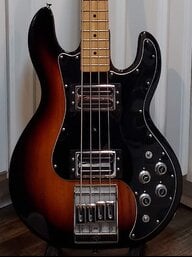
Hey 40 Hz... I just checked out the Audere website and the J bass preamps they offer. When its time to change the battery, I'm assuming you remove the control plate. Just concerned that constantly removing and reattaching the plate will (eventually) make the screw holes sloppy... what is your experience? Thanks! I'm really interested in this product.Easiest would be to install a preamp. I like Audere's preamps for jBs because they offer a drop in package that doesn't require any woodworking or modifications to your bass. But there are other equally good preamps out there.
I've got an Audere 4-band in my JB and the sound I get from it is massive.




Hmm, thinking further maybe that bass you played had a series/parallel switch and you started in parallel, which sounds a bit thinner?
Hey 40 Hz... I just checked out the Audere website and the J bass preamps they offer. When its time to change the battery, I'm assuming you remove the control plate. Just concerned that constantly removing and reattaching the plate will (eventually) make the screw holes sloppy... what is your experience? Thanks! I'm really interested in this product.

Based on it being 'years ago' and in a shop, I was thinking aural exciter or sonic maximizer.. was the effect you used a rack unit or a pedal?
Based on it being 'years ago' and in a shop, I was thinking aural exciter or sonic maximizer.. was the effect you used a rack unit or a pedal?
The battery lasts for quite awhile. I get a few months out of mine between battery changes. Which in my case is 2-3 times per year.
I suppose multiple removals of the wood screws could make the holes loosen up. But when you put the screws back in, just back them off a quarter turn or so first. You'll feel when they drop back into the threads that were already cut in the wood. So when you go to screw them back in you should feel zero resistance. That way you'll know you're not cutting new threads in the wood. Do that - and don't over tighten - and you should be able to remove and reinsert wood screws as often as you need to without experiencing any slop.
BTW that is a technique that works with any wood screw, including the ones holding the neck and pickguard.
And if you ever do have a loose screw (no pun intended) you can always grab a toothpick or other small wood dowel, put a neat drop of crazy glue on the tip, insert it into the screw hole, trim it flush, and then recut the threads into that. Works like a charm.
The only thing you need to be aware of are the clearances required for the preamp.
Per Audere:
"The preamp is designed to drop into the existing cavity of most jazz style basses; the cavity size needed is 1.2" deep, 1.1" wide (1.02" at the battery end), and 4.8" long.
On a standard Fender, and many if not most other Jazz style basses, it shouldn't be an issue. But it doesn't hurt to remove the control plate on your bass and check the dimensions first before ordering.
Minor note: I didn't find the Z-mode feature brings that much to the party if your JB is loaded with the usual JB single coils. So if you don't; (a) have a side jack; (b) want separate volume controlS rather than a volume-blend; and (c) don't feel the need for the "advanced" battery LED, you can save considerable money (about $60 last I looked) opting for Audere's regular preamp model rather than their Pro JZ3 series. I've used both. And while the extra flexibility of the Pro JZ3 was nice to have, I found I was just as happy with the results I got from their standard 4-band model - which is is what I've got in my bass right now. YMMV.
About the only caveat to be aware of with an Audere preamp is that there is no passive mode option due to the way it's designed. Nor can it be modded to have one. That means no power = no signal. Period.
This is common to all preamps that use what's called active blending. With active blending everything is handled by the preamp. It's not just a boost and EQ. It also electronically mixes the direct signals from your pickups. If you want to have both active and passive modes available you'll need to pick a different preamp brand like Pope or Aguilar.[/QU
Wow! Thanks for all the info! I have a 60s (reissue) J with stock pups. It has a side-mount output jack. I would be interested in the preamp you have (standard 4-band model)... you stated that the standard 4-band does not have the indicator LED? I thought that I saw it did when I visited the Audere site... could be wrong, though. Maybe the model with the side jack has the LED... but I thought all J basses had a side-mount jack... hmmmmm.
See attached pic regarding indicator LED on the standard 4 band.
Again, thanks for all the information and insight regarding this preamp... it's been very helpful!

The mids knob on your Amp probably would do wonders

Thank you for responding again. I've@Kipp Harrington - I didn't say it didn't have any LED. I said (probably not too clearly) that it doesn't have what they call an advanced power indicator LED. It does have a less fancy power indicator that flashes when you first insert the jack giving a rough but adequate indication of battery health.
As far as side jacks go, most Fender PBs and JB come with Leo Fender's original top mounted jack design. Side jacks are a relatively recent development when it comes to Fender basses. Most classic Fender guitars and basses (PBS, JBs, Strats) have top jacks. Only the Tele traditionally sported a side jack.
 got it straight now.
It was a multi effects pedal, reddish, but that's about all I can remember. I think the brand was ZOOM....


It doesn't "widen" the P bass, but I found the good old Dimarzio Model P emphasizes midrange frequencies in a very rude and thick way, making it both sound clankier and more substantial and less "polite". Especially when used with some amp or pedal drive(or both!)
I recently built a thin-sanded, hard maple bodied P bass that is already pretty bright, threw a set of ancient rounds I had lying around on it, and did a comparison between the Seymour Duncan Quarter Pounder(which also sounds great) and the Dimarzio Model P. I woudn't have bought the Dimarzio, except I thought the Duncan was dead - it was a cold solder right at the pickup. I fixed it but decided to try both to see which I was going to keep on the bass. I like metallic clanky tones so I figured the QP was going to stay, and the Model P would be much duller. I wound up being wrong about how I felt after hearing them. I felt the Dimarzio did something cool to the mids.
I know you're looking for an effect, but I felt this may be relevant. I felt the Duncan sounded smoother, whereas the Dimarzio had more attitude/attack.