• TalkBass has been independent since 1998. Add your voice.
    Create a free account to reply to discussions, view embedded media, and browse with fewer display ads.
    Join freeLog in
    Want zero display ads or expanded classifieds tools? Compare plans.

Beginner questions on fretting & muting in a specific exercise

I've been having a good time with a few books, BassBuzz, and StudyBass, but tonight I had a couple of rookie questions that I wasn't sure how to answer. I would really appreciate some pointers.

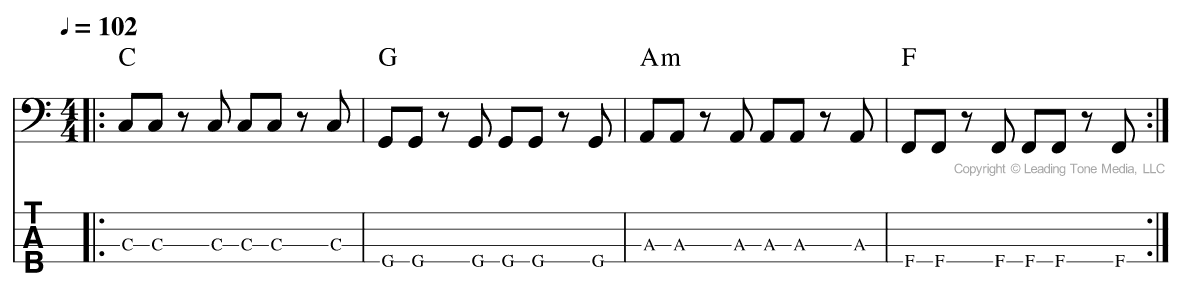
I was playing this exercise from StudyBass and realized that while I could play the notes I was not at all sure if my fretting or muting technique was correct.
upload_2020-10-26_22-1-9.png


Muting
When plucking I always try to alternate index and middle finger since that is what the Internet said to do. :) When I come to a rest or need to do a staccato note, I mute the string with the next finger in the sequence. So, for the first two C eights notes above, I go pluck 1, pluck 2, mute 1. I'd do the next 3 C eights notes with pluck 2, pluck 1, pluck 2, mute 1. That felt pretty natural... so of course I am worried that this is totally wrong.

Fretting
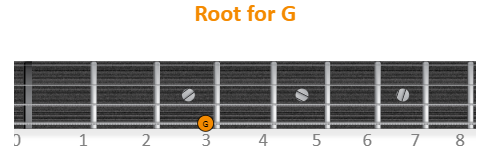
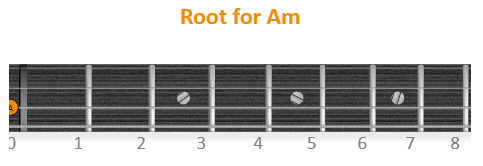
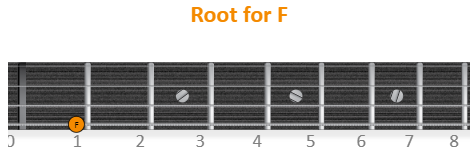
C and G are both on the 3rd fret of their strings, then you play open A, then move up to the first fret on the E string. There are a few ways you could do this, but I don't know what is best. Should use fingers 1 and 2 to hold down frets for C and G at the same time? Or, press the A string 3rd fret with finger 1 and keep finger 2 poised over the E string 3rd fret? Or should I use one finger and switch strings? Or... something else?!

However that happens I assume that while I am playing the open A I move finger 1 up to play F on the E string... but how do I prepare to jump back down to C? Do I try to place finger 1 on the E string and stretch finger 4 to prepare C on the A string?

Thanks a bunch if you can clarify any of this!

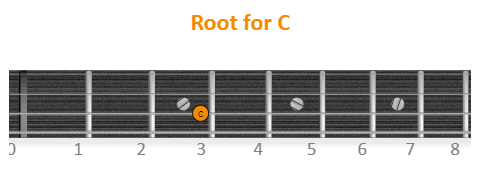
FWIW the fingerings offered for the notes in this exercise were:
upload_2020-10-26_22-2-1.png

upload_2020-10-26_22-2-18.png

upload_2020-10-26_22-2-34.png

upload_2020-10-26_22-3-16.png
 
Of course there is no "correct" approach

Muting: I see no problem with your approach
though I would be just as likely to left hand mute for this line.
practice both approaches, they all need to go in your tool box.

fingering:
I would approach this as half position, using 124 fingering
index finger hovering over fret 1
Finger C & G using my pinkie
finger F with my index

note1:
I never anchor my left hand in place and strain myself to "make the stretch"
I grip the neck with my index over fret 1, and when I need to reach fret 3
I give myself permission to move my left hand a little
I keep my thumb in place and slide my palm a bit toward the bridge
then slide back down when I need to fret 1

note 2:
when I fret with my pinkie, I usually 'back it up' with the other 3 fingers.
I am using my whole hand, not just the pinky.
This is true for every finger, as much as possible:
The ring finger gets 'backup' form the index & middle
The middle finger gets 'backup' form the index
some fast lines or big jumps exclude this approach
but more muscle = less strain on the hand

how do I prepare to jump back down to C?
note 3:
Generally when we speak of "up" and "down" on an instrument, the assumption is up and down in pitch.
different instruments orient in different directions, so geometrically "up" can vary
In my brain I think I'm jumping back up to C, arguably a more musical way to think.
 
First the left hand. In that example I would probably play the C with 2, G with 1, then A with 4 on the E string at 5th fret - avoiding the open string - then down to F with 1. Going back up to the C, I would probably just play the first 2 notes (1-and) with 4, then use the rest on '2' to switch to finger 2 for the remainder of the bar.

Things get a little more involved with the right hand. I am a strong advocate for alternate plucking (AP), but there are many facets to that approach, each with it's own issues. There is a school of thought that one finger is always dominant, and that the dominant finger - usually 'i' - should always get the important notes such as downbeats or other accents. I don't subscribe to that.


upload_2020-10-27_11-50-30.png

In 'A', strict alternation of everything including the rests (as you are doing) ensures that the accents and downbeats are always played by the same (dominant) finger. The danger of 'playing' the rest this way is that you actually close the previous note with a percussive click and pop instead of a good clean 'off'. Perfectly legit in some styles, but certainly not all. Muting is a job for both hands and anything else you have free at the time!

In 'B', only the sounded notes are alternated - rests just take care of themselves. In this case, the '3' is played by 'm', which to the 'dominant finger' thinker could risk making the surrounding off-beats ('2-and' & '3-and') too strong. Here the muting duties appear to fall mainly to the left hand, but - muting is a job for both hands and anything else you have free at the time!

In 'C' we see the appearance of the 'rake' - the same finger playing adjacent strings when descending. If you rake here but then continue AP for everything else, subsequent downbeats '1' and '3' get played by 'm'. Not bad per se, but possibly not ideal in the mind of the 'dominant finger' school.

In 'D', the rake followed by AP just for notes (not muting/rests) puts the dominant finger on the '3' but not on the '1'.

But see how the reversing effect of the rake follows through into the first bar of the next repeat - highlighted in red on yellow. So now the first repeat is leading on 'm'. Of course this will be reversed again at the next 'C' > 'G' transition...

Personally I think it should make no difference which finger 'leads' or gets the important notes. I think both 'i' and 'm' should be equal members of the team. I think there is merit in developing independence between the left and right hands, and exercises should be approached with that purpose in mind. So, first lead with 'i', play/mute the rests with the right hand, then don't play/mute the rests with the right - just lift off and mute with the left, as in examples A and B. Then switch over and do it all again, leading with 'm'.

As for the rake, I think it has a place under 'special effects', but it is also a 'false prophet' that fails to deliver the promised increases in speed and fluency. Shortcuts like the rake can make you think you are playing faster or more fluently at higher tempo, but in reality they just lay traps. With this type of pattern there are plenty of spaces in which to it switch fingerings at any time without too many problems - if the rake gets you out of step you can wait for the next one or make an ad-hoc change. BUT, and it's a big one, the techniques you develop at this stage need to be scalable in terms of complexity and tempo. Relying on 'corrections' like switching fingerings is not the way to do this - they might save you in a 'gappy' line at 70bm but they can trip you up and bury you in straight 1/16ths at 140+. But that is just my humble opinion, so YMMV.
 
@mambo4 & @SteveCS -- I dug in to both your replies during practice last night and it really paid off, thanks again. I had real breakthroughs on muting and fretting issues. Steve, marking up that music and getting into plucking details was going and beyond for sure, thanks so much.

I have a related question from working more with left hand muting via lifting off the fret.

When I push the finger back down onto a fret, it is really easy to make the string audibly ring. I have to concentrate on fretting softly to not add noise--which makes it hard to fret quickly. This may be normal, but I thought it might also mean that I am not plucking loudly enough--making normal fretting noise (if that is a thing) simply seem louder than it should. I'm trying to use a light touch everywhere, but I may be overdoing it on the plucking hand.

I can also camouflage the sound of fretting if I follow it with plucking as soon as possible but that feels rushed and unnatural.

You can't exactly feel and hear what I am, but if you have any thoughts on defeating fretting noise I am all ears.
 
  • Like
Reactions: SteveCS
are you playing unplugged? There are many minor noises on an unplugged bass that don't carry through the wires and speaker. You should target your technique for the sound you get from the gear, either amp or recorded signal.

Kudos to you for trying to keep a light touch, it will benefit you in the long run.
Left hand finger pressure is and often neglected subject.
but it is something you can practice and improve:
 
...
I can also camouflage the sound of fretting if I follow it with plucking as soon as possible but that feels rushed and unnatural.
...

Actually it is better to synchronise the left and right hands. Try to stop the string at the exact time that you pluck it. Here's a thought as to why...
Imagine 1/4 notes in 4/4 at 60bpm. That's one note per second. In a legato style, each note should be 1 second in duration, merging smoothly into the next with no space between. Say you fret ('stop') the string 1/8 of a second before you pluck. Each note is now only 7/8 of a second in duration, with 1/8s 'dead' time. Now lets do 1/16 notes at the same 60 bpm. Each note is now 1/4s long, but 50% (1/8s) of that is the dead time between stopping and plucking. More staccato than legato.
Now double the tempo to a modest 120bpm. Each note is 1/8s in duration. But you need that time to set the note up - you have no time to play anything before the next note comes along! Silence!
Get the 'dead time' down to 1/16s and your 1/16 @ 120 bpm will stay alive long enough to have pitch. Get it down to 1/32s and they become notes you can hear and play tunes with.
IME, synchronization is the key to cleaner, faster and more fluent playing.
YMMV.
 
Last edited:
  • Like
Reactions: JRA and 12BitSlab
Sorry I missed these replies!

@mambo4 I never play un-amplified but 99% of the time, I use a Link Removed instead of a speaker.

Thanks again for the detailed answer @SteveCS!

> a modest 120bpm

That'll be the day! If I try to play 100% clean it takes so long in between notes that I have time to make a sandwich.
 
  • Like
Reactions: SteveCS