• TalkBass has been independent since 1998. Add your voice.
    Create a free account to reply to discussions, view embedded media, and browse with fewer display ads.
    Join freeLog in
    Want zero display ads or expanded classifieds tools? Compare plans.

Best Approach to Fretless

I’ve done two sessions since thinking up my ‘system’ in post #236. It works. The thumb reference point works. I pointed it out to my guitarists and told them I was thinking about a series of custom indents on the back of the neck, and one replied “I saw a thing about Roger Fisher (original Heart guitarist) doing exactly that in some custom guitar builds”.

I find that fascinating. Dunno that I’m willing to start carving up a virtually new $1K bass now, but it’s cool that the idea is obvious enough that someone else, a person of some note, has also arrived at the same conclusion.
 
  • Like
Reactions: Papageno
...
The thumb reference point works.
...

Yes it does. My daughter's 'cello teacher uses a similar idea with his beginners...

Link Removed

But note how it is intended to promote and develop posture, not the finding of position.
I've said it before and I will say it again - intonation in any given position is a function of posture. Visual markers do not help with posture* and by reduction cannot help with intonation.

* all they do is show you where to put the fingertips, not how to hold the hand...
 
  • Like
Reactions: Auspuff
Very cool!
Yes it does. My daughter's 'cello teacher uses a similar idea with his beginners...

Link Removed

But note how it is intended to promote and develop posture, not the finding of position.
I've said it before and I will say it again - intonation in any given position is a function of posture. Visual markers do not help with posture* and by reduction cannot help with intonation.

* all they do is show you where to put the fingertips, not how to hold the hand...
I had observed earlier in the thread that posture is crucial, that the ability to know where one is in relation to the instrument kinda vanishes if the instrument position is not conducive to it (ie: “below the belt” fingerboard).

There’s good reason for the classical instrument position and posture. And it’s eminently justified if you are playing fretless, for this very reason.

In my band session last night I made a point of looking ONLY at the lead sheets. I did not look at the fingerboard once while playing. I was not perfect, but the pitch was on-target almost all the time. And when it wasn’t, I used my ear to know how sharp (I was never flat) and to quickly get back to correct intonation.
 
  • Like
Reactions: SteveCS
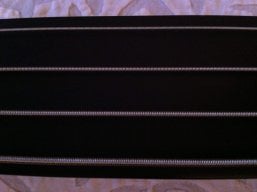
I have both lined and unlined, but I don't think there is anything wrong with a lined fingerboard. People who tell you that you don't need the lines and it looks better without lines can do what they want. You do what you want. You don't need approval either way.

I agree with Deathblade Eric's post above about playing anything and everything that you would on a fretted bass. The more you play the fretless, the more you'll like it and the more you can use it for all kinds of applications, but it takes some time to get comfortable with it. Play with the bass signal going through a good tuner to measure how well you are doing at staying in tune. As you know, though, even fretted basses are not perfectly in tune all the way up and down the fretboard.

On a fretless with fingerboard lines, I still intonate it like I would a fretted bass. That is, I intonate at the 12th fretline, placing my finger at the twelfth fretline, but just behind the line (exactly where the finger ideally goes with the fret there). Some people play fretless by fretting on the line. Mine is intonated at the bridge so that I fret just behind the line. That way, my fretted and fretless basses all feel the same to me. Others may disagree with this advice or have other takes, but I have been successful with it. It is important to understand, however, that the lines are just a guide and you still have to use your ear on stage to make sure you are in tune.

I have found that the fretless feels "silky" to me, so I can get away with incredibly low action and play faster. When I go, for example, from my Fender Am. Std. Fretless Jazz to my Fender Am. Std. 5-String Fretted Jazz, it feels like I'm going from driving a Corvette to driving a city bus. Both are great and they can do different things, but sometimes the frets (and wider neck) get in the way.

An old teacher of mine once jokingly told me to play fast on the fretless and people won't have enough time to ascertain if any single note is out of tune! He was kidding, of course.

Just wondering. If you put a tuner like the Boss TU-3 between the bass and amp can you leave the TU-3 on and just play normally watching how your intonation is on a fretless? I thought the TU-3 was just for tuning but this sounds like a good use for learning fretless.

Thx.
 
Just wondering. If you put a tuner like the Boss TU-3 between the bass and amp can you leave the TU-3 on and just play normally watching how your intonation is on a fretless? I thought the TU-3 was just for tuning but this sounds like a good use for learning fretless.

Thx.

Not sure about the TU-3 specifically, but most tuners have this capability. If not, then this is exactly what the "tuner out" 1/4" jack on amp heads is for.

Digital tuners are a great practice and performance tool for fretless bassists. Not sure why you don't hear tuners recommended more often in these threads. For example if you are playing a song where the bass plays an unacompanied introduction in a "flat" key, there aren't any open strings for pitch reference, and (like me) you don't have perfect pitch. You can use the tuner to make sure your finger is in the right place, so that opening Bb (or whatever) is in tune, then take your tuner off mute, and start playing. The audience deserves an in-tune bass introduction; they don't want to hear me sliding up and down, making "micro-adjustments" to the pitch.
 
Steve,
Have you tried the Tunerval app I suggested in my earlier post? It tests your ability to recognize relative pitches by playing the root and then the interval and asking if you think the interval is sharp flat or in-tune. (not sure if its ET or just, it doesn’t say so I assume ET.)
Its fun and its a great way to tune up your ears for a few minutes a day.
I am not very good, at least Im no where nearly as good as I would have thought I was.
If I am just working on one key and one interval, say a fifth, I am good to like 15-20 cents. But mix in different keys and different intervals, like thirds, fifths, m7ths with any roots between A4 to A5 and Im lucky if I can tell a major third is 35-40 cents sharp or flat.
If we are musicians, and we are often 30 cents off, I think we should relax. Unless you’re playing for an audience of Korg tuners, I think it will be ok. Great paintings, great recordings, novels- they all have flaws. We are making art here, not aiming for a high score.

Of course , I’m not saying it isn’t a good idea to use this app to train our ears. What’s the quote, “music, not gym”.
 
Things I've found helpful in my transition to Fretless. Some of these were carried over from my brief stint playing upright in College.
1. Your left hand technique is very important. If your left hand is sloppy on fretted, your fretless learning is going to be more complicated. Try to get your finger perpendicular to the strings, your thumb placement is important for consistent finger positioning and the ability to use vibrato. This will also help you avoid your hand creeping up or down the neck when playing in a single position...it happens. You won't feel like you're moving, but sure enough, you'll look over and your hand will have slid one way or the other a bit and then you wonder why your ear didn't catch it.

2. This has been said before, but use open strings to check yourself. This is an old upright technique. Sometimes if I'm playing, for instance, a D on the A string for more than a passing note, I'll also lightly pluck the D string to make sure I'm in a good spot. If you're practicing and want to reference, there's also harmonics that can either tell you where you are pitch-wise, but also act as landmarks on the neck. So, if you want to make sure you're landing on the right spot, check if there's a harmonic under that note you can check yourself with.

3. When Shifting, I think to myself "put your first finger where your third finger is" or "put your pinky one half step below where your first finger is" and I find it helps my brain move my hand to the right position. I do reference my fingerboard quite often, but I really try to play without looking at the board too much, unless I'm soloing. I like to try to make eye contact with the audience, but I will sneak peeks to check after a shift.

4. For improving my ear, I found this app called Chordbot, it's on Android and Apple. It lets you set up a chord sequence, and you can have it play chords, or arpeggios over that sequence with a variety of different instruments, in different registers, and move what note is in the low end. You can also adjust the tempo. I usually set each chord to go 4 or more bars before changing to the next chord.
When doing this, I run my signal through my Boss TU-3 pedal (just go out the bypass) and you can leave it on all the time), then out to my amp.
I'll then start playing the roots of the chords in various positions on the neck, when I think I've got it dead on, I'll reference my tuner and see how far off I am, then adjust accordingly and really listen. Then I'll move onto the next chord.
Once I've done that for a while, I'll start playing arpeggios so I get used to hearing the different "important" notes of the chord in reference to the chord being played, so it's more in context with what you'd experience in a live settings.
then I'll move on to just playing the 3rd, or the 5th, or any of the other notes in the scale for that chord to see if I can get that to land in tune, all the while I'm referencing my tuner ONLY AFTER I think I'm on pitch.

I found this quickly helped my intonation improve drastically to where I'm rarely more than 2 or 3 cents out, and man does it feel good when you nail it.

5. In regard to some of the other comments, I use a hybrid 1,2,4 and Finger-per-fret, I base it on what the need is. I favor the 1,2, 4, but there are times when the line is much easier with all 4 fingers. Basically, on my fretless, I try to shift as little a possible. This is helped by the 5 and 6 string fretlesses I play, but my upright teacher taught me that every shift is an opportunity to be out of tune.

6. Remember that while you tune, and hopefully everyone you play with is tuning, unless you have a fixed pitch instrument like a keyboard, there will be variations, and it's more important to play in tune with your group, than to be technically correct. This is one case where that is NOT the best kind of correct, because even thought your tuner might show you dead on, you'll sound off because the majority rules. If you have a keyboard, then you want to be in tune with them, and let the rest of the band hang out to dry. Guitars go out of tune pretty quickly, and if they have certain types of tremolos, it's even worse, and because the majority of guitars are fretted, they're locked into what their tuning is until the end of the song. (unless you have a guitarist with a great ear and the ability to play one-handed while he tunes cross-body with the other).

These are just my experiences, your mileage may vary. Music is an individual journey, and what works for one person may not work for the next. The important part is that you get joy from it.
 
  • Like
Reactions: 12BitSlab
Just wondering. If you put a tuner like the Boss TU-3 between the bass and amp can you leave the TU-3 on and just play normally watching how your intonation is on a fretless? I thought the TU-3 was just for tuning but this sounds like a good use for learning fretless.

Thx.
Yup, just use the "bypass" output and you can leave it on all the time. I do this on stage so I can double-check myself. If you're playing a lot of fast notes, it will struggle to keep up, or just not show anything, but the next long-ish note you have will usually show just like you want.
 
I second the Gary Willis comments posted by Papageno (pasted below).
Reading with a drone has numerous benefits besides improving your reading. Reading forces you to rely on efficient technique, muscle memory, and your ear. Slow tempos help identify poor intonation. The drone helps you stay in tune.
If you have notation software, try playing in unison with the audio playback while reading the chart.
Unlined fingerboards usually have dots. They function the same as lines, as far as I'm concerned. I look at them as needed.
Notes in the higher register are less forgiving (and worthy of practice).
Even double stops in the higher register at slow tempos. Try playing double stops to outline chords while playing along with iReal Pro.
Recording every rehearsal and performance allows you to identify problem areas. I use a Zoom H-4.
Minimize sliding and vibrato (less is more).
Dive in and play fretless exclusively for a while.

- in Tip 21 "Fretless reading" Gary writes "if you don't feel you've developed that perfect intonation muscle memory we all strive for (I know I'm not there yet) (NB: Gary W speaking here!), then a quick glance at the neck won't harm" (yes he does advocate a quick glance, and I guess noone would advocate no to do this),
- in Tip 40 "Fretless practice" Gary advocates practicing with a drone to work on intonation,
- in Tip 41 "Fretless pivot" Gary writes "If you don't happen to hit that spot with deadly accuracy all the time (believe me, it'll happen) (NB: Gary W speaking here!), then you'll need to coax the note in the right pitch without sliding. This is where the "roll" comes in", and then explains how to do it,
- in Tip 72 "Muscle memory", Gary states: "Learning to play in tunre on fretless is accomplished in two steps: hand-eye coordination and then eventually muscle memory",
- in Tip 87 "Ear training exercise" Gary writes "I've always maintianed that your ear is your most valuable asset".

I tried fretless once with a de-fretted Precision. I couldn't get it and gave up. Much later in life, I bought my current bass, a Warmoth J-style four-string with an unlined neck. It clicked. Full disclosure: I played bass for the musical "Kinky Boots" earlier this year. I decided I couldn't read well enough to play in tune, so I bought a fretted bass. Much less stressful.
 
  • Like
Reactions: fusionguy
Would like some advice to switching to a Fretless. Thanks in advance.
Just put your other basses completely away for a month or three, for starters. I started out on fretless and although I've owned a few really nice fretted ones it's never stuck. In the vast majority of my playing situations very few people even notice that I'm playing a fretless unless I decide to drop some cliche cues. And of course those cliches are cliches for a reason, because they can be very cool to listen to, and more importantly, a blast to play.
 
  • Like
Reactions: fdeck and SteveCS