• TalkBass has been independent since 1998. Add your voice.
    Create a free account to reply to discussions, view embedded media, and browse with fewer display ads.
    Join freeLog in
    Want zero display ads or expanded classifieds tools? Compare plans.

Best wood for bass?

You said that the wood provides the tone, and the pickups are just microphones that amplify the tone that the wood gives. As a builder, I can tell you that that is simply ridiculous. If it were true, pickup location wouldn't matter, pickup type and winding wouldn't matter, string choice wouldn't matter and hardware wouldn't matter. If wood does anything it contributions to the over all tone are very nominal.

I never said pickup location, quality of pickups or strings didn't matter nor that wood was the only defining factor in tone. You're putting words in my mouth. I'm saying wood is the most defining factor. We can only agree to disagree.
 
Which is exactly my point, if it takes a trained ear to hear a difference, then the difference is minor. If a layman can clearly hear a difference then that is a pretty major difference.

My experience is that I am a bass and guitar builder and tech. I'm not currently in a band and haven't been for years. I play everything from hard rock to country, and play every bass from a Padauk/wenge/ebony 5 string to a basswood bodied, maple necked P bass
I understand your perspective now. I don't think many on here were saying everybody could ascertain the difference. Your audience here is expected to be at least a player that has experienced the tonal differences, so we are all dealing with an emotional, highly charged subject. Long ago I remember reading an argument about if a Stradivarius sounded any different than a similar seasoned violin. Highly charged and two distinct camps. That didn't change anybody's opinions. In the end it is whatever you like.
 
The ironwood is heavy particularly combined with ebony, but coupled to a somewhat heavy alder body it still balances ok. I initially put ultralite tuners on it which helped a lot but eventually went back to mid 70's vintage tuners. There is no truss rod so that may change the weight some. The whole bass is about 9.5 lbs.
Was there any other stiffening other than the neck wood? Was there any neck bending? Was there any neck buzz? At 9.5 lbs. I would not call that overweight. I have seen plenty of oak basses heavier than that.
 
Was there any other stiffening other than the neck wood? Was there any neck bending? Was there any neck buzz? At 9.5 lbs. I would not call that overweight. I have seen plenty of oak basses heavier than that.
No other stiffening on this one, just the 2 woods. Granted, I use TI flats on this so they are relatively low tension. If I was going to build one for someone else I would definitely add a truss rod just in case since I wouldn't know what strings they were putting on. But because it was custom for me, I built just enough backbend in it so that it would give the perfect amount of relief when under tension. It has low action with zero buzz. This recent thread shows close-up shots of the action. At under 10lbs, it doesn't feel all that heavy.
 
  • Like
Reactions: Canadian APII
The argument can be made that past the 100% of frequencies provided by the strings, EVERYTHING downstream in the signal chain is subtractive. (I know, I know, active pickups and preamps... but they can only boost/cut what signal is provided to them. )

Essentially true, except for many common pedals, like the VT bass. It will generate partials that may be non-existent or only minimally present in the input signal. Then there is more dramatic distortion like plain old fuzz. In any case, distortion typically adds to, and often shifts frequencies in the input signal.
 
No other stiffening on this one, just the 2 woods. Granted, I use TI flats on this so they are relatively low tension. If I was going to build one for someone else I would definitely add a truss rod just in case since I wouldn't know what strings they were putting on. But because it was custom for me, I built just enough backbend in it so that it would give the perfect amount of relief when under tension. It has low action with zero buzz. This recent thread shows close-up shots of the action. At under 10lbs, it doesn't feel all that heavy.
Nice. Are there any sound bites anywhere?
 
So many posts containing generalizations about the effect of wood but so few differentiating between body wood and neck wood.

Q: What supports string tension?
A: Body and neck.

Q: Does the body have a truss rod?
A: No, because it's so rigid that it doesn't need one.

Q: Does the neck have a truss rod?
A: Yes, usually, because it's thin and flexible.

Which one (in a solid body bass of course) is much more likely to color the sound of the strings due to sympathetic vibrations?

Fingerboards? Why is so much importance attached to the fingerboard when it seems obvious that flexibility and resonance of the neck itself is a much bigger factor? What does the fingerboard contribute when you play an open string?
 
Last edited:
Nice. Are there any sound bites anywhere?

The bridge cover is on the bass in both of these video clips which adds a little weight but I have since taken it off. 9.5 lbs without it.

Here is a short clip of a co-worker playing Invalid Link Removed. He's much better than me and has only played fretless a handful of times.

This is me playing Summertime with some co-workers. The clarinet solos are great in this tune.
 
I think it depends of the kind of music you play.
I find this works best for metal.

metalcarver-guitar.jpg
That is so cool! What is it?
(Yes, I know it's a guitar...)
 
  • Like
Reactions: GBassNorth
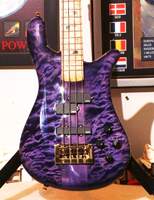
I like the variations but some of the best tone woods for the fingerboard are Pau Ferro or Ebony, for the body I found a nice sounding Spector Helium that had a redwood body (the redwood used for the body came from reclaimed water tank woods used in New York) with a figured maple top.

The builds that I have use a three piece rock maple neck with graphite rods, currently I have a fretless Ebony fingerboard along with a Pau Ferro and a sealed/coated Birdseye maple which are both fretted. I also have a matte finished Birdseye maple fingerboard on a solid rock maple neck. The bodies are all solid figured maple on the neck-thru basses, on the bold-on bass its figured maple over alder.
 
I never said pickup location, quality of pickups or strings didn't matter nor that wood was the only defining factor in tone. You're putting words in my mouth. I'm saying wood is the most defining factor. We can only agree to disagree.


And you are 100% wrong. A P bass sounds like a p bass no matter what it is made of because it is a 34" scale bass with a split pickup in the correct location. It doesn't sound like alder, ash or mahogany.
 
Last edited:
I understand your perspective now. I don't think many on here were saying everybody could ascertain the difference. Your audience here is expected to be at least a player that has experienced the tonal differences, so we are all dealing with an emotional, highly charged subject. Long ago I remember reading an argument about if a Stradivarius sounded any different than a similar seasoned violin. Highly charged and two distinct camps. That didn't change anybody's opinions. In the end it is whatever you like.

That's fine, so we can agree that wood does not make a huge difference, at least compared to other components and their locations.
 
So many posts containing generalizations about the effect of wood but so few differentiating between body wood and neck wood.

Q: What supports string tension?
A: Body and neck.

Q: Does the body have a truss rod?
A: No, because it's so rigid that it doesn't need one.

Q: Does the neck have a truss rod?
A: Yes, usually, because it's thin and flexible.

Which one (in a solid body bass of course) is much more likely to color the sound of the strings due to sympathetic vibrations?

Fingerboards? Why is so much importance attached to the fingerboard when it seems obvious that flexibility and resonance of the neck itself is a much bigger factor? What does the fingerboard contribute when you play an open string?


The string is basically being anchored to the fingerboard, and vibrations are being absorbed by the material. Of course this is pronounced more on a fretless bass, but it is still present on a fretted instrument.
 
I like the variations but some of the best tone woods for the fingerboard are Pau Ferro or Ebony, for the body I found a nice sounding Spector Helium that had a redwood body (the redwood used for the body came from reclaimed water tank woods used in New York) with a figured maple top.

The builds that I have use a three piece rock maple neck with graphite rods, currently I have a fretless Ebony fingerboard along with a Pau Ferro and a sealed/coated Birdseye maple which are both fretted. I also have a matte finished Birdseye maple fingerboard on a solid rock maple neck. The bodies are all solid figured maple on the neck-thru basses, on the bold-on bass its figured maple over alder.
Do you have photos of the fretless Ebony fingerboard neck?
 
Except in the case of open strings. I don't believe fingerboard material is that significant, but neck material yes.
I disagree. The thing that appears to make fretted fretboard wood seem less relevant is the presence of frets. Obviously, playing on frets creates its own set of sounds, so the choice of fretboard material (assuming the premise of tonewood is valid) is not as significant to the tone as the presence or absence of frets.

But here's the thing -- in the vast majority of cases, the nut is still mounted on the fretboard. So IF the choice of tonewood matters for fretboards when playing on the frets, it still matters when playing open strings.
 

Latest posts