• TalkBass has been independent since 1998. Add your voice.
    Create a free account to reply to discussions, view embedded media, and browse with fewer display ads.
    Join freeLog in
    Want zero display ads or expanded classifieds tools? Compare plans.

Best wood for bass?

Of course different components are going make two different P basses sound slightly different, but still very recognizable as a P bass. The 34 scale split P has its own character, some can be brighter, some warmer, some hotter, some mellower, but the main tonal character of a P bass is still going to be present, and still the biggest part of the sound of that instrument. Nothing about my statement was incorrect.

So tell me, is a P bass made of alder with a rosewood fretboard any less recognizable as a P bass, as an ash body with a maple neck? Same thing with a Jazz or or StingRay. If wood was the biggest contributing factor, like some people believe, different woods would completely change the character of the instrument to the point that it would sound totally different than an identical bass with different woods.

You clearly aren't too confident in your original statement... "any 34 inch split P precision bass will always sound the same regardless of what wood it's made from"

You have laughably moved the goal posts all over the field.

Just from your last few posts you've claimed...
Alder, ash and mahogany will all sound the same, then revised your statement to just alder and ash. Then changed your position from "sound the same" to "slightly different". And now you claim regardless of wood or other components it may no longer sound the same but it will still sound like a P bass - that is brighter or warmer or hotter or mellower than another P bass with different woods.

The good news is that your perpetually morphing position on tone woods impacting the sound of a bass is now pretty much in alignment with what just about everybody on this thread has been saying all along - if you change the wood a bass is made from it can alter the sound of that bass and possibly make it "brighter or warmer or hotter or more mellow" than it was before.

Glad to see you've finally accepted reality!
 
Last edited:
Q: Does the neck have a truss rod?
A: Yes, usually, because it's thin and flexible.

Which one (in a solid body bass of course) is muI understand
I still don't understand how you can think that wood is a major tonal contributor, when in most cases the human ear cannot tell the difference. If you have to use amazing sonar equipment to see it, it doesn't tell me much.
i understand your need to argue for the sake of arguement. Some people feel that need. There is substantial
ch more likely to color the sound of the strings due to sympathetic vibrations?

Fingerboards? Why is so much importance attached to the fingerboard when it seems obvious that flexibility and resonance of the neck itself is a much bigger factor? What does the fingerboard contribute when you play an open string?[/QUOTE]
I still don't understand how you can think that wood is a major tonal contributor, when in most cases the human ear cannot tell the difference. If you have to use amazing sonar equipment to see it, it doesn't tell me much.
i understand
I still don't understand how you can think that wood is a major tonal contributor, when in most cases the human ear cannot tell the difference. If you have to use amazing sonar equipment to see it, it doesn't tell me much.
I don't know the stats for who can hear the differences in tone. I am reasonably sure you don't know either.
 
  • Like
Reactions: GBassNorth
You clearly aren't too confident in your original statement... "any 34 inch split P precision bass will always sound the same regardless of what wood it's made from"

You have laughably moved the goal posts all over the field.

Just from your last few posts you've claimed...
Alder, ash and mahogany will all sound the same, then revised your statement to just alder and ash. Then changed your position from "sound the same" to "slightly different". And now you claim regardless of wood or other components it may no longer sound the same but it will still sound like a P bass - that is brighter or warmer or hotter or mellower than another P bass with different woods.

The good news is that your perpetually morphing position on tone woods impacting the sound of a bass is now pretty much in alignment with what just about everybody on this thread has been saying all along - if you change the wood a bass is made from it can alter the sound of that bass and possibly make it "brighter or warmer or hotter or more mellow" than it was before.

Glad to see you've finally accepted reality!

Evidently you have a reading comprehension problem, I never once said they sound exactly the same, I said they sound like a P bass. I also never gave credit for the slight difference in tone to the wood they are made of.
 
  • Like
Reactions: Imaginary Pony
Q: Does the neck have a truss rod?
A: Yes, usually, because it's thin and flexible.

Which one (in a solid body bass of course) is muI understand

i understand your need to argue for the sake of arguement. Some people feel that need. There is substantial
ch more likely to color the sound of the strings due to sympathetic vibrations?

Fingerboards? Why is so much importance attached to the fingerboard when it seems obvious that flexibility and resonance of the neck itself is a much bigger factor? What does the fingerboard contribute when you play an open string?

i understand


I don't know the stats for who can hear the differences in tone. I am reasonably sure you don't know either.[/QUOTE]
sorry. using my cell phone.
 
Don't bring Canada's national mascot into this. They are national treasures!;)
And there's the thing TalkBass taught me today. I honestly did not know that the beaver was a national symbol of Canada.

Which leads to the next topics for discussion: which wood tastes better? Alder or Ash? And which makes a better dam? Maple or Rosewood? I'm going to guess the beaver would go with maple...
 
  • Like
Reactions: Jah Wobble Fan
And there's the thing TalkBass taught me today. I honestly did not know that the beaver was a national symbol of Canada.

Which leads to the next topics for discussion: which wood tastes better? Alder or Ash? And which makes a better dam? Maple or Rosewood? I'm going to guess the beaver would go with maple...
Clearly alder. No need to argue here.
 
And there's the thing TalkBass taught me today. I honestly did not know that the beaver was a national symbol of Canada..

I just made that up but it is actually true. The beaver is an official "symbol" of Canada.

You DO learn something every day!

P.s. I think beavers prefer birch for dams.

cacb56479bc8d1116d781a86d1a5387c_zps37cc3ee8.jpg
 
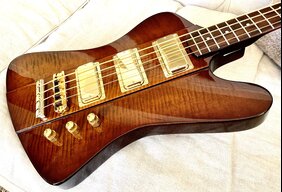
I've been drawing up a custom design to have a bass body made out of. When going through different woods I found that I really like Bloodwood and Wenge. There is a luthier on YouTube that has a series on different woods and does tap tests on the planks to help you get an idea of it's tone.
 
I have heard amazing, satisfying bass tone from instruments with just about every combination of materials possible, from alder, aluminum and ash to basswood..... through graphite, ipe, koa, mahogany and zebrawood......sounding from growly mids to big lows...it just depends on how well the instrument is built, the electronics used and strings . Two basses built of the same woods can sound dramatically different....or the same. Trying to predict or influence the tone of a bass by selecting the wood is a superstitious fairy tale, but it's a lot of fun to obsess over;), and if you sell basses or guitars, or if you have paid $$$ for the wood in your instrument, there is a VERY heavy financial bias in favor of promoting the mystique of wood species. Physics dictates that the wood has some influence, but a 5 degree rotation of any eq knob dwarfs any effect of wood on overall bass tone, and whatever small influence there is, is not predictable based on species. Can you ever close your eyes, listen to an instrument and determine (using only your ears) what a bass is made of? I have yet to meet someone who can, although a lot of people claim to be able to. Whenever I offer a wager on the subject, willing participants are nowhere to be found. YMMV. I love the look of beautiful wood, and choose based on that. Having said all that, most humans are not open to having their heartfelt beliefs questioned or objectively evaluated, and I would place the belief that wood influences an instrument's tone in a predictable way squarely in that category . Happy almost New Year....plus ca change, plus c'est la meme chose :)
 
Last edited:

Latest posts