• TalkBass has been independent since 1998. Add your voice.
    Create a free account to reply to discussions, view embedded media, and browse with fewer display ads.
    Join freeLog in
    Want zero display ads or expanded classifieds tools? Compare plans.

Bigger headstock=more resonance?

This is one of the theories I believe in. I have Strats with the CBS large style, and the later smaller size. The large headstock guitars have more sustain, not comparing the hardtail against a tremolo.

But, comparing that one (1976 Fender) against a top loading (recent Squire) hardtail bridge it sustains more. So maybe that's another apples to oranges comparison, Fender having better everything than the bottom rung Squier.

 
Serious question, what the heck is resonance in a solid body electric instrument anyway?
Can someone describe the difference in sound between a more and less resonant instrument?
Are resonance and sustain mutually exclusive traits? I.e. Does more resonance equal energy being lost from the strings?

Well, let me break it down for you.

A heavier headstock leads to more neck dive, and it also creates a fast neck because of the angle at which you slide up and down the fretboard. As you continually lift the neck up and the neck falls down again, this creates what is known as resonance.

In mathematical terms, the formula for resonance is:
(weigh of headstock in lbs) * (angle of neck dive) * (neck speed in meters per second) + number of frets = resonance in kiloJoules

Add 2 kiloJoules for string-through body.
 
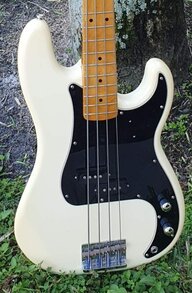
I'm sorry, I'm not familiar with the Thunderbird. Please say more.

Much bigger/longer headstocks than anything else around during the '60s.
IMG_2004_zpsqe6bdecs.jpg

These basses tend to really ring but there are other factors as well - as the reverse were neck through and both versions arguably had more powerful sounding pickups than were otherwise available at the time.
 
  • Like
Reactions: JIO
Most likely a myth. A bigger headstock actually only weighs a few grams more. Nothing comparable to a fat finger or different tuners. These also don't actually improve sustain, they simply change the resonance frequency, which may in turn lead to more (actual or perceived) sustain in the affected frequencies.

This is a question of faith, though. Much like the "tone wood" discussion. No point arguing. :)
 
By increasing the mass of the headstock you can improve tone and reduce dead spots is the concept behind the Fat Finger and the brass plate Alembic came up with many years ago.

Many basses sound good as they are but that doesn't invalidate the concept. I've seen the difference a Fat Finger can make on a bass that needed one and where it made no difference to a bass that didn't need one.
 
By increasing the mass of the headstock you can improve tone and reduce dead spots is the concept behind the Fat Finger and the brass plate Alembic came up with many years ago.

Many basses sound good as they are but that doesn't invalidate the concept. I've seen the difference a Fat Finger can make on a bass that needed one and where it made no difference to a bass that didn't need one.

Yes, they definitely often work against dead spots because they change the way the neck resonates. In doing so they move around the dead spots, hopefully to an area (or frequency) where it is not noticeable. Removing weight can have exactly the same effect, though. So the general statement that bigger headstocks "improve the resonance" (whatever that would mean in scientific terms) does not hold up to a critical analysis. Even less so because the little bit of wood that separates a strat with a CBS or a small headstock weighs next to nothing.
 
  • Like
Reactions: Dominic DeCosa
In that bass necks are made out of wood, and no two pieces of wood are the same, any comparison between two of them would leave too many variables for an accurate comparison.

About the only way you could test with some hope of getting to the bottom of it would be to make several hundred identically constructed necks with oversized headstocks, bolt them to the same test bed, have a device pluck the strings (to eliminate that variable), and measure - then repeat the test on each after the headstocks were reworked to be smaller.

I don't know how you'd get around the variables surrounding the strings however. Different sets, even of the same brand and type, have slight variations themselves. And as they're played, more variations start to occur over time.

Either way, I don't see such test happening due to the complexity and the expense of conducting it.
 
Last edited:
Not sure about this, the headstock on my Guild is huge but I wouldn't say it had more resonance than my other basses, possibly less in fact but then it has that 3-point bridge mounting where the bridges on the P and the Wal bolt directly to the body... there's no single factor that makes resonance.
 
Just saw a video where guitarist Robin Trower says that he had his signature-model guitar made with a big headstock because it provides more resonance. I wasn't sure that that could really make a difference, but I looked at the headstocks of my three basses, and sure enough, the one with the biggest headstock is the one that I've always thought has the best sound. Obviously, many other factors are involved (in my case, that bass is the only neck-through), but what do you folks think about headstock size alone? Could it be that size really matters?

Looks aside, maybe I should leave it as is... when not playing, I can use it as a boat oar.

IMAG1285_1.jpg
 
Serious question, what the heck is resonance in a solid body electric instrument anyway?
Can someone describe the difference in sound between a more and less resonant instrument?
Are resonance and sustain mutually exclusive traits? I.e. Does more resonance equal energy being lost from the strings?

The whole system is of course more complex but if you want to simplify it, then yes, resonance is in many ways the opposite of "sustain", whereby resonance is actually a scientific term, while sustain is not.

In theory, you should get the longest sustain where most of the energy of plucking the string stays in the string and is not passed on to the body. That means the more resonant an electric instrument reacts, the less sustain it will have. In practice, other factors come into the equation, such as feedback etc, but generally speaking that is the way it is. You cannot create more energy than there was. Either the energy stays in the string or it goes into the body and is therefore lost for the pickup.
 

Latest posts