• TalkBass has been independent since 1998. Add your voice.
    Create a free account to reply to discussions, view embedded media, and browse with fewer display ads.
    Join freeLog in
    Want zero display ads or expanded classifieds tools? Compare plans.

Bigger headstock=more resonance?

My Ibanez SR700 is a remarkably resonant instrument unplugged--and it has that characteristically small headstock on a bolt-on neck. If this is a legitimately important engineering factor, I suspect its relative importance is small. However, with long horns and tiny headstock, this instrument has no tendency to neck dive and has wonderful access to all 24 frets. That I am certain of.
 
  • Like
Reactions: navijaz
The whole system is of course more complex but if you want to simplify it, then yes, resonance is in many ways the opposite of "sustain", whereby resonance is actually a scientific term, while sustain is not.

In theory, you should get the longest sustain where most of the energy of plucking the string stays in the string and is not passed on to the body. That means the more resonant an electric instrument reacts, the less sustain it will have. In practice, other factors come into the equation, such as feedback etc, but generally speaking that is the way it is. You cannot create more energy than there was. Either the energy stays in the string or it goes into the body and is therefore lost for the pickup.
Sure. Just check out a hollow body bass. It has more resonance - you can hear the notes quite clearly unamplified. But they won't sustain like a solid body instrument. And the solid body is much less resonant - much quieter unamplified.
 
Have any of you noticed the Fender headstock is inspired by double bass headstocks?
View attachment 987766
View attachment 987775

I've always had a thing for big headstocks (especially the Fender one). It just looks badass.

A romantic idea, but not actually true. Leo Fender stole, er I mean adapted the headstock shape from Paul Bigsby.

Bigsby-StratCompare.jpg
 
i know i am new here but,
Robin likes all sorts of beverages
and what was that about small hands indicate small ....?
haven't read everything
had a few classes of red but
honestly...?
 
The whole system is of course more complex but if you want to simplify it, then yes, resonance is in many ways the opposite of "sustain", whereby resonance is actually a scientific term, while sustain is not.

In theory, you should get the longest sustain where most of the energy of plucking the string stays in the string and is not passed on to the body. That means the more resonant an electric instrument reacts, the less sustain it will have. In practice, other factors come into the equation, such as feedback etc, but generally speaking that is the way it is. You cannot create more energy than there was. Either the energy stays in the string or it goes into the body and is therefore lost for the pickup.
I would say sustain is an acceptable scientific term as it is easily tested with a standardized plucking system, a meter and a stopwatch.
 
I would say sustain is an acceptable scientific term as it is easily tested with a standardized plucking system, a meter and a stopwatch.

Sure, I didn't mean to sound smug. I just meant that "resonance" has a clear definition in physics, whereas "sustain" is something that gets thrown about rather liberally by (bass) guitar players. If it is to mean "decay time of an unamplified note plucked on a string", then yes it is measurable.
 
  • Like
Reactions: MVE
i know i am new here but,
Robin likes all sorts of beverages
and what was that about small hands indicate small ....?
haven't read everything
had a few classes of red but
honestly...?

:roflmao:

Everyone knows the best musicians have the smallest junk and are just overcompensating with their playing and giant instruments and amp stacks :smug:
 
  • Like
Reactions: 089
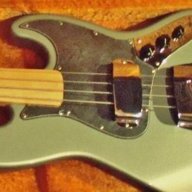
Much bigger/longer headstocks than anything else around during the '60s.
IMG_2004_zpsqe6bdecs.jpg

These basses tend to really ring but there are other factors as well - as the reverse were neck through and both versions arguably had more powerful sounding pickups than were otherwise available at the time.

This pic has inspired me to replace my nut with a brass one like yours. You can see in my post above that the nut (factory from 1964) spacing is way off. I didn't even notice it until recently - I've owned it since '78.
 
  • Like
Reactions: davidprice
This pic has inspired me to replace my nut with a brass one like yours. You can see in my post above that the nut (factory from 1964) spacing is way off. I didn't even notice it until recently - I've owned it since '78.

This one had the brass nut when I got it (about 15 years ago). I tend to think the carve is more important than the material. BTW I also have a '64 Epiphone Embassy Deluxe with a similarly huge "bat wing" headstock.
For the record, relative to the original subject, I think the headstock size has very little to do with any noticeable amount of resonance (though both of these basses are quite resonant...)
 
  • Like
Reactions: JIO
The ratio of headstock mass to body mass does have an effect on resonance. I know this because switching out the stock tuners for lighter Hipshot tuners on my Rick 4001 moved the notorious dead spot on the D string, 10th "fret." Whether a headstock of greater mass increases resonance relative to the resonance of the same bass with a smaller headstock or not, I don't know.
 
In theory, you should get the longest sustain where most of the energy of plucking the string stays in the string and is not passed on to the body. That means the more resonant an electric instrument reacts, the less sustain it will have.

I agree.

This is why you actually get more sustain with lighter gauge strings than heavier due to the lighter string losing less energy transfer to the body and neck of the instrument....... as measured and discussed here.
 
  • Like
Reactions: navijaz