• TalkBass has been independent since 1998. Add your voice.
    Create a free account to reply to discussions, view embedded media, and browse with fewer display ads.
    Join freeLog in
    Want zero display ads or expanded classifieds tools? Compare plans.

Bill Nash Bass Info

Did a search and didn't really find what I was looking for, so I was wondering if anyone here knows what the necks and bodies on the Nash Fender copies are. I keep hearing that they are "parts" basses, but I was originally under the impression that they were built by Nash...

Just wondering, because I would hate to pay $1600+ for an Allparts or Warmoth bass I could build myself for under a grand. The Low End couldn't answer this either, so I was hoping there were some Nash owners on this board that would be more willing to provide info

Thanks!:)
 
That's my understanding as well. Go to www.thelowend.net, and ask Brian. He's a Nash dealer.

I already asked and they gave no real info, except they thought maybe the bodies were built for Nash. Not bashing them, they are super cool there to deal with, but the bass I'm talking about is at their shop and was hoping I could at least find out what the neck was. I've had my hands on the bass before and it's wonderful, but for the price, I just wanted to know what I'm buying:smug:
 
I had a 63 J and still own a 50's P from Nash. The P 50's neck is the best P neck I have ever played - but - it does not feel the same (thickness, contour) neck as the Fender 57 RI or the 58 Custom Shop as I have owned them as well. Sorry, I don't know what they are but do know they feel different than the Fenders.

Also the J Warmoths feel bigger (thicker) than the Nash.

Hope that helps somewhat.
 
I played 2 of 57pbasses Nash Basses. They were great. They were put together extremely well and I love relic basses. These 2, a P and a J were very vintage looking.

If you think you can build a bass for less. Go ahead. It's a lot of fun and it's very prideful to play a bass that you know you built with your blood, sweat and tears.

If you think the bass is overpriced, buy one from a place with a good return policy and see for yourself.

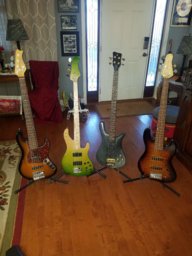
HPIM2877.jpg

HPIM2868.jpg
 
:cool:
They are a little overpriced.

I own a 57 Nash P-bass.
It is well made.
Sounds great.
Lightweight.
And they feel amazing.

Nails that relic, vintage vibe.

I look at it this way.
70's Fende basses, are now $3000.00 to $4000.00.
For get 60's Fenders.
And you can't find a 50's Fender for under $10,000.

So $1650.00 is not to bad?
 
Well, if you buy the parts retail to make such bass, it will cost you between $800 and $900, without finishing. Add $300 to $400 for the nitro finish, and at least another (modest) $200 for the relic'ing job, and that is between $1300 and $1500. And that's is not even counting the labor to put it together and setting it up.

$1650, taking in consideration that there are dealers in between the transaction, is not bad at all. Of course, Nash buys parts in bulk and does the finishing and relic'ing himslef, but still the prices are very reasonable.

The problem is when you enter the used market and find used Custom Shop Fenders or USA Laklands for about the same price. That is a tough decision because Nash is not an established name yet, and value in time is still not defined (if you care for depreciation).
 
Well, if you buy the parts retail to make such bass, it will cost you between $800 and $900, without finishing. Add $300 to $400 for the nitro finish, and at least another (modest) $200 for the relic'ing job, and that is between $1300 and $1500. And that's is not even counting the labor to put it together and setting it up.

$1650, taking in consideration that there are dealers in between the transaction, is not bad at all. Of course, Nash buys parts in bulk and does the finishing and relic'ing himslef, but still the prices are very reasonable.

The problem is when you enter the used market and find used Custom Shop Fenders or USA Laklands for about the same price. That is a tough decision because Nash is not an established name yet, and value in time is still not defined (if you care for depreciation).

Yeah, I agree with you 100% here. I was just thinking about the cost of finishing, relicing etc. this morning and decided I hadn't considered that aspect carefully enough...But it does seem unanimous that people are happy with their Nash basses. I may just take the plunge. And like I said, I did have the opportunity to play the exact bass I want and it was really nice...I guess I'm just being extra geeky about what the components are:hyper:
 
I know he uses both pre-made necks and bodies, but i'm really sorry I can't remember where I read this; in any case the source was a good one. dang memory loss...

I've been trying to figure out what makes his basses so consistently nice, and I have a theory that he spends time matching up necks and bodies to find the best combination for tone and playability. The reason I think this is because of hearing about many people swapping necks between Fenders and sometimes ending up with at least one of the two sounding much better; and also from hearing about many people who build their own from parts ending up with mediocre results sometimes, and excellent results other times, all from parts from the same companies.

They are usually quite light, too, so I assume he has a triage system when selecting parts for weight as well.
 
Did a search and didn't really find what I was looking for, so I was wondering if anyone here knows what the necks and bodies on the Nash Fender copies are. I keep hearing that they are "parts" basses, but I was originally under the impression that they were built by Nash...

Just wondering, because I would hate to pay $1600+ for an Allparts or Warmoth bass I could build myself for under a grand. The Low End couldn't answer this either, so I was hoping there were some Nash owners on this board that would be more willing to provide info

Thanks!:)

If you want to build a bass then building an allparts or warmoth bass is a worthwhile excercise. If it's your first build and you're doing it to save money you won't end up with a bass as good as what you could buy from Nash. Plus with the Nash you can order one and if you don't like it you can send it back. You put together a bass and you don't like it and you're going to take a bath when you try and sell it. Buy right cry once, and it's always cheaper to buy than to build.

Dave

PS. I've owned a Nash jazz since last winter and it's become my favorite 4 stringer.