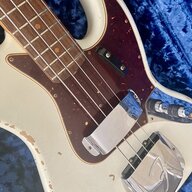
Fender's gonna Fender and she's doing her thing, which is cool since it has absolutely no effect on anything in my life. The only way any of it would matter is if it made my next bass cheaper 

TalkBass has been independent since 1998. Add your voice.
Create a free account to reply to discussions, view embedded media, and browse with fewer display ads.
Join free Log in
Want zero display ads or expanded classifieds tools? Compare plans.
You speak the truth!Deserve has nothing to do with it. Never has and never will

Would we be having the same conversation, though?If she was male, and we were having the same conversation regarding the possible disconnect between skill level and popularity (and we WOULD be having the same conversation) would that be OK? If it WOULD be OK if she was male, isn't that therefore also sexist?
That trope HAS to end. Not everything is sexist or any other kind of "...ist." People hear what they hear, independent of an artist's demographic. People agree or disagree with policy, too. If the disagreeing parties happen to be from different demographics, that does NOT mean the demographics are the reason for disagreement.

Or, if someone really can’t fault Mohini, they’ll grouse about her slapping(which I find fascinating, as she uses tabla rhythms and similar, bringing something new to the technique).You could copy and paste some of the thread responses when Tal Wilkenfeld first hit the scene to the Blu threads. Same as it always was.
I do think that, as a society, we would do well to tweak what we find popular and what merits popularity. There's no harm in examining all the facets that contribute to a certain artist's popularity; reflection is a good thing. Perhaps Blu's success IS 100% due to her ability as a bassist and singer. My ears don't hear that, but there's no reason others have to agree.
Honestly, I think a pretty much similar thing could have been written in the ‘50’sPart of the issue is that 'popular music' is basically chosen for us at this point by marketers. Sure, you can become successful on your own merits in the music industry but I'd reckon it is a lot harder now then it used to be. Yes, there's platforms like youtube that one can use to promote their own material and get a following but you'd be up against companies with a lot more influence that can easily push some random new artist to the top with a couple of 'hit songs' written by some people in an office. It's kind of unfortunate that we currently have more access to music then ever before but that what is popular is basically so concentrated on a relative few number of pop artists that nobody is exposed to all of the great music being made (when I say no one, I mean the average non-musician consumer who is just happy to listen to top 40 radio). Of course I could be totally wrong about all of this, just my opinion about how I see the music industry today.
 .
.
Honestly, I think a pretty much similar thing could have been written in the ‘50’s
I agree, back then the DJs could push or play a band and help break them, corporate radio doesn't offer that option. Also, back then you had indi record stores that were always fertile ground for breaking non mainstream bands and artists.Yeah for sure. I just think there has been a bit more opportunity and airplay provided to some more obscure or less mainstream artists to make it then would be given now. I have a hard time seeing a band like Radio head in 90s getting played on the radio on today's mainstream rock stations. At least I'm the 60s and 70s there were music scenes developing that tried to push boundaries and were successful commercially like Yes, Pink Floyd, Rush etc. Like everything else these days, commercial power is essentially monopolized by a small few players leaving few options for anyone else to gain traction.
No, we wouldn't.Would we be having the same conversation, though?


Part of the issue is that 'popular music' is basically chosen for us at this point by marketers. Sure, you can become successful on your own merits in the music industry but I'd reckon it is a lot harder now then it used to be. Yes, there's platforms like youtube that one can use to promote their own material and get a following but you'd be up against companies with a lot more influence that can easily push some random new artist to the top with a couple of 'hit songs' written by some people in an office. It's kind of unfortunate that we currently have more access to music then ever before but that what is popular is basically so concentrated on a relative few number of pop artists that nobody is exposed to all of the great music being made (when I say no one, I mean the average non-musician consumer who is just happy to listen to top 40 radio). Of course I could be totally wrong about all of this, just my opinion about how I see the music industry today.


Part of the issue is that 'popular music' is basically chosen for us at this point by marketers. Sure, you can become successful on your own merits in the music industry but I'd reckon it is a lot harder now then it used to be. Yes, there's platforms like youtube that one can use to promote their own material and get a following but you'd be up against companies with a lot more influence that can easily push some random new artist to the top with a couple of 'hit songs' written by some people in an office. It's kind of unfortunate that we currently have more access to music then ever before but that what is popular is basically so concentrated on a relative few number of pop artists that nobody is exposed to all of the great music being made (when I say no one, I mean the average non-musician consumer who is just happy to listen to top 40 radio). Of course I could be totally wrong about all of this, just my opinion about how I see the music industry today.
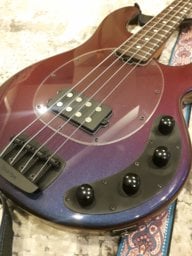
Thanks for the detail, I was curious about the bass. I don't think I would buy one because the finish isn't my style, but the sounds are great in the videos I've seen.I kind of wish this three would be closed. Some posts from early on were scrubbed so some of the context is missing. But while it’s still open, I’ll share that I finally played one! I live in the SF Bay Area and haven’t seen one in person - had to come to the Fender Flagship store in Tokyo to play one!
It was great - felt “solid” and yet not that heavy. No G string 5th fret deadspot. With the active eq and pickup selection could go from bright for slapping to more of a fat old school sound with the neck pickup. And of course I love the binding with dots. Wish I had thought to play Vintage on it!