• TalkBass has been independent since 1998. Add your voice.
    Create a free account to reply to discussions, view embedded media, and browse with fewer display ads.
    Join freeLog in
    Want zero display ads or expanded classifieds tools? Compare plans.

Bobe's 9 String Fretless

Then again, depends on what you intend to play... I know for me that anything below 29lbs. is too light, since I don't drone on the low notes.

You're right and I don't drone on the low strings either :)

I play my Sub contra bass no differently than I do as I would on my standard tuned basses,the same groove factor is applied.

Are you using a bass with below standard tuning now ?
 
Are you using a bass with below standard tuning now ?

A 5-string tuned down one step. Personally, taking into all techniques into account, I wouldn't go below A0 on "35, much less C#0 on "34! :D That's however because I find strings really anemic on that scale with thicknesses over and included .145. A .130 on "35 tuned to A0 works just great for me, I'm getting in my .135 tomorrow, so we'll see how that goes.
I've got plans for an extended range suboctave E bass, but that's pretty far away - with quite a few custom components required. Still, something I intend to make a reality once time and money allows! (Mostly the latter... :p) Not to mention knowledge.
 
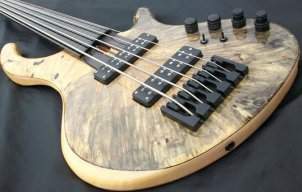
I spent most of last week carving the bass and sanding. Here's a few pics. I'll be starting the finishing stage this week.

fl9-004027.jpg

fl9-004037.jpg

fl9-004034.jpg
 
Yeah, but on the other hand, rule of thumb is that for every octave down, you should double the gauge. You don't tune to C# below E-standard with a .095, do you? In terms of tension, .195 @ "34 is very very light... Barely enough for a suboctave E, in fact.

String tension is not all about gauge. If you have a thinner inner core with more layers, the tension will be less than a thicker inner core with less outer wraps.

All depends on the brand of string and its construction.

You can't judge the tension by the gauge alone. :)
 
String tension is not all about gauge. If you have a thinner inner core with more layers, the tension will be less than a thicker inner core with less outer wraps.

All depends on the brand of string and its construction.

You can't judge the tension by the gauge alone. :)

Thanks for the information! I just wish that more companies would publish complete information-charts for their strings, much like the old D'addario-charts which even featured unit weights for the strings.
 
Phil,

awesome job, man...

those pickups are going to be monsters! Are you sure you have enough wire and magnets to do the job???? :D

how are you going to wind them? single bobbin? or are you going to split the bobbins?

If you split the bobbins, you have an option of making them humcancelling. Or, by splitting, you can put more winds on half to adjust the voicing and making the tone more even across the board...

Not only that, but keeping the wire nice and tight across a single, wide bobbin will be quite a feat.

This is so interesting...I've been glued to this thread since you've started it...
 
A crapload of knobs! :D

There's actually a Bartolini 3-band on this thing, 5 buttons + 1switch and yes it will be cramped.

The weight right now, without the pickups is 4.5kg/9.9lbs I expect it to be about 4.8kg/10.5lbs once done. Surprisingly the neck and the body are pretty much the same weight about 2.2-2.3kg each.

Pilbara, you've been doing your homework on pickups have you? :) For now the pickups will be long single coils in humbucking mode -i.e. 2 coils for bridge & 2 coils for neck- for the winding I'll probably just slow down the winder and tighten the wire a bit more so the whole thing is not too loose, potting will fix whatever "looseness" there might be. My winder also needs to be upgraded to a stronger motor this week since it won't spin such large and heavy pickups with the amount of torque I need.

I'll post a few pics of the knob setup as soon as it's done and a few pics of the pickup building as I get to it in the next few weeks.
 
String tension is not all about gauge. If you have a thinner inner core with more layers, the tension will be less than a thicker inner core with less outer wraps.
All depends on the brand of string and its construction.

You can't judge the tension by the gauge alone. :)
Wrong. Tension is the one of four mutually related variables. (The others are unit weight, pitch, and vibrating length.) Core size does not enter into it.

Using english units, the equation is : T (Tension) = (UW x (2 x L x F)2) / 386.4

That's not to say that core size doesn't affect tone, feel, or other properties. But tension is not one of them.
 
A crapload of knobs! :D

There's actually a Bartolini 3-band on this thing, 5 buttons + 1switch and yes it will be cramped.

The weight right now, without the pickups is 4.5kg/9.9lbs I expect it to be about 4.8kg/10.5lbs once done. Surprisingly the neck and the body are pretty much the same weight about 2.2-2.3kg each.

Pilbara, you've been doing your homework on pickups have you? :) For now the pickups will be long single coils in humbucking mode -i.e. 2 coils for bridge & 2 coils for neck- for the winding I'll probably just slow down the winder and tighten the wire a bit more so the whole thing is not too loose, potting will fix whatever "looseness" there might be. My winder also needs to be upgraded to a stronger motor this week since it won't spin such large and heavy pickups with the amount of torque I need.

I'll post a few pics of the knob setup as soon as it's done and a few pics of the pickup building as I get to it in the next few weeks.


Cool stuff, Phil….just make sure you don't do a "Tim the Toolman" upgrade on your winder at put a 45kW Toshiba 3-phase 4-pole motor on it ;)…

I gotta get me a winder and get into some "pickuping"…but I have this cool Idea about making small, round single-pole bobbins (a la Wal pickups) and winding them on the wife's sewing machine...:D won't she be thrilled...lol ;)
 
I gotta get me a winder and get into some "pickuping"…but I have this cool Idea about making small, round single-pole bobbins (a la Wal pickups) and winding them on the wife's sewing machine...:D won't she be thrilled...lol ;)
Cool- I never knew Wal used single bobbins.


Also if you're looking for ideas, take a look at Atlansia's site. They have single round pups "with an interesting twist" on several basses, and you can see some closeups if you go to the Patents or the Parts section.
http://www.atlansia.jp/

Also Linear Pickups had some cool ideas. They seem to have gone out of business, but you can see some of their site if you look here and go back to 2005 or so:
http://web.archive.org/web/*/http://www.linearpickups.com/
 
Wrong. Tension is the one of four mutually related variables. (The others are unit weight, pitch, and vibrating length.) Core size does not enter into it.

Using english units, the equation is : T (Tension) = (UW x (2 x L x F)2) / 386.4

That's not to say that core size doesn't affect tone, feel, or other properties. But tension is not one of them.

The greater the mass of the string, the lower the tension needed to get it to a certain pitch. Some strings like like the TI are lower in tension at the same pitch. This is easy to feel. This is because of the core to wrap ratio. More outer wraps means more mass... it's easy to understand. There's more wire on the string. To get more wraps at the same gauge you need a thinner core wire.

You can prove that a same gauge string has less or more tension at the same pitch... just change the set on your bass and see if you need to adjust the truss rod. If you do, then the tension is different.

Another example was the old Maxima strings Rickenbacker used to use. Thinner core, more warp layers, and lower tension. If you owned a 70's 4001, Rickenbacker told you not to use other brand strings unless they were low tension.

Another example is GHS vs. D'Addario strings. The same gauges will have very different tensions.

Gibson made some flatwound bass strings in the 70's called Observers. They sounded great, but were VERY high tension. They weren't heavier gauge than the Maximas, but they would warp the neck like crazy!

So, your equations don't explain why two strings of the same gauge have different tensions at the same pitch.

You have a history of having something contrary to say about various subjects, usually to my posts, but little to back it up. You are using simplistic science, but leaving out a lot of variables.

Oh and Phil, that's a nice looking bass! Crazy wide neck!