• TalkBass has been independent since 1998. Add your voice.
    Create a free account to reply to discussions, view embedded media, and browse with fewer display ads.
    Join freeLog in
    Want zero display ads or expanded classifieds tools? Compare plans.

Bobe's 9 String Fretless

The string equation gives us: T = m * (f *2L)^2

Hence, tension increases when mass increases.

Whether mass increases, is equal or even is less when changing to another gauge/diameter of the string is a matter of how it is constructed. With more and thinner wire wound on the core, the mass will be higher than on that of a string using larger diameter wire. The thicker wire will make for bigger voids in the coil. A string wound of only flat "wire" will contain very few voids, hance have higher mass.

Again, the laws of physics prevail, while theories fluffs. Newton still stands, and Hawking still sits.

 
:D

The John Hall quote, is, BTW, wrong on one point. If you increase the mass density, you've got to increase the tension to get the same pitch.

It is potentially misleading on another point. If you are using rectangular cross-section wraps (flat wire), the fact that it's one or two layers won't necessarily make it higher or lower density. It all depends on the space left between wraps, caused by the choice of lead and helix angle.

Also potentially misleading is the comment on flexibility wrt number of layers of wrap. In a flatwound string, the flexibility of a double-wrapped string is going to be highly dependent on the aforementioned spacing/lead/helix angle aspect, and by the tension on the outer wrap. You can make a more flexible string, or you could end up with a string that is even stiffer than a single wrap string, due to bridging between the layers (like a running bond or stretcher bond in brickwork).
 
The string equation gives us: T = m * (f *2L)^2

Hence, tension increases when mass increases.

Everyone is leaving out a big thing here.. at which pitch? The strings get thicker for the lower strings precisely because you need either a longer string, or more mass (or both) to get it to tune at a lower pitch.

No one is saying that a thicker string will have less tension tuned to a higher pitch. Try tuning your low E up to the G string pitch for instance. But that string was not designed for that.

String manufacturers are using the process John Hall talked about to make lower tension strings.

You can't deny that two strings of the same diameter and turned to the same pitch can't have more or less tension. You can go out and buy these strings. TI strings less less tension than others, yet are the same gauges and tune to the same pitch.

Anyone who has switched to a different brand of string, at the same gauges, will know that sometimes you have to readjust your truss rod, because the new set of strings have different tension from the old set.

The truss rod doesn't care what the gauges are, it only "knows" what the overall tension on the neck is.
 
Everyone is leaving out a big thing here.. at which pitch?
Suburban's statement was assuming fixed pitch and fixed vibratory length, and varying the mass and tension.
The strings get thicker for the lower strings precisely because you need either a longer string, or more mass (or both) to get it to tune at a lower pitch.
Exactly.
No one is saying that a thicker string will have less tension tuned to a higher pitch. Try tuning your low E up to the G string pitch for instance. But that string was not designed for that.

String manufacturers are using the process John Hall talked about to make lower tension strings.

You can't deny that two strings of the same diameter and turned to the same pitch can't have more or less tension. You can go out and buy these strings. TI strings less less tension than others, yet are the same gauges and tune to the same pitch.
No denying it, certainly. But the reason for it is not arcane construction techniques that can change the pitch/tension relationship regardless of the weight, nor someone saying "I designed this to be an E string" or "a G string." It is because, despite being the same gauge (diameter), the TI strings are lighter. They weigh less per foot. As a direct consequence, at the same pitch and length, they will be at lower tension.
Anyone who has switched to a different brand of string, at the same gauges, will know that sometimes you have to readjust your truss rod, because the new set of strings have different tension from the old set.
This is because, due to material or construction differences, the new strings are lighter or heavier, despite being the same OD. Therefor, they require more or less tension to achieve the same pitch.
The truss rod doesn't care what the gauges are, it only "knows" what the overall tension on the neck is.
Yup.
 
Yep, now that we have sorted some misunderstandings, we are all fine and eager to see the final result!:)

Thank God!!! ;) Well, since we're here I might as well post some of the small things I've been doing.

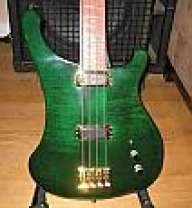


Here's the pickup covers I did. They're Ebony, Purpleheart and Tasmanian Blackwood. They're still unfinished.

004-fl9076.jpg

004-fl9078.jpg


And here's a pic of my winder which I've recently decided to fix-up. Gotta thank David Raven Moon for posting pics of the insides of the Schatten winder. Mine's a clone of it.

winder-2.jpg


On the left side you've got the on/off switch and the motor speed button. On the right side at the top you can see the small white thing, that's the reed switch, it's activated when the magnet protruding out of the wooden bobbin holder passes in front of it.
 
Sorry guys ill speak french for a second.
Siboire yen a des Quebs sur cte Thread la, ca vous dirait de se rencontrer toute la gang, jsais que y'a Yvon, Renniw, Francois (Bassman 74) pis un autre Phil aussi, ca serait cool de se voir, prendre une biere pis discuter la lutherie ensemble, montrer nos instruments, qui sait on pourrait peut etre inviter Michel Fournelle tant qua y etre !!! non ctune joke, quest ce que vous en pensez? Si ca vous interesse on pourrait partir un Thread pour inviter tous ceux qui n'auront pas vu ce message. entk, jespere avoir de vos nouvelles, ecrivez moi un PM si vous voulez. ciao les gars !!
 
Thank God!!! ;) Well, since we're here I might as well post some of the small things I've been doing.


Here's the pickup covers I did. They're Ebony, Purpleheart and Tasmanian Blackwood. They're still unfinished.

004-fl9076.jpg

004-fl9078.jpg


And here's a pic of my winder which I've recently decided to fix-up. Gotta thank David Raven Moon for posting pics of the insides of the Schatten winder. Mine's a clone of it.

winder-2.jpg


On the left side you've got the on/off switch and the motor speed button. On the right side at the top you can see the small white thing, that's the reed switch, it's activated when the magnet protruding out of the wooden bobbin holder passes in front of it.


awesome winder...

do(did) you have any issues with bounce on the reed switch? or is it fitted with a debounce capacitor?

I had an idea for a feeder for such a winder using the end of an old fishing rod, fitted to a board and hinged...tension adjustible via a spring...