• TalkBass has been independent since 1998. Add your voice.
    Create a free account to reply to discussions, view embedded media, and browse with fewer display ads.
    Join freeLog in
    Want zero display ads or expanded classifieds tools? Compare plans.

Boutique Bass Benefits

I don"t have one but look forward to maybe one day. I think it is appreciation, appreciation of the materials, the craft work and the reputation of the builder. Knowing it was built by a skilled artesian, built with precise measurements of the finest materials. I never grow tired with highly figured woods or the grain of an old growth piece. An interesting article non bass related is about Neal Pearts reclaimed wood drum set, wish I could get a bass of that wood. I think it is something some can appreciate but others don't pay it much attention.

 
Some of the boutique makers craft truly special instruments that don't sound and/or play like those made by the mammoth manufacturers. Last time I checked, nothing Fender, Yamaha or Ibanez makes sounds like a Sadowsky. :smug:

I love my Valenti basses. The designs I chose lean toward classic Fenders (sturdy basses made from the same woods with a similar visual appearance)... but I wanted crazy good pickups and electronics that offer strength and variety I didn't feel like I could get from the big boys. Additionally, Hipshot hardware, bone nuts and asymmetrical necks were options not offered by the mainstream makers. Icing on the cake -- I got all of this at an affordable price. I'm happy.

Being able to design the instrument of your dreams is fun and can be rather gratifying if you hit on something that trips your trigger. However, as a first-time boutique buyer (or parts bass assembler), it's easy to fall into the pitfall of ending up with an instrument that might not live up to your expectations. Sometimes you get the sound wrong and many times boutique basses/parts basses come out too heavy.

So, my advice -- if you opt to go the boutique route and don't fully know your stuff, lean on the maker's expertise as to which ingredients will produce which tones. Be honest in your conversations and tell your maker what style of music you play... what kind of sound you're looking to achieve... and what kind of weight you're shooting for. You'll be glad you did! And if your maker isn't willing to have these chats, then that's a maker you don't want to do business with.

Reach out to people on this site who have done it before. Most folks here are happy to give you a few pointers.

Good luck!
 
  • Like
Reactions: BeefPie84
For me, I think I have always had unusually high expectations about the instrument(s) I play. In the earlier days, I wanted a quality instrument that not only fit me properly, but was a reflection of both my personality and my artistic sensibilities. It had to match up with the image I had in my mind - and yes - I was tired of buying basses that didn't fit me or didn't inspire me off the rack. I also had no desire at the time to follow the Fender or Gibson crowd. Do you want to blend in, or do you want to stand out? You a trailblazer or a follower? No right or wrong either way, it's simply a choice you make at some point. It's all about the sensibilities that you want to cultivate. That goes not only for your choice of instruments, but also speaks to the way you play bass. Like to blend in or stand out? Key question, actually, but I am guessing that most of us do both at times.

Back in my formative years, every time I picked up a bass off the rack, it was - wow, if they just changed this or modified that - this bass might work for me. I just couldn't find it, so I designed my dream bass along with Paul Reed Smith, and he built it for me in 1977. This was when the PRS Factory was a glint in his eye, as the factory didn't come to fruition until 1985. It was the only bass I owned from 1977 - 1999, so having a "boutique" bass by a world class luthier, didn't give me gas at all. I had found it, I was over-the-top elated and inspired - and it was all I needed.

NEW UP copy 1.jpg
 
Last edited:
Expensive boutique P and J basses have no appeal for me, but I get why some prefer getting to choose everything about them, or might prefer a really well made clone done by a boutique shop. We all have likes and dislikes. And some have money and some don't. For those who don't, Squiers are pretty solid. But not all of us want to play Squier quality.
 
  • Like
Reactions: Relayer71
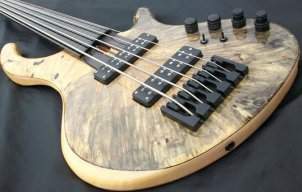
I recently picked up a custom bass used. I was looking for things that are difficult to find in an off-the-shelf instrument: I wanted to play a piece of art and I was intrigued by the idea that I would own something that literally no one else in the world would ever own. I also liked that the instrument was made from woods that are a little more uncommon like zebrawood, ebony and Koa. You can go to a store and buy a fender if you want, but you'll never be able to find another bass like the one I just picked up unless you buy it from me. :)
 
  • Like
Reactions: scottyd
The biggest advantage is the attention to detail. Just as important is the allowed customer input on the build of the instrument.. Neck shape and thickness, string spacing, pickup and hardware selection, wood selection the sky's the limit and are all things that will drastically change how the instrument plays. You're paying for a personalized instrument.
 
The flipside to the exclusive, one of a kind item is if you buy a Fender P-bass, you know what it's going to sound like and what its' going to feel like.

If you custom commission a bass made from an exotic tonewood with an unusual body shape and an equally unusual neck and fingerboard, you can never be too sure what it will sound like until it's assembled.
 
The biggest advantage is the attention to detail. Just as important is the allowed customer input on the build of the instrument.. Neck shape and thickness, string spacing, pickup and hardware selection, wood selection the sky's the limit and are all things that will drastically change how the instrument plays. You're paying for a personalized instrument.

Absolutely, Paul Reed Smith actually honed and shaped the neck to my hand, and the exact feel that I wanted - in real time. Not unusual at all, if you go out of your way to let your luthier know that is important to you.
 
Last edited:
  • Like
Reactions: scottyd
Hello all,
I would like the opinions of what makes the custom made basses command the price we see in the market, especially those modeled after the P and J bass. The body style and necks are very similar. So if one pick up a used American P or J in the $ 1k range, what drives the market. Is this weight, pickups??

Your input is appreciated.

Regards,
Michael


there's a quality factor that mass production can't touch for one thing. that's worth money- if you want that and can afford it.

and there's the personal relationship that you may have with these guys. obviously that's part sales pitch to a degree, but ime it's one on one with people who love bass, basses, and bassists.

and the extreme level of customer service. extreme.

so that's 3 things...
 
  • Like
Reactions: Relayer71
I think boutique basses are worth buying only if you buy used. Otherwise, they are a waste of money. The cheapest Alembic is over $8,000 new, but they can be found used in the $,1500 to $2,500 range. That is a huge amount of depreciation compared to an MIA Fender for example. I own several Alembics which I purchased used. They are great basses and I love them but they don't sound or play like they are $4,000 better than an MIA Fender or other comparable bass.
 
The heart wants what the heart wants...

If you can't tell the difference or if the difference is not substantial enough to justify the cost then it's not for you.

There are things unseen though, better electronics that don't pick up noise in a noisy environment, pots that don's start to crackle after a few years, necks that are supremely stable and the ability to set the action very low if that's what you need.

When something is bespoke it takes time and care to put it together and boutique builders can't produce the quantities to achieve economy of scale. Actually we're very lucky that we have so much choice and diversity in instruments, choose what you like or what you can afford.

More importantly whatever you play get out there and make some great music, that's the goal, tools are just a means to an end.
 
Ah, those overpriced boutique basses.

1. Woods. You easily spend 300 bucks on a few logs big enough to build a bass - given that you'll use select hardwoods that have dried for years and some fancy top.
2. Hardware. Those boutique basses usually come with top notch pickups, electronics, bridges and tuners.
Add another 300.
3. Work. Calculate about 100 hours of labor for a master luthier - so 25 bucks per hour sound ok?
 
I've never been in a place where I felt I could/should spend the money on a boutique instrument. However, I admire the workmanship and the quality of the pictures I see. I'll probably never own one, but there's nothing wrong with owning something truly special. Of course, all my bargain basses are truly special to me. All my instruments come via trade-in, discount or used and they keep me satisfied and they all make music for other people to enjoy.
 
Ah, those overpriced boutique basses.

1. Woods. You easily spend 300 bucks on a few logs big enough to build a bass - given that you'll use select hardwoods that have dried for years and some fancy top.
2. Hardware. Those boutique basses usually come with top notch pickups, electronics, bridges and tuners.
Add another 300.
3. Work. Calculate about 100 hours of labor for a master luthier - so 25 bucks per hour sound ok?

You may have left out a few items here;
Rent
Electricity
Plant and equipment cost
Shipping
Insurance
Administration costs
Advertising costs
other expenses

And of course you need to make a profit so yeah, it's not easy to make them on the cheap.
 
  • Like
Reactions: Relayer71
I've never been in a place where I felt I could/should spend the money on a boutique instrument. However, I admire the workmanship and the quality of the pictures I see. I'll probably never own one, but there's nothing wrong with owning something truly special. Of course, all my bargain basses are truly special to me. All my instruments come via trade-in, discount or used and they keep me satisfied and they all make music for other people to enjoy.

If I could get a boutique bass that looked and sounded like a P-Bass that would be sweet :thumbsup:
 
  • Like
Reactions: pbass74
I earlier made a comparison to my $260 Sterling ray4 to a expensive bass. Your $4000 dinkledorf is not 20 times better than my $260 sterling. Does not stay in tune 20 times better, honestly I have played it at my past 5 gigs, stays in tune the whole night. Sound? Maybe your bass with pickups hand wound by nuns may sound a little better, maybe more different than better. Hand made by a luthier? Ok, my sterling is assembled by hand. Your Mercedes is assembled and painted by robotics. Main difference between basses is the finish.
 
  • Like
Reactions: Tazziedevil