I was keeping up with it last night and missed most of the Steelers game!
BLASPHEMY!!!! I KEPT UP WITH THIS WHOLE THREAD AND WATCHED EVERY SECOND OF GLORIOUS STEELERS FOOTBALL ACTION! FOR SHAME

TalkBass has been independent since 1998. Add your voice.
Create a free account to reply to discussions, view embedded media, and browse with fewer display ads.
Join free Log in
Want zero display ads or expanded classifieds tools? Compare plans.
I was keeping up with it last night and missed most of the Steelers game!

BLASPHEMY!!!! I KEPT UP WITH THIS WHOLE THREAD AND WATCHED EVERY SECOND OF GLORIOUS STEELERS FOOTBALL ACTION! FOR SHAME


Since I started this post, I need to remind you that I said that just a because a certain class of basses tend to be better made, that is no reason not to enjoy the bass you have.
More importantly, a better made bass may not be comfortable for you or have the sound you like. For years, I wanted a Streamer, and bought one a week ago today, but when I took it to a serious rehearsal, it hurt my arm so badly, I returned it, and I am currently playing a super cheap Affinity Jazz, and it suits me much better than the Warwick although the Warwick is 100x better. In fact the Squier sounds so good (although it needs shielding) I am tempted to keep it!
I started this thread to state the obvious because too many arguments having started over something that makes no sense. It's kind like saying that generally a bigger person will win a fight, it doesn't mean that every big person is tougher than every small person, but all things considered, size makes a real difference in a fight.

Yet another thread about the boutique's greatness, im in love with talkbass :d


To be honest, I can't understand boutique bashing, but then I can't understand bashing at any bass, if its not for you, move on. Its not hard to do, there are certain "very" popular basses, that I don't like, not even slightly, but then, I somehow manage to not get my panties in a bunch over it.

<SNIP> You left out two major points:
What is the definition of better?
What is the definition of boutique?
Without those I'm clueless as to what you are referring to.

That settles it. Rob Allen, prepare to meet lighter fluid!

What's different about the Streamer? How did it hurt your arm?
I think a couple of things were going on. First, the Roscoe Beck has a very full sized body which forced my hand into a slightly different postion, and it caused me some tingling. Then the Warwick had a very tiny body and a very thick neck. The combination of those two just set me off. I just need a bass the size of a Fender Standard or Deluxe to accommodate my right hand positoning.
That blows. You seemed really into that Warwick judging by the thread you made on it. Oh well, as long as you didn't take a $$$$ beating on it.
+1
Having read as far as your post, I haven't yet seen anyone reach agreement on what constitutes a "Boutique" bass.
The bassist who orders an instrument directly from Skjold, Sadowsky, Tobias, et al, and collaborates with the maker to obtain a bass that satisfies his every desire would be likely to consider the resulting instrument "Boutique." On the other hand, someone who buys the same axe from a music store may consider it "merely" a high-end ready-made bass.
One of the reasons I've never paid more than $600 for an electric bass is because I routinely re-shape and refinish every bass I buy to suit my needs. I try to buy instruments that sound good, are comfortable in my hands, play easily, have decent electronics, balance well, and so forth. Everything else is up to me.
Were I in a position to collaborate with a custom instrument maker, I would probably want to build and finish the body myself, and have him take care of the neck, hardware, and electonics. We'd each do what we do best. Problem is, I can't afford that kind of collaboration, and a custom builder probably wouldn't want to have his name on the headstock of an instrument with a body that was built and finished by someone else. Good thing the name on the headstock, in and of itself, is unimportant to me.
I don't doubt that there are custom basses that are inarguably superior to factory-made basses in at least one clearly demonstrable attribute. My questions usually revolve around the fuzzy point on the graph where the "X" of suitability for my needs, and the "Y" of cost intersect. In other words, how much more comfort, playability, etc., do I get for my money?
For those in a position to obtain custom basses I say more power to you. Great. You're fortunate, indeed. Even if it's just for looks and bragging rights. Fantastic. Glad you're happy.
For those, like me, who have to wrestle with conflicting demands for my time and money, and obtain instruments that satisfy our needs at a reasonable cost, I say life is good. Enjoy it. Do the best you can with what you've got, and don't worry about what it says on your headstock.
As I've heard some of the kids at school say, "It's all good."
Dr. Cheese is not unintelligent, he is not a fool, and he's not a moron. What in the world pissed you off so much that you had to resort to name calling?
This is a good post. While one of the things that separates 'boutique' (meaning high price, small batch made basses) from the rest is consistency. However, consistency never means 100%. I had a HORRIBLE experience with a Fodera, had to send an FBass back due to truss rod problems, etc.
The good news is, as you post, you will be 'made right' in virtually all cases, but bad stuff can still happen.
The boutique guys that really seem to have it down (Sadowsky comes to mind) are those who us machines to do the grunt work, so things stay VERY consistent, and then put their time into final assembly, fretwork, etc. That's the 'sweet spot'. You mention Jimmy Coppolo's basses, and he is also moving to a CNC machine to do the rough stuff to increase consistency in the early stages of the process (I assume cutting body blanks, etc.), and will continue to hand finish and assemble the instruments.
This, IMO is the 'sweet spot' between efficiency of manufacturing on the one end, and 'hand made precision, quality, and attention to detail on the other.
IMO!
Me too! No stabbing the internet here.....
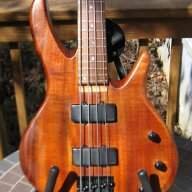
I spent many years in the fashion business designing and making men's custom suits. in the case of a quality suit, there are certain features that are not typically available in a mass produced garment. The individual preferences and needs of the of the customer were built into each custom suit. Also because of the many hand made operations the finished product literally fit like a glove. I can say that I clearly can understand why many musicians who want a more unique instrument choose something that appeals to their personal taste. Having said that, I have played basses that were under $500.00 that were great value for the money and tried out high end instruments that were not.