
how do you make the 1/2 bit make the corners. all the pickups ive encountered half 1/4 inch or smaller corners, and i always have to use a chisel or pre drill my corners
I have a 1/4 inch shouldered bit I use for the tight corners.

TalkBass has been independent since 1998. Add your voice.
Create a free account to reply to discussions, view embedded media, and browse with fewer display ads.
Join free Log in
Want zero display ads or expanded classifieds tools? Compare plans.
how do you make the 1/2 bit make the corners. all the pickups ive encountered half 1/4 inch or smaller corners, and i always have to use a chisel or pre drill my corners
There are some surprises coming . . .


LedBelli, I have never made my own necks. When you rout the trussrod channel, is it a constant depth for the entire length? How do you get the bow in the truss rod to put opposide pressure on the neck to counteract string pressure? Some use a small arched shim or block placed in the propper place on the neck.
LedBelli, I have never made my own necks. When you rout the trussrod channel, is it a constant depth for the entire length? How do you get the bow in the truss rod to put opposide pressure on the neck to counteract string pressure? Some use a small arched shim or block placed in the propper place on the neck.


Here's an interesting related idea from David King as far as fret-induced back bow:Negative bow can happen, I didnt see the point either, until I did 'Frank's Bass'. The neck was Purple and Wenge, blank was jointed, dead flat, so was the wenge board, everything flat. Then I fretted it, and when came time to level the frets I really asked myself what the hell had happened... and the neck was stiff enough to keep the unwanted bow.. well it was stiff enough to keep the unwanted an unwanted bow. So the rod came in handy and I actually put tension on it the other way, it was somewhat awkward.
When I saw the new CT videos that a fellow TBer posted, it all came clear to me what had happened. Passionate people are great.
http://www.kingbass.com/build-a-bass.html said:With ebony and other very hard fingerboards I need to "set" the fret tangs in to the sides of the slots by standing on the fingerboard while it is supported at each end, otherwise the tight frets will force backbow into the neck. (Also it's nice to know a neck can stand a little abuse before it leaves the shop).
Negative bow can happen, I didnt see the point either, until I did 'Frank's Bass'. The neck was Purple and Wenge, blank was jointed, dead flat, so was the wenge board, everything flat. Then I fretted it, and when came time to level the frets I really asked myself what the hell had happened... and the neck was stiff enough to keep the unwanted bow.. well it was stiff enough to keep the unwanted an unwanted bow. So the rod came in handy and I actually put tension on it the other way, it was somewhat awkward.
When I saw the new CT videos that a fellow TBer posted, it all came clear to me what had happened. Passionate people are great.
Cleve.. you do really nice work, you really got me wondering what you are doing on this bass.. surprises eh?.. I love your designs and clean work. Peace
-Mario

There are some surprises coming . . .

Wow. I really like the looks of this.

Post: 01/24/2009 Quote" Also, around now is where I will start using the profile guage pictured on the left. All profiles are taken from the original Noah. Thin: 1/2" "C" at the nut to 9/16" "soft-C" at the 17th fret.
Are these measurments -eg:1/2" at the nut" just the neck or the neck including the fretboard thickness?
Thanks, I know this a question way back in this tread!
Your work is inspiring to say the least!
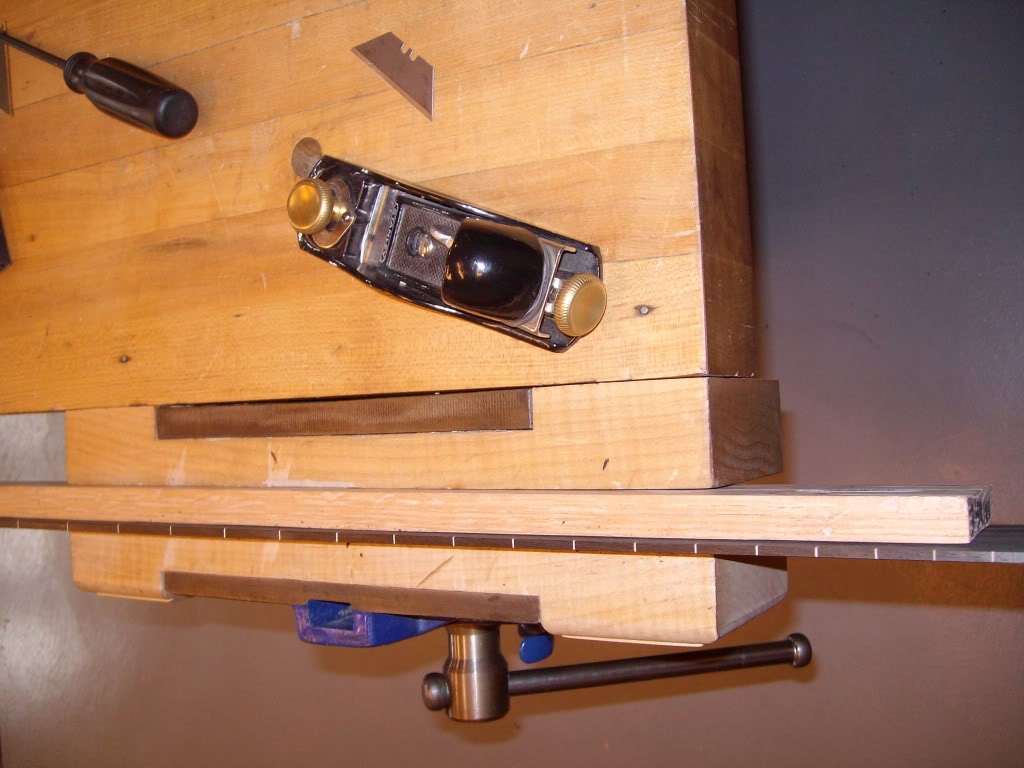
I love your work bench set up in a later post in this thread. My quess is that you have a table saw out feed extention that clamps in the vise to the right of your bench alining with the table saw. Could you share a photo of that if so?
Thanks greatly, DBC, Dino
Forgive me if this is a duplicate post, I attempted to reply but it doesn't appear to have taken?
Do you have a prefered radius you like on a five string?
My Current 5'er Design I am working on, I am trying to keep the nut width about 1-11/16" at the nut and as thin as possible and 3/4" spacing at the bridge.
Undesided on 35 or 36" scale.
Low as action as possible .040x.080 frets.
I have played basses that have played like power steering no buzzes all the way up the neck(few)!
I stumbeled accross a article found on "Stewmac" (what a great company) about why compound radius necks are used.
Link to article:
Invalid Link Removed
What have you found to work to your likeing?
2nd Question:
I had chose to use the "Stewmac" "Hotrod dbl. Action TR. w/Spoke wheel and was going to put the adjuster wheel at the body end.
I think you mentioned in one of your posts (forgive me if it was someone elses post) that the personal choice was "LMI's" Dbl action Rod or a Gibson Style because it required a shallower route slot in the neck, thus being able to keep the neek thinner and still maintainin 1/4" of wood beneth the rod?
Oh and use a allen adjuster at the head end.
I know it is a personal design toss up wether you want a cover at the head stock or body end.
To mention also neck thru or glue set neck so I can get a fully contoured neck to body transion.
Thankyou for any and all imput,
always as the new cool tee shirt says "Rock Bottom"
(Plug for the Talk Bass Store) I just got my new shirt!
"Rock Bottom"
DBC, dino

I use a compund radius of 12 inches at the nut and 20 inches at the 24th fret. I use a compound radius jig that works very well. My neck width is 1 3/4" at the nut and 3" wide at fret 24. I use a progressive string spacing that compensates for the wide variation in string diameters on a bass.
My choice of the LMI truss rod is based solely on its design and construction, not on its dimensions (see earlier post in this thread for more info).
Thanks again for your kind words!
Can you go into a little more detail about this compound radius jig if you don't mind? It just seems like that is a very tedious and time consuming part of building that I can make go faster with the right jig.
Can you go into a little more detail about this compound radius jig if you don't mind? It just seems like that is a very tedious and time consuming part of building that I can make go faster with the right jig.


