
• TalkBass has been independent since 1998. Add your voice.
    Create a free account to reply to discussions, view embedded media, and browse with fewer display ads.
    Join freeLog in
    Want zero display ads or expanded classifieds tools? Compare plans.

Building a Shop

pnchad said:
Alright, I will try to find the room and the $$$ :crying: for a jointer.

Back to humidity though. I have now done testing throughout the house with a hygrometer. Here in south Florida the A/C is on auto ALMOST all year long. I keep mine set at 77 degrees most of the time. The air outside is somewhere around the mid 80s now with a humidity of probably 75+ percent.

My readings show the house at 59 - 62 percent humidity pretty solidly. I think I can get a room A/C with dehumidifier function and reduce the average to around 50 - 57 percent.

Is that gonna be good enough for stable wood??? :ninja:

Easily!

While a controlled climate environment could be important in extreme areas like yours, I think you can relax with all of the calculations. The point is that your wood will aclimatize to where it's at and then you'll build with it in that same environment. As long as nothing radical changes, your instrument will be fine. Every builder in the world has a different set of climate conditions but their instruments don't reflect these differences.

And consider the use of a router table for jointing. If you don't have the room or budget for a jointer, quite acceptable results can be made with a 1/2" diameter x 2" long spiral cut bit and your router.
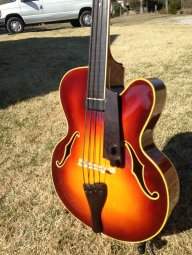
 
I thought that if the wood has been well dried that it would probably climatize as long as the environment is consistent.

And yea, the book I'm reading now suggests the router table as an option for facing stock too. Might be a better example of your 'multiple usage' theorum? :eek:
 
somewhere around 40-50% relative humidity is the target for most shops -- you should be fine.

neither my house nor my shop is air-conditioned. and only heat in the house, none for the shop. i just let the wood acclimate for a few months before working it, and avoid working it on extremely wet days. so far, i've had zero issues with warpage -- furniture or basses.

2" spiral bit won't work for me -- my typical through-neck blank is around 4" x4". on the first bass, it was solid wenge, which my router would have laughed at.
 
Hambone said:
... And consider the use of a router table for jointing. If you don't have the room or budget for a jointer, quite acceptable results can be made with a 1/2" diameter x 2" long spiral cut bit and your router.

Is that that "bit" that only leaves shavings, no dust? Kinda looks like a drum-shaped cheese grader? I have been jonesing for one of those for my drill press. Just curious on how well they work. The only one I can find is at Grizzly ...

jtg
 
JTGale said:
Is that that "bit" that only leaves shavings, no dust? Kinda looks like a drum-shaped cheese grader? I have been jonesing for one of those for my drill press. Just curious on how well they work. The only one I can find is at Grizzly ...

jtg


JT, I think that one is called a "micro plane" drum. Those are pretty neat and I'd like to replace my sanding drums with some. But the one I'm talking about has 2 flutes with a twist. The shearing action works great on tough woods like walnut to prevent tear out and it leaves the surface very smooth.

Schuyler is right in that you probably wouldn't do as well with a bit that is longer. The longer they get, the more chatter you'll have when they are used in hand routers - even in a table. If you use a bit that's shorter than the height of the wood, you can make a second pass with a laminate trim bit.

...or get a jointer!