• TalkBass has been independent since 1998. Add your voice.
    Create a free account to reply to discussions, view embedded media, and browse with fewer display ads.
    Join freeLog in
    Want zero display ads or expanded classifieds tools? Compare plans.

Can someone explain old combo amps to me

Yep. The Marshall 412 stack was designed for Entwistle afaik. The SVT was a guitar and bass rig for the Stones afaik when it came out.

Designed for Townshend, not Entwistle. In fact, he originally asked for/demanded an 8x12 cabinet. In an interview conducted a couple of years before he died, Jim Marshall said that he tried to persuade Townshend that the Who's roadies would have a hard time moving those cabinets. Townshend replied, "Sod em! They get paid."

Evidently he quickly changed his mind, since only a couple of the 8x12 cabs were ever built.
 
My first bass amp was a wurlitzer juke box amp that pops picked at a Army/Navy Electronics store in Annandale Virginia, picked a pair of large PA horns with it. I also employed a large PA speaker too. It did alright. I wanted an Ampeg flip top 30 (still do sort of) however a Heathkit behemoth TA-38 bass amp kit showed up and dad help me get it soldered up running. Dad was an ET by trade and a good one, so the assembly went very smooth. I learned quite a bit on that project. So I had volume. The garage band days lasted thru HS and a few more years the Heathkit was well used and looked it. Lots of outings. I used it in college then eventually scored the a Sunn 2000S... with JBL D-140s it felt like moving a bank vault, our backs were young and we had a step van so life was good. And from there... I eventually went combo with a bullet proof Carvin B200 with a 15.

I moved the Sunn with me to Guam and it was in good shape. I sold it for more than I paid for it initially, it became a house bass amp in one the more popular cha-cha dance halls on the island. No regrets, that beast was tough to move around and required it's own support vehicle!
 
Last edited:
My experience with early bass combos was dreadful. I never found one that was worth a damn, and I could never afford anything better. The last 30 years have truly been the golden age of bass. You can get decent, usable bass tones out of affordable products that are not much larger than a boot box. Back in the day, there were many big, heavy, underperforming bass amps that were way overpriced for a young, impoverished player such as myself.
 
Last edited:
  • Like
Reactions: Fynn and agedhorse
I don't have a lot to say about amp design, but one thing that isn't widely known is that the US had large regions where homes had no electricity at all before WWII. The push to increase access to electrical power to these areas started in the 1930s, during the New Deal under FDR. Electricity had reached only about half of American homes by that time. Then WWII broke out and that slowed down. But after WWII government loans for houses included standards for electricity that led to much more access to electricity across the nation. By 1960, virtually all homes were electrified. Even so, you're not talking about a LOT of electricity.

As the New Dealers knew, increased access to electricty increased demand for products that used it - even electric guitars, which were in their infancy. But it took decades for appliances that used a lot of electricity to find a mass market. I suspect that if you brought a modern 300-watt bass amp back in time to the 1960s, there would have been few places you could have plugged it into without blowing lots of fuses. So it would make sense that amp design would take that into account.
 
Fender moved to closed back cabinets when they introduced the first “piggyback” Bassman (1960). I owned one of those heads but not the cab, which was a sealed 1-12”. That’s right, they replaced an open back 4-10 combo with a head and a 1-12 cab.

th-1317679798.jpeg


The amp also was the first two channel Bassman. They soon switched to a 2-12 cab, first side by side then vertical. The 2-15 cab didn't arrive until late 1968.

There were a lot of interesting combo amps made in the 1960s. The Ampeg B15 and their other “fliptops” are the best known, but there were the Kalamazoo amps (made by Gibson) with a chassis that tilted out in the rear of the cabinet and the Oliver amps that had a motor to lift the head up out of the cab. Obviously it was thought that some players didn’t like the newfangled idea of having to carry two pieces to the gig.


th-2666753859.jpeg


Designed for Townshend, not Entwistle. In fact, he originally asked for/demanded an 8x12 cabinet. In an interview conducted a couple of years before he died, Jim Marshall said that he tried to persuade Townshend that the Who's roadies would have a hard time moving those cabinets. Townshend replied, "Sod em! They get paid."

Evidently he quickly changed his mind, since only a couple of the 8x12 cabs were ever built.
Designed for the Who under Pete's direction. Entwistle also used Marshalls during the same periods in the 60's.
 
Designed for the Who under Pete's direction. Entwistle also used Marshalls during the same periods in the 60's.

"Designed for the Who under Pete's direction" is splitting hairs. Of course Entwistle would have used the Marshall stacks too, but Jim Marshall didn't mention Entwistle during the interview.

In the same interview, Marshall mentioned that the Tremoloes were one of the first bands to buy the stacks after the Who. He recalled standing at the back of a ballroom where the Tremoloes were playing and being impressed by how clear the guitar sound was, thanks to the slanted top cabinet projecting the full range of the guitar's output over the heads of the dancers.

That was an accidental benefit. He said that he'd slanted the front of the top cabinet simply because he thought it would look better to give the head and the top of the cabinet the same depth.
 
  • Like
Reactions: Fynn and agedhorse
It's an interesting question that somewhat relates to the musical zeitgeist... these days, a bassist can get wattages that compete with a stovetop range in a package that's only a few kilograms. At the same time though, stage volumes are on their way down - listeners seem to be more concerned about protecting their hearing and about actually hearing the band, rather than a painful wall of noise. I don't know where things will eventually meet, but I'd suspect that it'll be really high wattage class D amps turned down low or lower wattage tube amps turned up really high, depending on the timbre the player is after.

Fortunately though, bass is here to stay as an audible and present instrument!
 
  • Like
Reactions: Fynn and Guitalia
I suspect that if you brought a modern 300-watt bass amp back in time to the 1960s, there would have been few places you could have plugged it into without blowing lots of fuses.
This might be somewhat true if you substituted '1940s' for '1960s', but even in the rural Texas farm town where I grew up there was adequate electrical distribution in houses well before WWII. Even folks who lived on farms out in the sticks had at least some electricity. How much power do you think a modern 300-watt amp takes? But you're right that rural electrification was very much a product of the New Deal, at least here in Texas. Lyndon Johnson built his career early on by promising to bring 'the lights' to the hard-scrabble farmers and ranchers of the Texas Hill Country and was able to deliver on that promise.

I had never considered it because I'm not as enamored of big tube amps as some folks, but I guess the size of a class-AB tube amp is constrained by 15-amp branch circuits to no more than 4 pairs of output tubes, or less than ~400 watts of output power. And yeah, you probably would have had to make some special allowances to plug something like that in at my Mam-maw's :) place out in the country in the early '60s, where electricity was available but not unlimited.
 
As has been said, it's hard for anyone younger to imagine how crap the gear was, how little was available and how broke we were. Also, at the amateur level where I was, how ignorant we were about the science. This in England which was even more broke.

I'm a bit younger than some here, started playing early mid 70s. Information for someone like me was what I picked up from music press. Not really any such thing as bass practice amps where I was so I started off with a mono record player with a jack socket added. Knew enough to know speaker couldn't survive, so saved up for cheapest 15in Fane driver. Face down on a table to give it some sort of chance. Built a box as soon as I could. Sealed, ported was way too difficult.
Eventually afforded a Gibson Atlas head, cheapest amp in shop, and my goodness it was awful. It wasn't until after college I could get anything better, which was an HH guitar head and a cab a mate had home built roughly based on an HH folded horn 1x15.
 
This might be somewhat true if you substituted '1940s' for '1960s', but even in the rural Texas farm town where I grew up there was adequate electrical distribution in houses well before WWII. Even folks who lived on farms out in the sticks had at least some electricity. How much power do you think a modern 300-watt amp takes? But you're right that rural electrification was very much a product of the New Deal, at least here in Texas. Lyndon Johnson built his career early on by promising to bring 'the lights' to the hard-scrabble farmers and ranchers of the Texas Hill Country and was able to deliver on that promise.

I had never considered it because I'm not as enamored of big tube amps as some folks, but I guess the size of a class-AB tube amp is constrained by 15-amp branch circuits to no more than 4 pairs of output tubes, or less than ~400 watts of output power. And yeah, you probably would have had to make some special allowances to plug something like that in at my Mam-maw's :) place out in the country in the early '60s, where electricity was available but not unlimited.

Yeah, I have had little success finding out how MUCH electrical power the average American home had on hand immediately after WWII. It wasn't much before that, mainly because i don't think that there were lots of affordable appliances that used lots of electricity, primarily refrigerators and electric ovens/ranges. I'd love to find out more about this.
 
  • Like
Reactions: Redbrangus
Something to bear in mind. Many bassists didn't play that low in those days due to vinyl recordings, AM radio, playback systems and upright bass technique.

Low bass frequencies used up a lot of headroom in the cutting process and could cause the needle to jump out of the groove - likewise AM radio wasn't great with low frequencies either, so it was generally high-passed. Not to mention, most people's record players didn't reproduce bass frequencies very well.

Many bassists started out playing upright - unamplified. So they had developed techniques to cut through a mix of guitars and drums such playing further up the neck.

As such, a lot of bassists continued to play basslines further up the neck with a more mid-range tone to cut through and ensure they didn't cause recording and playback problems. An open-back guitar cab could reproduce a typical 50s/60s bassline in a live environment okay.

PS, I've heard several stories of whole bands plugging into a single AC30
 
Last edited:
"Designed for the Who under Pete's direction" is splitting hairs. Of course Entwistle would have used the Marshall stacks too, but Jim Marshall didn't mention Entwistle during the interview.

In the same interview, Marshall mentioned that the Tremoloes were one of the first bands to buy the stacks after the Who. He recalled standing at the back of a ballroom where the Tremoloes were playing and being impressed by how clear the guitar sound was, thanks to the slanted top cabinet projecting the full range of the guitar's output over the heads of the dancers.

That was an accidental benefit. He said that he'd slanted the front of the top cabinet simply because he thought it would look better to give the head and the top of the cabinet the same depth.

This is all covered in the individual bio's for the 4 members. I have read all of them.
Pete Townshend asked Jim.Marshall to build the Stacks and they were created from that request. The single cab 8×12's was the first variation. Townshend kicked one over on stage and commented on the head crashing down to the floor as still working.

Recommend reading them all, even the Moon Autobiograohy was astonishing in its research and detail.
 
Yeah, I have had little success finding out how MUCH electrical power the average American home had on hand immediately after WWII. It wasn't much before that, mainly because i don't think that there were lots of affordable appliances that used lots of electricity, primarily refrigerators and electric ovens/ranges. I'd love to find out more about this.
The Rural Electrification Act’s effect began in the late 1930’s and slowed down during WW2. About 1/2 of all American farms had access to electricity after WW2 and most had electricity by the late 1950’s.

Much of it was 110V AC and 30A service was common, expanding to 220V service then getting larger. During this time, the US adopted the 120/240V service in combination with 240V, 3ph delta and 120/208V, 3ph wye and 208V, 3ph delta services that most are common today. (Plus 277V/480V wye and 480V delta).
 
Something to bear in mind. Many bassists didn't play that low in those days due to vinyl recordings, AM radio, playback systems and upright bass technique.

Low bass frequencies used up a lot of headroom in the cutting process and could cause the needle to jump out of the groove - likewise AM radio wasn't great with low frequencies either, so it was generally high-passed. Not to mention, most people's record players didn't reproduce bass frequencies very well.

Many bassists started out playing upright - unamplified. So they had developed techniques to cut through a mix of guitars and drums such playing further up the neck.

As such, a lot of bassists continued to play basslines further up the neck with a more mid-range tone to cut through and ensure they didn't cause recording and playback problems. An open-back guitar cab could reproduce a typical 50s/60s bassline in a live environment okay.

PS, I've heard several stories of whole bands plugging into a single AC30

Whole bands plugging into one amp happened with a lot of bands composed of teenagers who were financing their music careers with lawnmowing money. But the multiple inputs in amps usually were meant to make the amps more versatile for a single player. Early four-input Marshalls had only one channel, but the inputs differed in sensitivity and tone.

Come to think of it, I still have several California-built mid-'60's solid-state Vox amps with six inputs: two for the Normal channel, two for the Brilliant channel, two for the Bass channel (and with tremolo and distortion on the Normal channel, mid-range boost with three settings for the Brilliant channel, and reverb assignable to either guitar channel). (Still my favorites among the guitar amps I've owned.)
 
Just for a different perspective, the kids like me who were learning bass in the 80s had a bit of an advantage with the availability of Peavy combos. They didn’t sound all that great, but they were less expensive than what guys 10 years before us had to choose from and you could actually play loud enough to play with a band. You just about couldn’t break them, either. I started with one of those and soon “regressed” to an old Ampeg V4 and a 1x 15 cab. That sounded a lot better. I got into some weird rack stuff in the late 80s, but that’s beside the point.
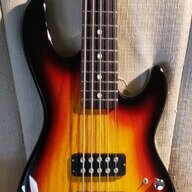
in 1987, My first "good" amp was a Peavey TNT 300. It was great, I thought, and loud enough. About 200 pounds..
 
  • Like
Reactions: PhillipHolbrook

Latest posts