• TalkBass has been independent since 1998. Add your voice.
    Create a free account to reply to discussions, view embedded media, and browse with fewer display ads.
    Join freeLog in
    Want zero display ads or expanded classifieds tools? Compare plans.

Can someone explain SX basses to me?

I think the thing about quality difference between an SX and, say, a Fender, or even between an MIM Fender and an MIA, is really just in the QC. They're all using alder and maple (or whichever woods), nickel, steel, and copper wire, and they're all using pretty similar schematics for the CNC machines etc. So theoretically, yeah - there's no particular reason an SX can't be just as good an instrument as an MIA Fender. But what the difference in price means is that the SX goes through the mass production line a bit faster with less checking for detail. If everything works just right, it will be a great instrument, but there's higher odds something won't be quite right and the problem won't get caught. You're more likely to get a lemon. That's the only reason I can say that some people say they're "junk" and others say they prefer them to their Fenders. It's the same difference between MIM and MIA Fenders; not that American workers are better than Mexicans (there's the old joke anyway, that MIMs are made in Mexico by Mexicans and MIAs are made in California by Mexicans), but that Fender uses the American plant to make instruments a little slower with more attention to detail and uses the Mexican plant for faster mass production.
 
I think the thing about quality difference between an SX and, say, a Fender, or even between an MIM Fender and an MIA, is really just in the QC. They're all using alder and maple (or whichever woods), nickel, steel, and copper wire, and they're all using pretty similar schematics for the CNC machines etc. So theoretically, yeah - there's no particular reason an SX can't be just as good an instrument as an MIA Fender. But what the difference in price means is that the SX goes through the mass production line a bit faster with less checking for detail. If everything works just right, it will be a great instrument, but there's higher odds something won't be quite right and the problem won't get caught. You're more likely to get a lemon. That's the only reason I can say that some people say they're "junk" and others say they prefer them to their Fenders. It's the same difference between MIM and MIA Fenders; not that American workers are better than Mexicans (there's the old joke anyway, that MIMs are made in Mexico by Mexicans and MIAs are made in California by Mexicans), but that Fender uses the American plant to make instruments a little slower with more attention to detail and uses the Mexican plant for faster mass production.


I believe this is quite close to the truth.
 
This is a misconception that has not been the case for several years now. It is simply not true that Chinese labor is so cheap. Maybe 20 years ago, but no longer.

We manage Chinese manufacturing for our clients. We have watched wages increase about 800% over the last 10 years. The typical factory workers in China now makes a reasonable wage that allows him to return home with quite a bundle to start his own business, etc. after a few years in the factories. No - it does not compare with Western rates, but the cost of living in China is still very reasonable, and the factory worker has no living expenses - everything is provided. As part of the job he gets:

40 hour week before being paid overtime
Clothing
Meals
Free Health Care
Free lodging with generous minimum standards for personal space.
Social Security
Unemployment insurance
MANY Holidays

Actually - the cost of labor has risen so much in China that the way that the Chinese manufacturers are now keeping their costs down is to wisely invest very heavily in automation. The Western manufacturers are still fighting this trend. Many electronic items are now manufactured with very little hand labor. Some of the more advanced factories can do it with NO hand labor at all, using robotics from making and testing the PCB to final assembly and packing the product in the box. I have seen car stereos made without a single human touching it until the pallet of boxes is taken away for shipping.

Rondo has hooked up with a good supplier. While there are still many hand operations required for guitars, I am certain that most of the production of the instrument is fully automated from the cutting and shaping of the wood parts to the painting of the bodies and maybe even packing.

The reason now that so many things are made in China is no longer because they have the cheapest labor, but because they have many of the newest, most advanced and highest quality production facilities in the world and can make goods at any price level you order at a competitive price - from Apple products to Nikon cameras and medical equipment - AND in the quantities you require.

Yes - there are still some schlock manufacturers located in some far parts of China, but this is becoming more and more rare and limited to very simple products such as garden furniture, etc.

As the factories become more and more automated and labor becomes a smaller part of the cost, the bigger and smarter companies have found other ways to cut cost. Fender has set up an amazing state-of-the-art factory in Indonesia. Why? It is not for the cheap labor. It's because that is where the wood is! It is cheaper to ship the electronic components from China to the automated factory in Indonesia than to ship huge boatloads of lumber to China. We benefit from this by having incredible Squier guitars at great prices.

Sorry for the rant, but I want to clear up this misconception.

And, BTW, Kurt at Rondo has been nothing short of terrific to deal with.
Thanks for the info
 
Well I'd take an SX over a Fender USA any day as well! So you don't take me seriously?

Your mistake is like so many here who always ask "which bass is best?"

Nonsense questions. You always have to ask: Best for WHAT?"

So when is my SX better than my Fender? Well, I bought them to be "bar basses". Namely inexpensive easily replaceable, but nice sounding, nice playing basses good enough for live gigs that you didn't have to get paranoid about a trip to the John if nobody is watching your bass. Obviously a USA Fender worth a grand plus can't handle this job.

And another purpose of my SX was expanding my bass horizons. What in hell is it about fretless anyway? What in hell is it about a 6 string Fender Jazz (like say the Steve Bailey)? So how many grand do I want to drop to find out if this stuff means anything to me? Well my Fretless SX cost me $99 and I STILL love it though it isn't going to replace my fretless L2500 as my main axe. And I love the SX 6 string passive Jazz bass thing so much I bought THREE SX 6ers: now with rounds, flats, and fretless. Can USA Fender do that? Well I suppose it can, but I'd have to take out a loan on my house to do it.

And one more purpose of my SX was educational. How does one do shielding? How do you level frets? How do you do a setup? What would happen if I changed the electroncs from vol/vol to vol and a pickup switch? Would that work? would I like it or hate it? What do threaded inserts do for tone? And on and on with the educational questions. CAn I learn this stuff by tearing apart a USA Fender? Well, sure. But would I be dumb enough to actually try it? Hardly.

But the final thing an SX can do that a USA Fender can't is that if you do all of the above, the SX can get you READY for the day when you actually DO have the nerve to start "adjusting" your USA Fender just the way you want it.

So would I take an SX over a USA Fender for fit, finish, tone, playability, mojo, or whatever, well no. But when you say take an SX over a Fender you must first ask "for what purpose!"

PS. OF course you CAN use Squier basses for the above purposes as well. In fact I have as say in my Squier P/J experiments. But even though I learned a lot about P/J doing that and ended up with a really nice "bar bass" PJ Squier, unlike an ash or alder SX my Squier has an Agathis body which while OK isn't quite there.

Yes, they get paid such a good wage that somebody can afford to pay them, pay for equipment, materials and space, pay for international shipping and still manage to make a profit off $99 USD.

I am sure things are much better than they are 20 years ago but to act like they are getting a fair shake of the stick is a little much. The average Chinese person pulls in about $2400 annually, about $1.20 an hour. I would say that labour, not the machinery is the biggest reason for the cost savings. You think Carvin's machinery is really that different? Their cost is eight times what an SX is and they are so cheap most manufacturers cannot compete on their price point.
 
I have one of the "Lakland headstock" SX Jazz basses...the '75 model with an ash body, tort guard, maple block neck.

There are things about it I would put on par with/ahead of a Fender MIM, and there are things that are a reminder that it was a $150 bass.

I would buy another SX. They're cheap and cheerful, and are worthy of much of the glowing praise.

But I'd also buy an old U.S. Peavey used at the same price point, and get an all-around better bass for the money that *would* realistically approach/surpass Fender quality.
 
Yes, they get paid such a good wage that somebody can afford to pay them, pay for equipment, materials and space, pay for international shipping and still manage to make a profit off $99 USD.

I am sure things are much better than they are 20 years ago but to act like they are getting a fair shake of the stick is a little much. The average Chinese person pulls in about $2400 annually, about $1.20 an hour. I would say that labour, not the machinery is the biggest reason for the cost savings. You think Carvin's machinery is really that different? Their cost is eight times what an SX is and they are so cheap most manufacturers cannot compete on their price point.

Yep ... the reason the SX basses are so cheap is some Chinese person works for a lot less money than the American. Also they do not have to deal with EPA regulations, and they don't have to deal with the US tax code, and they do not have to comply with Obamacare. Give them Union labor and USA regulations and then add shipping and import duties and the SX bass would be around $1000 or more.
 
The average Chinese person pulls in about $2400 annually, about $1.20 an hour.
Got a source for this?

Any factory I have been to (I have been to China several times) the lower level workers will get anywhere from $400-$1000 per month plus whatever accommodations or living allowances are required, with the export level sales people, buyers, managers getting $1000-$2000 per month. It will depend on the city also, as the same person will have to make a much higher wage in Shanghai than in some small town.

You can build a very comfortable home in those smalls towns for about $5000, by the way. A condo in Shanghai on the other hand will be similar to Toronto or San Francisco or New York. Comparing wages to those in the west is very far from apples-to-apples and saying "they make less than American workers" is the laziest way of all to claim they are underpaid.

A yearly wage of $6,000 may well afford the worker a similar lifestyle and buying power to an American worker making $36,000. There are vast disparities in the US also, when you consider a 4,000 sq' home can be had in rural USA for 1/4 of what it would cost in a major city. A $13 wage in one state affords the same lifestyle as a $26 wage in another.

As long as the wages are fair within that particular jurisdiction, that is what is important - along with workplace safety and general treatment of their people. There are places that force long hours, use punitive measures for mistakes, etc... that wouldn't be tolerated here, but with hundreds of millions of people wanting work in various parts of Asia, it also comes down to marketplace competition. If you don't want your job, you can be sure someone else will gladly take it from you.
 
average Chinese person pulls in about $2400 annually, about $1.20 an hour.

The figure may or may not be accurate, but it's an irrelevant figure. Urban manufacturing workers are not the "average Chinese person," 90% of whom are peasant agricultural labor in the countryside.

I'm sure the average Chinese factory worker does get paid less than the average American factory worker, of course. There's a reason you won't find a lot of $109 American-made basses. But the issue is HOW MUCH less they are. China is rapidly moving from "developing" to "developed" economic status, indeed it's largely there already. Wages have risen and are rising, and it's no longer simply a given that you can make stuff cheaper by having the Chinese do it anymore, nor is it a given that a low retail pricetag means the workers must automatically have been abused sweatshop workers.
 
I have one of the "Lakland headstock" SX Jazz basses...the '75 model with an ash body, tort guard, maple block neck.

There are things about it I would put on par with/ahead of a Fender MIM, and there are things that are a reminder that it was a $150 bass.

I would buy another SX. They're cheap and cheerful, and are worthy of much of the glowing praise.

But I'd also buy an old U.S. Peavey used at the same price point, and get an all-around better bass for the money that *would* realistically approach/surpass Fender quality.


1. The bass you describe sounds like the " old headstock SJB75. That is not a Lakland headstock, IMO. The Andromeda is the Lakland headstock.

2. Please explain what makes the Peavey "all-around" better?
 
I've got an SX Ursa (P bass). It's an American Swamp Ash body with a clear, high gloss finish, a curly maple neck and peg head, and a maple fretboard with white inlays.
It plays well, and sounds pretty good.

It was $180.00 delivered, and honestly, the wood and finish is worth more than that.
I had a good set up done on it, and have the frets filed down at the neck binding. It's a little heaver than my Fender P/J (Fender body is Alder), and sound extremely close to any MIM Femder I've owned or played.

I use it for outdoor gigs where the humidity here in Georgia can play havoc with a bass neck, and I use it when playing where the crowd is know for being rather "lively" at times.

It's a pretty darn good utility bass, and with a simple string change and set up, and some amplifier EQ'ing it sounds pretty darn good, too.

I'd recommend one for everyone "arsenal", especially if you have some expensive bases, and a tendency to play where they can receive something less than tender love and care.

You can't go wrong for the price, and if you wished to drop in some better electronics, and have the neck shaved a little, you've have a very decent player, for not a lot a cost.

Any beginner considering a new bass as his first purchase should look into Rondo Music, and SX basses. In most cases they are about half the price of a comparable Squire, and offer much more than their price in value.
 
As fate would have it, I picked up an SX P Bass yesterday on the cheap - here's a couple of pics:

IMAG1137_zps4bfebf98.gif


IMAG1142_zps149d7005.gif


IMAG1139_zpsf07982ae.gif


This is probably the 4th or 5th SX I've owned - I've probably played another half dozen, besides those... My experiences with these are similar to those of Squier or *some* Peavey basses - in short, my personal experiences directly contradict claims that: " I'd put my SX/Squier/Peavey up against any MIA Fender" - and this SX isn't any different... It is by far an inferior instrument to any CV or VM Squiers I've played, or any MIA Peaveys, as well... The bridge was junk - I would've needed to hog out the hole on the baseplate to load it with a .105 D'Addario E string - I swapped it out for a Fender threaded saddle bridge I had kicking around, instead... The tuners aren't as good as a typical Fender/Squier/Peavey - but are serviceable - the nut is garbage, as is it's installation - and will end up being replaced, and it will need a fret level to even come close to playing as well as my other basses... The work in the control cavity is pretty shoddy, but functional - and it doesn't sound bad at all...

In short - no one in their right mind would take this bass over a MIM Fender, let alone an MIA Fender... and IME, this is a typical example of an SX bass...


- georgestrings
 
The neat thing is that just about every industrialized country is capable of building a product to meet a price point. You want a bass for <$200? You got it! Now, go ask an American manufacturer to do the same here on US soil. They'll hang up on you halfway through the call (...well, maybe not Wishbass). While we're discussing the merits and value of the lower-tiered SX line, Chinese shops are kicking out MTD AG 5's, Dingwall Combustions, and a host of others that, quite frankly, blow my mind in terms of craftsmanship & quality. Makes for an interesting juxtaposition.

Riis
 
People think that all China is capable of making is junk, an opinion that came to exist because that is what western buyers went over there looking for. If you need stock for your dollar store or Walmart level goods, then you remove every penny of quality and labor cost that you can, and you get junk. Much of China's industry thinks this way because that is what they were taught we wanted.

You can, however, deal with companies who can and will make quality goods and charge you accordingly. It will still be lower cost by our standards, but there is the ability to buy better goods from China than the penny pinching junk that fills many container ships that hit our shores.

Look at the airports, bridges, stadiums etc... that they build over there and it makes North American stuff look cheap and inferior by comparison.

I don't own a Rondo bass and typically shy away from Chinese made instruments... not because I dont think they can be any good but because I know that most of the time, the western importer if those instruments is just looking to make a quick buck by paying as little as possible and willingly selling 2nd rate gear to people who dont know or care much about what they're buying. These sellers seldom have repeat customers and rely on ignorance to find their next sucker. Rondo is clearly not in that boat as they have many happy repeat buyers, which us the greatest advertising and endorsement a company can benefit from.
 
Rondo Music is very reputable. I remember back in the day when they had a store on US Hwy 22 in Union, N.J. I visited there many time, purchased my old Mosrite there. They dealt in in quality instruments of all types.
Recently I googled the store, and found that it had been closed. A link on the site brought me to Rondo Music who now sells the SX instruments.

I've had no issues with the company while doing business with them back in the day. They were very reputable, and stood behind everything they sold. Likewise, It seems that the new iteration of "Rondo Music" is following suit. I, for one am very happy with the treatment I received while doing business with them, and even when asking questions of customer services, afterward.

It doesn't seem to me that they are trying to pull the wool over anyone's eyes, either. The are offering a decent product for a good price. What you receive from Rondo Music is an instrument well worth the money you pay for it. They make no pretense as to what they are selling.

I own one, and as I stated elsewhere, the materials the bass is made of is worth the price, alone. The bass I purchase was described as American Swamp Ash body with maple neck and fret board with a clear finish. I received all of those things, and upon receipt of the bass, I noticed that it had a curly maple neck, and headstock. That wasn't advertised, but it was there, nonetheless. An extra cost item at any manufacturer's site.

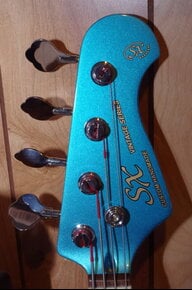
In fact, the only thing that I'm not particular happy with is the head stock shape. It's rather generic, rather than the Fender-esque headstock they used to have. Still, I have no reason to complain. The delivered bass was $186.00 A $75.00 set up, and a set of new strings, and it's an good sounding, good playing bass that is excellent for a beginner, or as a utility bass.
I own Ricks, Fenders, Gibsons, Hofners, and Carvins. I'm not claiming that this SX is on par with, or a replacement for anyone them, but, it's like the original VW beetle, it's good at what it's supposed to be. In this case it's a vanilla bass, made well, for a very reasonable price, from a reputable dealer..
Whether or not I agree with the politics or economics behind it, doesn't change any of that.