
I see nothing wrong with how it looks and would love to own it.

Enjoy the benefits of a premium membership!
Upgrade Account
-
TalkBass has been independent since 1998. Add your voice.
Create a free account to reply to discussions, view embedded media, and browse with fewer display ads.
Join free Log in
Want zero display ads or expanded classifieds tools? Compare plans.
You are using an out of date browser. It may not display this or other websites correctly.
You should upgrade or use an alternative browser.
You should upgrade or use an alternative browser.
Can someone explain this?
- Thread starter stevensivak
- Start date
More options
Who Replied?

from ctmullins "That’s wood variation. Yes, it should have been obvious in the wood selection process.
(Also, nothing based on a Fender design can be called “very high end” - too many engineering compromises in that realm.)"
Your Signature; "I'm highly opinionated and extremely self-assured" seems accurate and tells me you are one of the very Few who is 'Self Aware' a good thing
(Also, nothing based on a Fender design can be called “very high end” - too many engineering compromises in that realm.)"
Your Signature; "I'm highly opinionated and extremely self-assured" seems accurate and tells me you are one of the very Few who is 'Self Aware' a good thing

Truth be told, I've been ogling this Olinto in the Classifieds section for weeks.
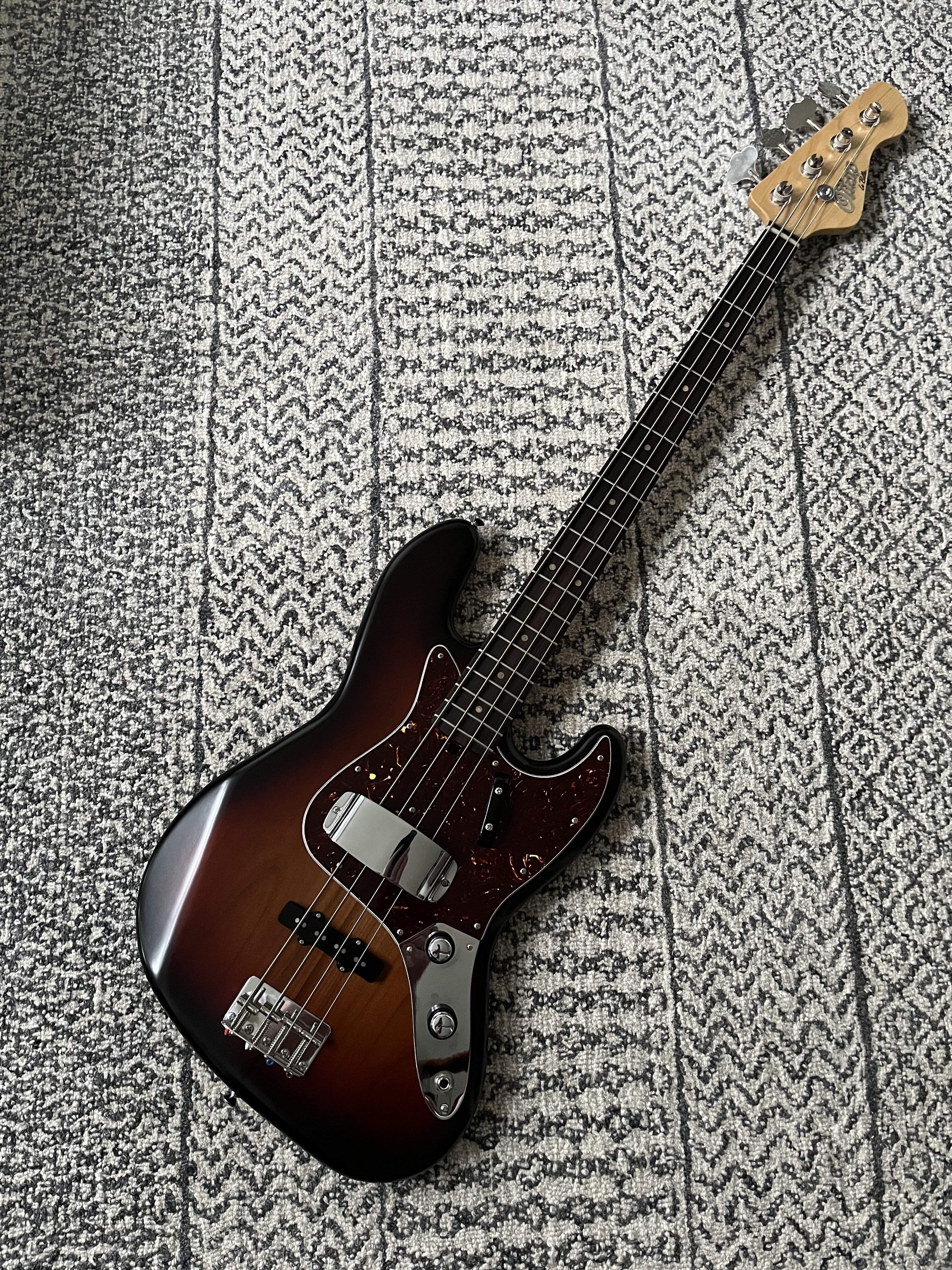




Doesn't affect anything but I don't like how it looks. If I paid a bunch of money I'd not want that

Smooth_bass88
vaxx!
- Oct 31, 2006
- 12,122
- 16,793
- Disclosures
- have been on nationally released albums, charting on the Billboard 200

That's all you needPerfect from the front.... and plays like a dream.... but I find it visually disturbing
Who looks at the back.


nothing based on a Fender design can be called “very high end”


For technical reference, that's not Book-matched wood construction, it's what we often call Side-Matched.
In Book-matched construction, you start with a board that's more than twice as thick as needed. Then saw it in two in a horizontal plane. Trim those two parts to thickness in a planer or wide belt sander. Then the grain pattern of those two boards, when flipped apart like the pages of a book, will be symmetrical and almost identical. Book Matching is done for visual beauty reasons, not structural or mechanical reasons.
Building bodies Book-Matched, in simple 2-piece construction, is expensive and troublesome. It's harder to find boards that are thick enough and wide enough to use. And, if you find them, it's hard to get them dried out properly. It takes more time and care to do it right. Thick boards are more likely to have internal stresses and cracks. That's why Book-Matching is usually done in a thinner board, a Top, which is glued onto a thicker main board. The boards in the main thickness of the body are usually Side-Matched or Non-Matched.
In Side-Matched construction, you start with a board that's about the right thickness, but twice as long. Saw it into two pieces, and rotate one of them around 180 so that the edges that were on the same side of the original board now get joined together. That makes the rings and grain of the two halves symmetrical and opposing, which is good practice for strength and stability of the body. Most high quality bass bodies are made by Side Matching, for that reason. And, that allows most bass bodies to be made using 8/4 kiln-dried lumber, which is more commonly available and more reliable.
On most boards, the rings get closer together toward one edge of the board. That's the "old growth", that was closest to the center of the original tree. In Side-Matched construction, you generally want to put the old growth in toward the center. The edges of the two boards that have the closest, tightest looking grain should be joined to each other in the center of the body. That's for structural/engineering reasons. That edge of the board is stronger than the wider-spaced new growth edge.
And that's what's going on with this Olinto body. It's Side-Matched, joining the two old-growth edges together in the center. That's the way to build a body correctly for strength and stability.
The reason why it looks mismatched visually, is because edge of the left side board goes in closer to the center of the log. Not by much, maybe a quarter inch. The grain/rings get so close together that the edge starts looking much darker. If, when they were jointing the edge of the left board, they had taken off about another 1/4", then the two boards would have matched much better visually. And we wouldn't be having this discussion. My guess is that the left hand board was barely wide enough to fit that half of the body. That's why they didn't take off that extra bit to improve the appearance.
That's the "flaw". It's purely visual and has nothing to do with reduced structural strength or poorer quality construction. A nice looking board and good construction technique.
My guess is that it was a split slab, and book matched on the front,
but the more porous newer sap wood at the corner, took more tint.
The pith wood appears to be toward the outside.

Weight?
Finally! We've moved onto the fat-shaming round.
If it was book matched on the front, it would be book matched on the back, no?
Have you met we?
I... The royal we.

Small possibility, but it could be due to the adhesive used to join the wood together. From about 1946 on, all the Orvis Split Bamboo Fly Rods used resorcinol to joint the 6-strips together. It's a waterproof adhesive that actually penetrates into the wood. It dries a sort of dark purple color. At the time the Orvis bamboo rods were flame-hardened by hand and then impregnated with a phenolic resin which darkened the wood a LOT. So the dark lines at the edges weren't really visible.This is an Alder two piece body on a very high end bass.
Is this joint color issue the result of a finish problem or a
wood "issue"?
Could it have been noticed in the wood selection process?View attachment 5090601
Then they switched to a machine built to flame-treat the bamboo and it didn't darken the wood nearly as much, but still was dark enough to hide the adhesive lines. Finally they stopped using flame-treatments altogether and heat-treated the bamboo in the same ovens they used to cure their graphite fly-rod blanks that used a thermo-set resin. Those heat activated resins require much higher temps than "normal" resins used in graphite. That temperature was enough to temper the bamboo and it resulted in very light colored bamboo rods, what are known as "straw-colored rods". Now the resorcinol dark purple lines showed up, especially as they penetrated the bamboo to a few thousands of an inch on each side of the edge. The finished split-bamboo rods looked like they had glue lines from improper matching of strips, but if you took a magnifying glass to them you could see that they were perfectly matched. It looked like they didn't match because the waterproof adhesive permeated into the edges of the bamboo strips and was very dark next to the straw color of the rod itself.
Something similar may have happened here. That is, a very strong adhesive was used that seeps into the top layers of the wood it is joining and, when it dries, it appears as a dark line. Although that might be quite a stretch with adhesive for a bass body, that might be the case...should probably ask them about it directly.

It looks to be a feature.This is an Alder two piece body on a very high end bass.
Is this joint color issue the result of a finish problem or a
wood "issue"?
Could it have been noticed in the wood selection process?View attachment 5090601
It reminds me of a derrière.


