Why do you think post 76 is not correct?Post 76 is not correct... doubtful on the 79, etc. etc... but some good lessons here....

TalkBass has been independent since 1998. Add your voice.
Create a free account to reply to discussions, view embedded media, and browse with fewer display ads.
Join free Log in
Want zero display ads or expanded classifieds tools? Compare plans.
Why do you think post 76 is not correct?Post 76 is not correct... doubtful on the 79, etc. etc... but some good lessons here....

I can assure you it is correct. I don't know how many instruments you have built, I've only built 20 at the last count but I'm sure of my facts. Take a piece of timber with a marked grain pattern like pine, for instance. Is the pattern identical on both sides? If it is, and you saw it through its thickness and open it up like a book, it will appear to be book-matched on the back as well as the front. But the grain pattern is almost never identical on both sides, so the front will be book-matched but the back will have the original front and back surfaces side by side.If it was book matched on the front, it would be book matched on the back, no?
No. Not unless it was a perfecty quarter-sawn block to start with.
Because of the definition of book matching- which can be done with any grain type, it does not not necessarily imply quarter sawn... although that is what most have come to expect.
IMOThat’s wood variation. Yes, it should have been obvious in the wood selection process.
(Also, nothing based on a Fender design can be called “very high end” - too many engineering compromises in that realm.)

Can't tell from your photo.....is there a step in the seam? Looks like the left side of the seam was a little high and caught some black overspray.
Does the website, brochure, whatever, specifically state it's supposed to be book-matched? If so, they've done a terrible job. If not, meh. So what? About the only time I look at the back of my basses is when I clean them. Provided it doesn't look like that from the front, that wouldn't bother me at all.
IMO
There are FSO made by companies that don’t compromise.
I own 1969 P bass, though a nice bass, it hangs in my den and never gets gigged. I play it at home one or two times a year.
None that I know of. I'm just responding to a post that mentioned compromise.What is the compromise you refer to, it's too nice?
The farther a surface is from the split, the more the wood pattern is going to diverge. This would be minimized with a perfectly quarter-sawn block but since trees are not perfectly cylindrical or conical there will still be divergence.If it was book matched on the front, it would be book matched on the back, no?
No. Not unless it was a perfecty quarter-sawn block to start with.
Because of the definition of book matching- which can be done with any grain type, it does not not necessarily imply quarter sawn... although that is what most have come to expect.
That's not some guy. That's Dave Higham, maybe check out his builds before lumping him in with the opinionatti.This photo above explains what I was trying to tell the guy who built 20 basses...
Book matching does not necessarily produce "mirror" like results...


Hold yer horses. The first time you brought this up, it was a question. It was explained a few times, by people who know the answer. I'm not sure you fully understand what the term "book match" means, in relation to woodworking. Maybe take a breath and digest what a few of the more experienced luthiers here are trying to explain, before getting snappy.I don't care if he built 2 zillion basses. If a solid slab block is book matched on the front it is by definition book matched on the back, regardless of what the appearance is. If you doubt what I am saying , just look at the tree diagram. And if that doesn't to convince you, then there is nothing to say.
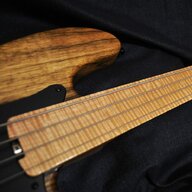
I don't care if he built 2 zillion basses. If a solid slab block is book matched on the front it is by definition book matched on the back, regardless of what the appearance is. If you doubt what I am saying , just look at the tree diagram. And if that doesn't to convince you, then there is nothing to say.


My comments above do NOT pertain to this bass. This pertains to wood or any material for that matter
Here is what I said and this is what Dave is arguing about:
If a solid slab block is book matched on the front it is by definition book matched on the back, regardless of what the appearance is.
And you guys are stating that is not true?