
Thanks, Now I can't 'Not See' it when I look at it.It looks to be a feature.
It reminds me of a derrière.

Enjoy the benefits of a premium membership!
Upgrade Account
-
TalkBass has been independent since 1998. Add your voice.
Create a free account to reply to discussions, view embedded media, and browse with fewer display ads.
Join free Log in
Want zero display ads or expanded classifieds tools? Compare plans.
You are using an out of date browser. It may not display this or other websites correctly.
You should upgrade or use an alternative browser.
You should upgrade or use an alternative browser.
Can someone explain this?
- Thread starter stevensivak
- Start date
More options
Who Replied?
It was patterned after the ladies' stockings from the 1940's with the seam in the back. It's a retro thing. Never really caught on, though. Sort of like the "non-slip" tremolo handles imbedded with razor wire. Interesting concept, but not exactly user friendly. At least this one is only visual and doesn't involve bloodletting. 


If it was book matched on the front, it would be book matched on the back, no?
Not necessarily. The front may have been a very nice match, but at the sacrifice of the back.
That dark line may be the youngest part of the chunk, the most outside ring, just before the bark.
Wait, is that the front of the same bass?Truth be told, I've been ogling this Olinto in the Classifieds section for weeks.
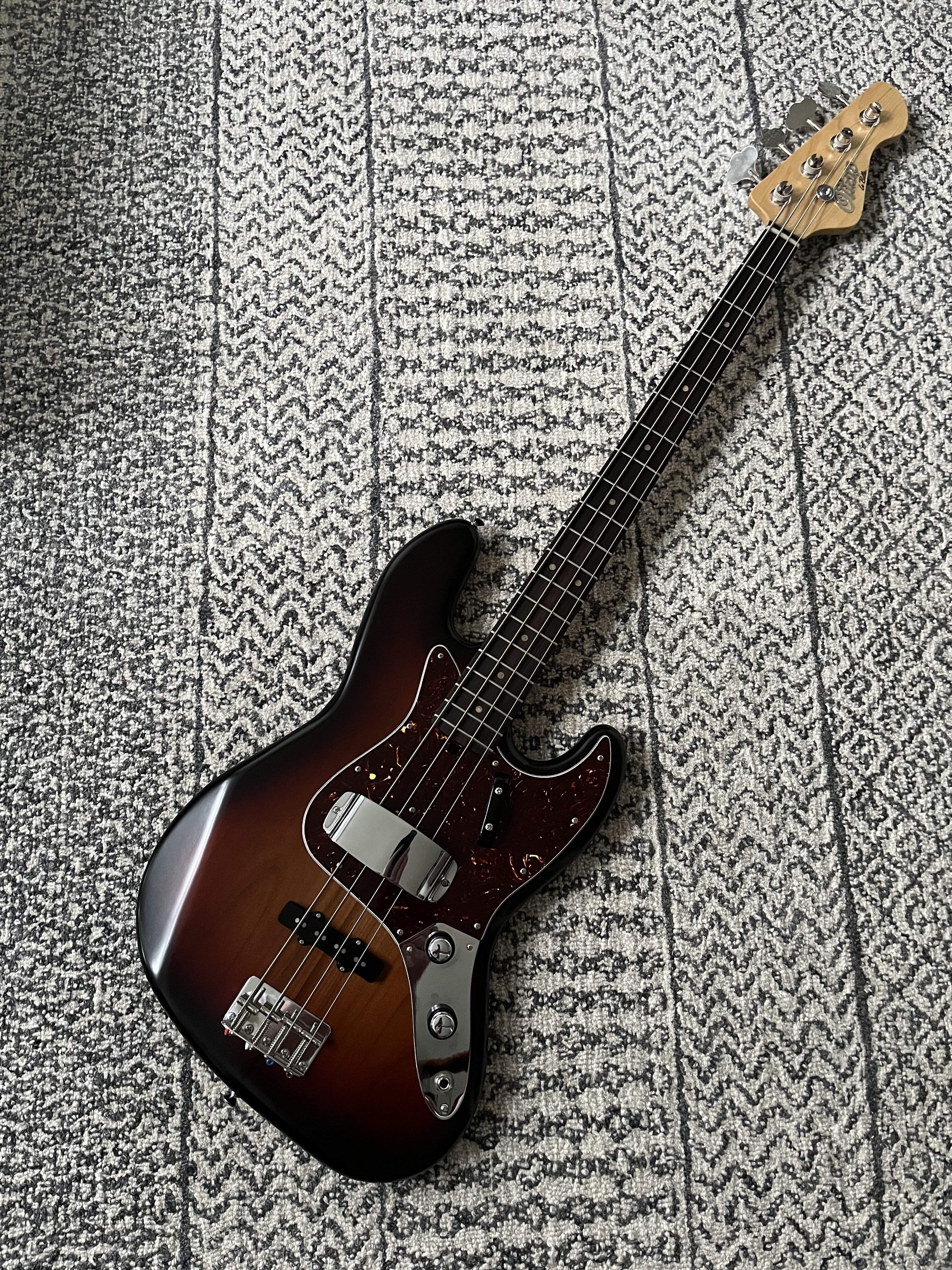


Visually appealing to me. Love it!This is an Alder two piece body on a very high end bass.
Is this joint color issue the result of a finish problem or a
wood "issue"?
Could it have been noticed in the wood selection process?View attachment 5090601
All of the images are here.
Ah, so it is the same bass.
Looks like the front had the same contrasting character.

Two very helpful and informative posts. Thank you. I have two basses I built myself made from Fijian mahogany slabs. One is two pieces from the same board, cut, dressed and glued by a guy at the suppliers who just happened to be a bass player and knew exactly what I wanted. The other is one whole piece and is interestingly, noticeably heavier. The finished basses are only a couple of years old so I’ll observe the ageing with interest. Both are well oiled and have darkened quite a bit already to a beautiful rich and warm rusty red/brown. I’m loving the colour. Let’s see what happens in another two years or so.Well, sure. With a one-piece body, there's more risk of the body warping or cracking. It doesn't mean that it will happen, but that there's more chance that it could. If the board was dried and selected carefully, and it stays stable for a year or two, then it should be fine for the long term. Building in two or more pieces, making the ring and grain orientation symmetrical and opposing, reduces the risk of warping and cracking.

This is an Alder two piece body on a very high end bass.
Is this joint color issue the result of a finish problem or a
wood "issue"?
Could it have been noticed in the wood selection process?View attachment 5090601
If the contrast reversed when looking at it from the other way, it would be a chatoyancy effect-
IE-the way the grain reflects/absorbs the light source.

If it contrasts the same when viewing from either direction,
it would be the younger wood absorbing more base tint.
Last edited:


JeezyMcNuggles
Inactive
- Feb 23, 2018
- 14,723
- 20,970
- Disclosures
- I suck, but nobody really notices
Well, it looks like a Squier. I'd exchange it.This is an Alder two piece body on a very high end bass.
Is this joint color issue the result of a finish problem or a
wood "issue"?
Could it have been noticed in the wood selection process?View attachment 5090601
This is the quality I get for 100 bucks.
Last edited:
Does the website, brochure, whatever, specifically state it's supposed to be book-matched? If so, they've done a terrible job. If not, meh. So what? About the only time I look at the back of my basses is when I clean them. Provided it doesn't look like that from the front, that wouldn't bother me at all.
That could be the case. Even bookmatched acoustic guitar backs rarely have a perfect bookmatched pattern as the saw cut and sanding takes out some wood and on the inside the pattern can be quite different, even though they are usually less than 1/8" thick.My guess is that it was a split slab, and book matched on the front,
but the more porous newer sap wood at the corner, took more tint.
The pith wood appears to be toward the outside.

That’s the nicest body I’ve seen on a Jazz.Truth be told, I've been ogling this Olinto in the Classifieds section for weeks.
No. Not unless it was a perfecty quarter-sawn block to start with.If it was book matched on the front, it would be book matched on the back, no?

Beaut bass. Probably just the photoThanks, Now I can't 'Not See' it when I look at it.

Can't tell from your photo.....is there a step in the seam? Looks like the left side of the seam was a little high and caught some black overspray.
Last edited:


