• TalkBass has been independent since 1998. Add your voice.
    Create a free account to reply to discussions, view embedded media, and browse with fewer display ads.
    Join freeLog in
    Want zero display ads or expanded classifieds tools? Compare plans.

Can You Tell The Difference??? ASH vs. ALDER

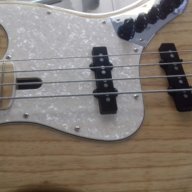
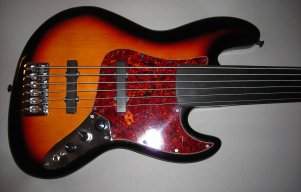
WHICH IS ALDER? WHICH IS ASH?

  • 1-A and 2-A are Alder, 1-B and 2-B are Ash.

    Votes: 17 15.7%
  • 1-A and 2-A are Ash, 1-B and 2-B are Alder.

    Votes: 48 44.4%
  • I can hear a difference between the "1" recordings, but not the "2" recordings

    Votes: 16 14.8%
  • I can hear a difference between the "2" recordings, but not the "1" recordings

    Votes: 3 2.8%
  • I can't hear a difference between any of them!

    Votes: 24 22.2%

  • Total voters
    108
i haven't resorted to insulting anyone...

Yes, you have. I can prove it by cut and pasting your posts from this thread. If you need proof, just let me know.

but you certainly have.:rollno:

No, I have not. I commented on your posts, not you. Your posts often mention your resume and ask others to post theirs (or challenge them by saying you don't believe they even play bass).

It's ad hominum, it doesnt' address the posters' comments, and it should be discouraged or prohibited here (imo).
 
It seems to me like the Christ-campaign analogy is becoming more and more fitting as the argument drags on.

"I don't have to prove anything to you, I can state my claims because I know they're right, and I've been stating them for years. Therefore, I am right and you are wrong"

I
am
afraid.


And, Johnk_10, I have to say that I usually find your posts informative, somewhat funny, and always entertaining.
Until this thread.
In this thread you have been bully-ish. In this thread you have been completely closed off to any new ideas or concepts that might otherwise broaden your musical perspective. More than anything, in this thread you have been downright condescending to your peers in favor of your self-proclaimed but entirely unfounded superior intelligence.

If this is the personality you wished to convey to your fellow TBers, mission accomplished. Personally, I hope to see the Johnk_10 posts I've become accustomed to make a comeback.

And seriously, whether someone can play a single note or not has NO bearing on how well they can hear. I have a really hard time trying to see where you're coming from with the "You don't even play bass" thing. To me, that seems more 3rd grade than anything else in this thread.
 
You're assuming a production consistency which doesn't exist.

As someone with a good bit of coil winding experience (for precision LVDTs) I can tell you taht two magnetic wound pickups, even of identical design, aren't the same.

Never mind the times that I've played two identical model basses (same body wood, pickups, neck, etc., etc.) and had them sound noticeably different.

You have to limit the variable to just what you want to test.

Concerning Warwick basses , they are very consistent in their production (and in their pickup widings !!) , just go and visit their factory and MEC factory also. By the way I've never heard a bubinga bodied bass who sounded like an ash bodied bass, but yes I've sometimes got alder basses that could do the trick. So accept the truth : some woods sound very different than others and it makes a difference in sound. So do strings !
Now if you think that a computer that analyses moisture content of the selected wood , that machines that directly sculpt the body, and the professionnal luthiers that assemble the rest are inconsistent in production..then tell me why everybody knows "the sound of wood"(warwick sound).
 
Concerning Warwick basses , they are very consistent in their production (and in their pickup widings !!) ,

I don't care HOW consistent you think they are - they aren't exact.

I don't care if you use completely automated winders - there is STILL variability.


Now if you think that a computer that analyses moisture content of the selected wood , that machines that directly sculpt the body, and the professionnal luthiers that assemble the rest are inconsistent in production.

Of course they're inconsistent in production. EVERYONE is given a particular level of "inconsistent".

What is the weight range of say a Bubinga Corvette? Is every example within a couple ounces of every other example in total weight? Surely they must be within 1% weight variation... or are they inconsistent?
 
Every once in a while, I channel God himself, and he says wood doesn't matter that much. Does that trump 12,987 "When I hung out with <insert famous luthier here>, this is what THEY said"'s? Not if you don't believe in God (or Leo Fender as the end-all tell-all of bass makers, for that matter).

Hate to drop the dime like this, but even if Leo Fender DID invent the bass guitar, he sure as hell never made the best sounding or nicest one. There are a hundred companies out there that bass enthusiasts the world over agree make FAR superior instruments than Fender.. His opinion here would be no more or less accepted/correct/whatever in this thread than yours, mine, or the next guy's.

So umm,
Can we quit with the name/resume dropping? Nobody cares, and it comes across as condescending and insulting to the people you're talking to.

Maybe I'm just in a foul mood and should go do something else for a while...

mongo2: I haven't seen that skit in a LONG time. Good one :)
 
Believe what you want . I'm tired with this topic.

We would have a debate on nickel vs stainless steel strings it would be the same useless, everlasting question who leads man to make war, organize international soccer championships "who has the bigger d.ck ?".

But it has been clear to me through the year that the type/specie of wood used definitely confers the character of the instrument, it gives it its voice. That's why even when you change the pickups , the instrument will sound like upgraded poo if it sounded already like poo.

Good quality of wood resonates better, and as , according to the species, they don't vibrate the same way , they don't have the same "general" voice . That's pure genetics, science. Now I don't say that electronics don't matter . Try to sing with a poor pickup , and then with a good pickup , you won't sound the same...but your mommy and friends will be able to identify your voice.
Many friends of mine say my brothers and I have a very similar voice , they identify a certain character in our voice(while we still have our own voice) , and we get if from our parents.
And many times even our aunties are mistaken ,when they have one of us on the phone , they think it's one of the other (and we aren't triplets;) ).

That's what I know , and it's not a question of belief , I've been "suprised" many times about how two wood species could sound different.
That's why I'll never buy a bass made out of plastic , or luthite , or something else than wood.
 
You're welcome to disbelieve, and even though I know it to be true - it's not supported by objectively provable evidence and is therefore an unsupportable assertion.

thanks for that.
i was hoping that you might get a kick out of it. it was an attempt at internet humor, and i realize (or at least hope) that you got that i was saying it in jest. ;)
 
I always thought ashy and alder were very similar woods tone-wise anyway. Now mahogany or maple vs. ash or alder would make a greater difference. You did not show scientifically that wood makes no difference, you simply showed that ash and alder have similar tonal qualities.
 
thanks for that.
i was hoping that you might get a kick out of it. it was an attempt at internet humor, and i realize (or at least hope) that you got that i was saying it in jest. ;)

:D

Yeah - I got the joke of it.

My response is meant to illustrate a serious point about evidence though.

If it ain't repeatable or objectively verifiable - it ain't evidence. It's just another faith based argument... like religion and the supernatural.
 
i dunno. i really want balsa to sound like honduras mahogany, but so far, somehow it hasn't sounded at all like it to me yet. ;)

And I want Basswood to sound like swamp ash too. Oh wait! A Bongo is basswood and sounds killer! So does swamp ash sound like basswood? No, it doesn't. I've A-Bed two G&L Tribute basses identical except for color and wood. One was swamp ash the other was basswood. Was there a difference? Yes, there was. Was it a HUGE difference? No it wasn't. Was it an IMPORTANT difference? Now HERE is where we get the argument of this thread!

Just how much of a difference is "important"? We all agree that the wood difference is small in most cases (Let's face it there ARE some truly nasty things out there you COULD build a bass out of, but we aren't talking about those!) And the Bongo bass proves that the small differences CAN be compensated for by other design measures. So with a proper EQ and selection of bass design, theoretically it shouldn't be too hard to get balsa wood to sound like Honduras Maghogany...or at least sound reasonably decent.

But that still doesn't solve the "important" question. I personally regard the tonewood difference as "important". In fact I regard EVERY tiny difference in an instrument as "important" especially if you are trying for some kind of "exceptional" instrument. My idea (and I've said so here before) is that if you want to build a Stradivarius, you don't just slap it together out some old crate wood. Each and every piece no matter HOW TINY a difference it may make to the total product needs to be optimized. It's as simple as that! Hence, from that viewpoint, tonewood matters.

But now we have to ask, what does "optimized" mean? And I think that there, it is clear that this means "most satisfying to any given person's opinion". So that is now an opinion thing. And opinion has no "best". So does tonewood "matter"? Only if those small differences that it can bring matter to you. And those difference do matter to me. Which is why nearly all my basses are ash or mahogany or something nice. So am I wasting my time and money? Well, in my opinion I'm not, so that pretty much settles it, I'd say. For you it may be different.
 
I thought the argument at hand was the way we perceive things based on preconceptions (or at least partially)?

That was very well put, bassbenj. I don't disagree with anything that you said, other than to say I don't know how much I agree with your definition of optimized. I think the analogy would make a little more sense if you said "If you want to build a Stradivarius, you don't just slap together some old crate wood. Each and every piece no matter HOW TINY a difference it may make to the total product needs to be of the highest possible quality." Although synonymous with "highest possible quality" in the current context, it is neither the usual or widely accepted use of optimized...

...You know, now that I think about it, there is a good deal of actual optimization that goes into woods being prepared for instrument building. You have to season and sometimes straighten or bend the wood. You have to treat the wood and let it go through several humidity/temperature cycles (I've read some good things about roasted woods, recently) to get it stable. I fully retract the above ramble.