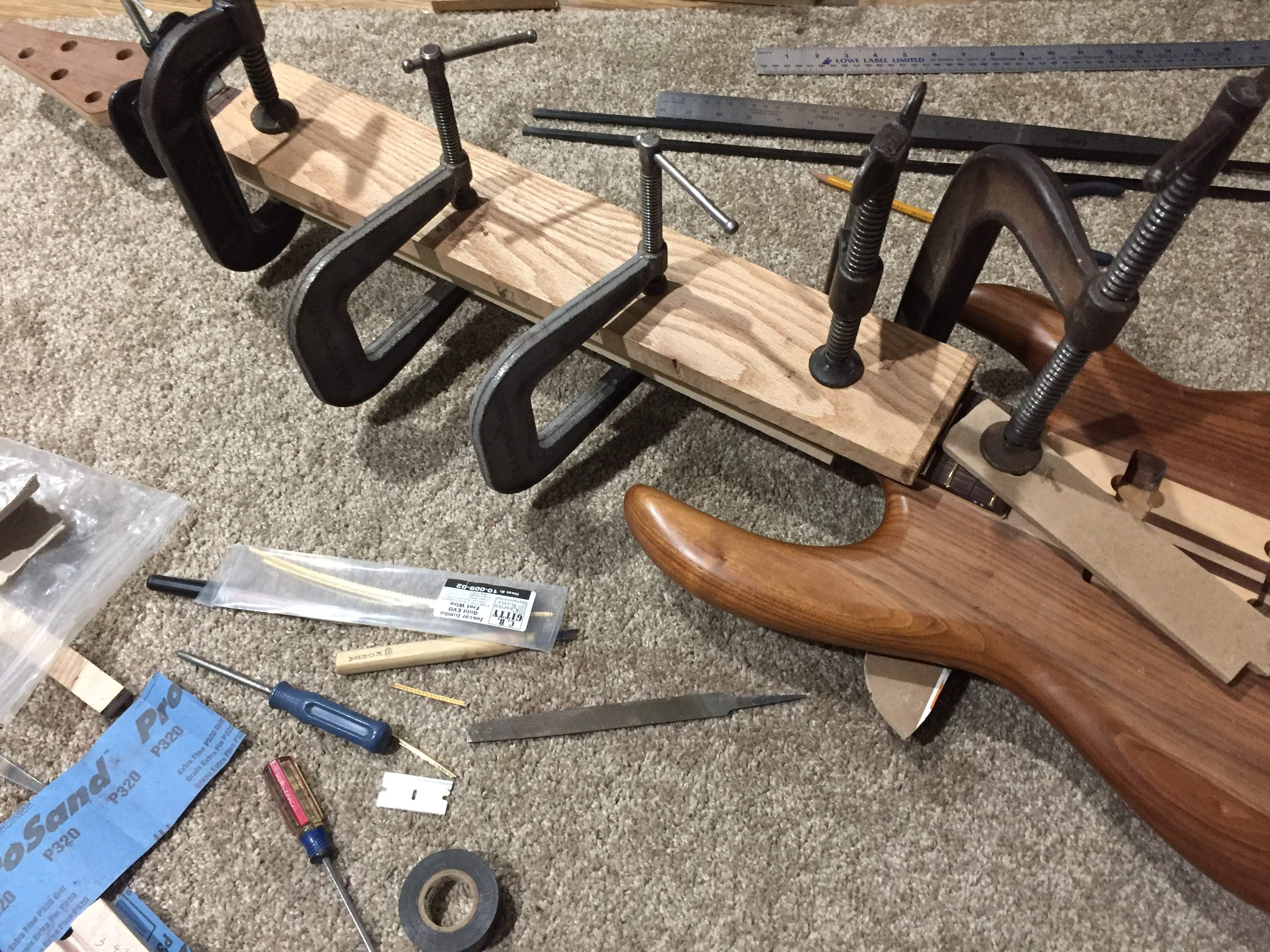
There it is
. The deed is done
. Fretboard glued
. Probably tomorrow morning I'll unclamp and tap the the last two frets and start cleaning it up
.
. The deed is done
.
TalkBass has been independent since 1998. Add your voice.
Create a free account to reply to discussions, view embedded media, and browse with fewer display ads.
Join free Log in
Want zero display ads or expanded classifieds tools? Compare plans.
. The deed is done
.
!
. At the time I didn't check intonation
. I added a thin veneer to the headstock and that moved the break point for the neck plane to headstock plane about 3/32"
. I played with the idea of a Fender style thin nut and run the fretboard out further but remembered the bridge saddle issue I had observed
. So I repositioned the saddles at their most forward adjustment and placed the board where it would need to be to have a nut like original and found the fretboard was 3/32" further away from the bridge (naturally) and that the bridge saddle lined up much better
. This should give a little more adjustment for the B stringThis is the first time I've held a Carvin so it has been interesting. Not having any preconceptions there are a number of observations that I may detail at the end regarding design, build quality and overall QC. These would be tempered by the obvious poor care and maintenance that has been inflicted on this unfortunate instrument.My first "real" bass was a koa Carvin LB75 with a koa neck. I had the "No show" option, so you couldn't see the neck through the top. I loved that bass, it developed a back bow and I had to send it back to Carvin for a neck reset with heat. After it came back it was fine until it burned up in my house fire (the ultimate heat "reset"?). I'm late to the party here, but as you discovered, that didn't look like koa to me, mine was more honey brown than brown brown.
I bought a Kiesel Icon 5 to get back playing as quickly as possible after the fire, that bass looks and sounds amazing, but the neck was very unstable for the first year I owned it. No joke, I was doing 1/2 turns on the truss rod weekly and it was kept in a relatively stable humidity, indoors with heat/AC, I've never had a neck move like that. Since that time it's settled down and has needed only very minor seasonal touch ups. I was surprised, with embedded carbon rods, that a neck would move like that.
Great project, thanks for documenting it!
I don't have the LB75 to A/B compare to the Icon, but from my memory this Icon is miles above the LB with regards to design and fit/finish. It's way more refined. The neck movement was counter to their marketing message, but in doing some searching around it seems my experience was not unique at all (specifically with the Icon). I found quite a few examples of people experiencing the same. Perhaps they are over-drying their wood - they do run their own kiln.This is the first time I've held a Carvin so it has been interesting. Not having any preconceptions there are a number of observations that I may detail at the end regarding design, build quality and overall QC. These would be tempered by the obvious poor care and maintenance that has been inflicted on this poor instrument.
My first "real" bass was a koa Carvin LB75 with a koa neck. I had the "No show" option, so you couldn't see the neck through the top. I loved that bass, it developed a back bow and I had to send it back to Carvin for a neck reset with heat. After it came back it was fine until it burned up in my house fire (the ultimate heat "reset"?). I'm late to the party here, but as you discovered, that didn't look like koa to me, mine was more honey brown than brown brown.
I bought a Kiesel Icon 5 to get back playing as quickly as possible after the fire, that bass looks and sounds amazing, but the neck was very unstable for the first year I owned it. No joke, I was doing 1/2 turns on the truss rod weekly and it was kept in a relatively stable humidity, indoors with heat/AC, I've never had a neck move like that. Since that time it's settled down and has needed only very minor seasonal touch ups. I was surprised, with embedded carbon rods, that a neck would move like that.
Great project, thanks for documenting it!
I don't have the LB75 to A/B compare to the Icon, but from my memory this Icon is miles above the LB with regards to design and fit/finish. It's way more refined. The neck movement was counter to their marketing message, but in doing some searching around it seems my experience was not unique at all (specifically with the Icon). I found quite a few examples of people experiencing the same. Perhaps they are over-drying their wood - they do run their own kiln.
I've owned a couple LB75s and currently have one from 2003 and outside of an initial setup never touched the truss rods although I am in the perfect spot in FL. I had 3 different Kiesels that were bolt ons and never adjusted a thing from the factory. I owned one of those for 4 years, giged with it and had several string changes and only adjusted the intonation once. The most stable bass I've ever owned, it was just too heavy for me so I let it go.I've had a number of Carvins over the years, including a beautiful Icon that I didn't keep very long because I grew to prefer passive basses. Like others on TB, I grew up drooling over the Carvin catalogs as a kid, so while it's been fun for me to buy and sell a few of their instruments (including a fretless LB75) during my decade-plus-long ongoing GAS attacks, what I used to really dream of was ordering my own with all of the options chosen by me from the many catalog (now website) options. I finally "lived the dream," ordering my own PB4 to my specifications in August. It's supposed to arrive in January, but now, @Jisch, you've got me worried, as I'm also in Connecticut USA and I don't want to be adjusting the truss rod on a weekly basis. Hope mine's a bit more stable than that! (I'll definitely post a NBD thread when it arrives...)
@Slidlow, thanks so much for this wonderful thread. I've been on TB for decades, and this is one of my all-time favorite threads, no question. Great work.
Not having seen the original truss rod, except for the route left behind, I guess it is of less then stellar design. This may have led to attempted adjustments, eventual failure and subsequent poorly executed replacement. Your experience seems to lead me to believe they may have continued use of that design. As well poor drying practices may be a factor as well. The same people are running Kiesel so bad habits may have carried over. My biggest issue was with the neck carve. This still had the original finish so I'm pretty sure the neck was untouched except for the bore holes. The profile is very inconsistent side to side and along the length. Knowing they did asymmetrical necks I checked with a profile gauge and found the variances not enough to prove that design and pretty much show a very poorly carved neck. I can correct somewhat but not 100% as it would leave the neck very thin overall and it is pretty thin now. There is also a lot of evidence of maybe over zealous sanding all over the bass prior to the original finish. Maybe inexperienced employees or lacking QC? From what you indicate with your Kiesel some of these items may have been addressed over the years. I am just looking at this one instrument.I don't have the LB75 to A/B compare to the Icon, but from my memory this Icon is miles above the LB with regards to design and fit/finish. It's way more refined. The neck movement was counter to their marketing message, but in doing some searching around it seems my experience was not unique at all (specifically with the Icon). I found quite a few examples of people experiencing the same. Perhaps they are over-drying their wood - they do run their own kiln.
You are very welcome@Slidlow, thanks so much for this wonderful thread. I've been on TB for decades, and this is one of my all-time favorite threads, no question. Great work.
I didn't do that level of assessment on either of my Carvin basses, but overall I am impressed by the Icon. I'll take a closer look at it with a profile gauge when I get a chance.Not having seen the original truss rod, except for the route left behind, I guess it is of less then stellar design. This may have led to attempted adjustments, eventual failure and subsequent poorly executed replacement. Your experience seems to lead me to believe they may have continued use of that design. As well poor drying practices may be a factor as well. The same people are running Kiesel so bad habits may have carried over. My biggest issue was with the neck carve. This still had the original finish so I'm pretty sure the neck was untouched except for the bore holes. The profile is very inconsistent side to side and along the length. Knowing they did asymmetrical necks I checked with a profile gauge and found the variances not enough to prove that design and pretty much show a very poorly carved neck. I can correct somewhat but not 100% as it would leave the neck very thin overall and it is pretty thin now. There is also a lot of evidence of maybe over zealous sanding all over the bass prior to the original finish. Maybe inexperienced employees or lacking QC? From what you indicate with your Kiesel some of these items may have been addressed over the years. I am just looking at this one instrument.
I wouldn't have checked the neck either but for the fact that it felt really weird when I first played it before stripping it down for the rebuild.I didn't do that level of assessment on either of my Carvin basses, but overall I am impressed by the Icon. I'll take a closer look at it with a profile gauge when I get a chance.
My suspicion is the neck was machine cut (CNC or otherwise) symmetrical and went out of whack during final hand finishing but that is speculation on my part.The profile stuff sounds strange as the necks are CNC cut now. Maybe the LB75 was from a pre-CNC era.
@Jisch I did notice that the rods in this neck were in there with wood glue. I've installed the new rods with epoxy for a better bond with the wood. If the wood glue failed to hold the carbon rods then they really wouldn't do what they were supposed to.I was surprised, with embedded carbon rods, that a neck would move like that.
I will say one of the reasons I haven't built another Kiesel is because the upcharge to put in different electronics and routes for any pickup but theirs. I love their current work but imo their focus is on guitars now and not basses because there really hasn't been any new innovation with them in years now.I don't mean to knock Keisel either, I suspect my bass is an outlier, though like I said I have read others having a similar issue. I bought it out of their "in stock" basses as I needed something quickly and I had some insurance money to spend, I don't know how long it was sitting in their shop (not that it should matter). It's a great bass in looks, playability and stability (now). I doubt I'll ever part with it. The electronics are a vast improvement over the LB75, of that I am very confident.
I guess if you love guitars you build guitars and if you love basses you build guitars and bassesI will say one of the reasons I haven't built another Kiesel is because the upcharge to put in different electronics and routes for any pickup but theirs. I love their current work but imo their focus is on guitars now and not basses because there really hasn't been any new innovation with them in years now.
!